
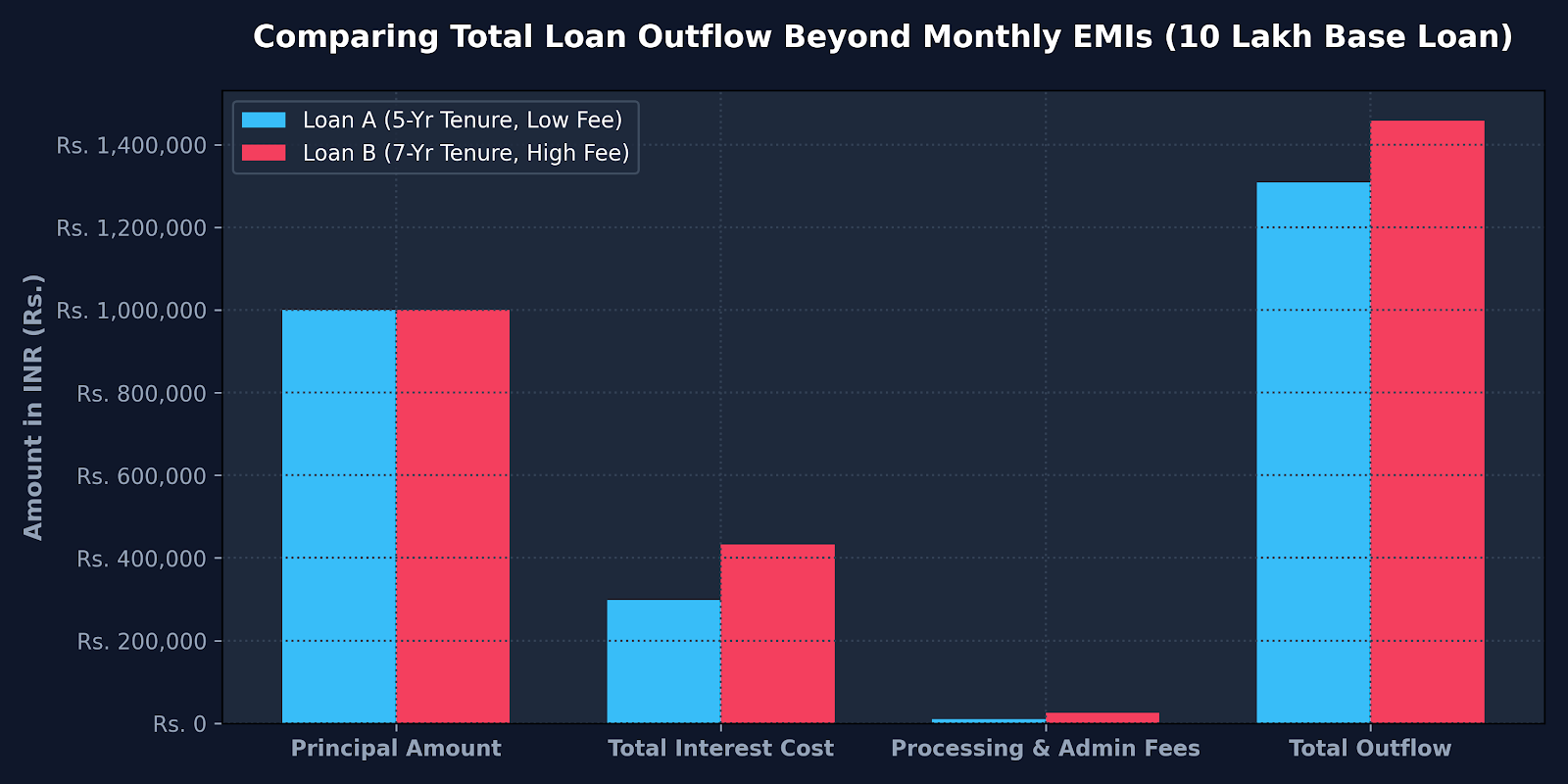
When evaluating two loan offers, comparing Equated Monthly Installments (EMIs) is often the first step borrowers take. While a lower EMI might feel easier on your monthly budget, it frequently hides the true cost of borrowing. A loan with a lower monthly payment can actually end up costing you significantly more over time due to extended tenures, high compounding interest, and hidden administrative fees.
To make a financially sound decision, you must evaluate loans holistically. Here is a comprehensive guide on how to compare two loans beyond just the EMI.
1. Interest Rate Structure and Calculation Method
The headline interest rate is crucial, but how that interest is calculated matters just as much as the percentage itself.
- Reducing Balance vs. Flat Rate: Under a reducing balance method, interest is calculated on the remaining principal balance after each repayment. In a flat rate calculation, interest is charged on the original principal amount throughout the entire tenure. A 10% flat rate is significantly more expensive than a 10% reducing rate.
- Fixed vs. Floating Rates: Fixed-rate loans offer predictable EMIs, protecting you from market fluctuations. Floating rates fluctuate based on benchmark rate changes. While floating rates often start lower, they introduce risk over long tenures.
2. Processing Fees and Upfront Costs
Upfront costs directly reduce the actual loan amount disbursed to your bank account while adding to your debt burden.
- Processing Fees: Lenders charge a fee to evaluate and process your application, typically ranging from 0.5% to 3% of the total loan amount.
- Documentation and Legal Fees: Mortgage or property loans often carry additional charges for legal verification, property evaluation, and stamp duty.
- Administrative & Login Charges: Some lenders charge non-refundable fees regardless of whether your loan gets approved or rejected.
Always calculate the Net Disbursed Amount (Loan Principal minus Upfront Fees) to see how much money you are actually receiving relative to what you are borrowing.
3. Tenure and Compound Interest
Loan tenure acts as a multiplier for interest cost. Extending your loan tenure reduces your monthly EMI, but dramatically increases the overall interest paid over the life of the loan.
| Metric | Loan Option A (Short Tenure) | Loan Option B (Long Tenure) |
|---|---|---|
| Principal Amount | $50,000 | $50,000 |
| Interest Rate | 10% p.a. | 10% p.a. |
| Tenure | 3 Years (36 Months) | 5 Years (60 Months) |
| Monthly EMI | ~$1,613 | ~$1,062 |
| Total Interest Paid | $8,082 | $13,741 |
| Total Repayment | $58,082 | $63,741 |
As demonstrated above, choosing Loan Option B lowers the monthly payment by $551, but increases total interest out-of-pocket by $5,659.
4. Total Repayment Cost (The Ultimate Metric)
To compare two loans accurately, ignore the individual parts for a moment and look at the Total Outflow.
Total Repayment Cost=(EMI×Tenure in Months)+Upfront Fees−Disbursement Costs
Comparing the final numeric total across both offers provides an immediate, unvarnished look at which loan truly costs less.
5. Prepayment Charges and Foreclosure Penalties
Your financial situation can change. If you receive a bonus or windfall, you may want to pay off your loan early.
- Prepayment Penalties: Many lenders charge a penalty (typically 2% to 5%) if you pay off part or all of your loan before the tenure ends.
- Foreclosure Lock-in Periods: Some contracts prohibit early repayment entirely for the first 6 to 12 months.
Look for loan agreements that allow partial prepayments with zero penalty fees, as this flexibility can save you thousands in future interest.
What If You Are Already Overwhelmed by Existing Loans?
Comparing loan terms is vital before signing a new agreement, but managing existing, high-cost debt requires a different approach. When multiple loans become unmanageable and repayment costs exceed your monthly capacity, seeking specialized assistance can prevent severe financial distress.
Working with a professional loan settlement agency can help negotiate revised terms with your lenders. Experienced loan settlement services evaluate your financial standing to structure realistic payment arrangements or single-time payoffs. Consulting a dedicated loan settlement expert allows borrowers to navigate negotiations strategically, avoid aggressive recovery practices, and reach a formal loan settlement that closes out delinquent debts cleanly.
Final Takeaway
Never choose a loan based solely on the lowest EMI callout in a marketing brochure. Evaluate the interest calculation method, add up all upfront processing fees, review prepayment penalties, and calculate the total repayment cost over the entire tenure. Taking these extra steps ensures you select a financing option that supports your long-term financial health.