
When applying for credit—whether a home loan, personal loan, vehicle financing, or credit card EMI facility—lenders always assess one critical financial metric: your EMI-to-Income Ratio, formally known as the Fixed Obligation to Income Ratio (FOIR).
This ratio measures the percentage of your net monthly take-home salary dedicated to paying recurring Equated Monthly Installments (EMIs). Borrowing without tracking this metric can quickly push household budgets into financial stress, leaving little room for savings, essential living expenses, or emergency funds.
Understanding ideal EMI-to-income benchmarks helps you maintain healthy cash flow and avoid unsustainable debt burdens.
What Is the Fixed Obligation to Income Ratio (FOIR)?
The Fixed Obligation to Income Ratio (FOIR) is the parameter financial institutions use to evaluate a borrower’s repayment capacity. It compares your total monthly debt obligations against your net monthly disposable income.
How to Calculate Your FOIR:
$$\text{FOIR (\%)} = \left( \frac{\text{Total Monthly EMI Payments}}{\text{Net Monthly Take-Home Salary}} \right) \times 100$$
For example, if your net monthly salary is Rs. 100,000 and your combined monthly EMIs equal Rs. 40,000, your FOIR is 40%.
Breakdown of FOIR Risk Zones
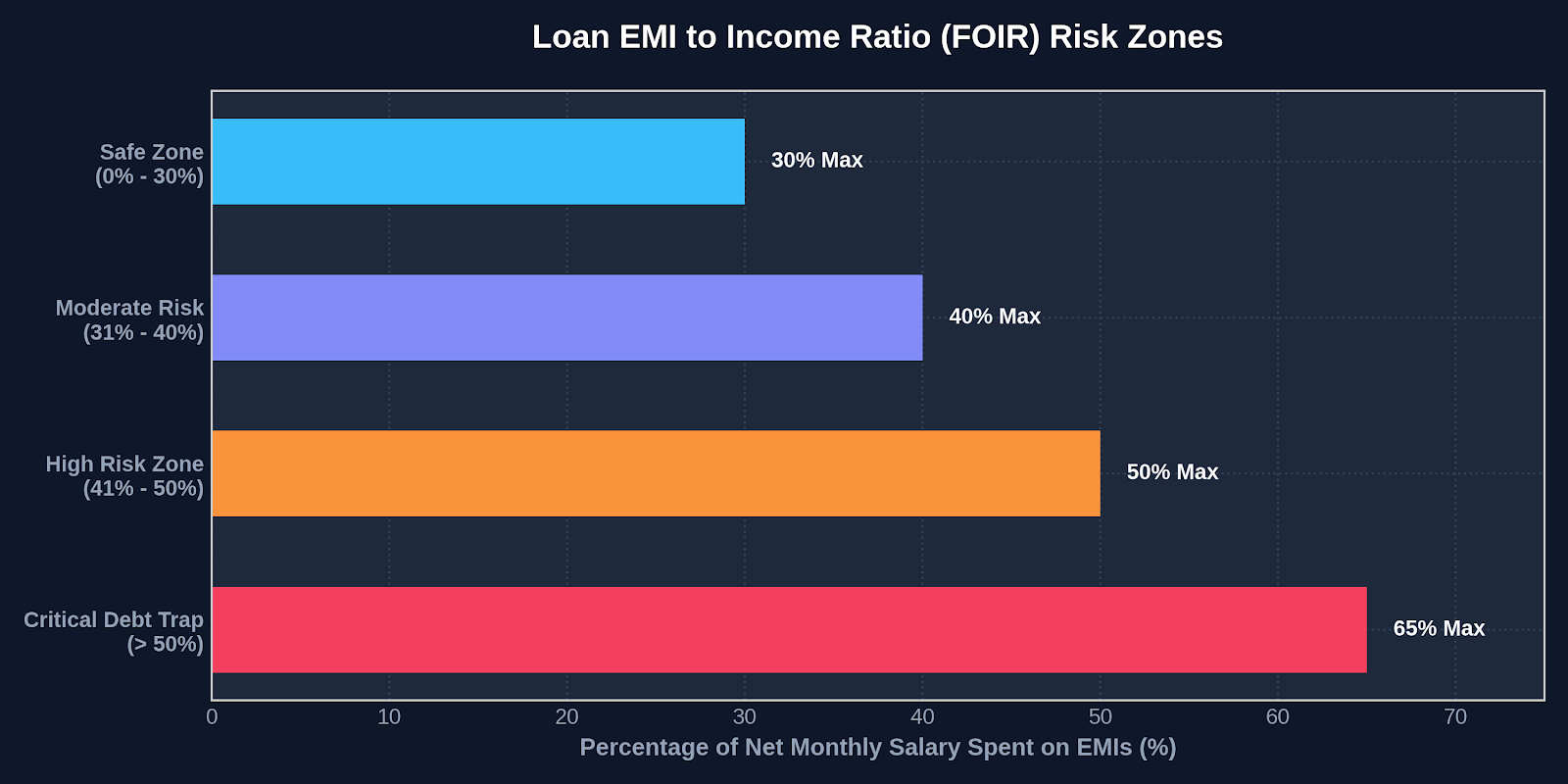
Lenders and financial planners categorize EMI-to-income ratios into distinct risk tiers:
1. The Safe Zone (0% to 30%)
Allocating up to 30% of your take-home salary toward EMIs keeps your finances healthy. You retain sufficient cash flow to cover daily living costs, invest for future goals, and build emergency buffers without relying on credit cards.
2. The Moderate Risk Zone (31% to 40%)
This is the standard upper limit accepted by major Indian banks for personal and auto loans. While manageable under stable economic conditions, unexpected medical emergencies or temporary income dips can cause cash flow strain.
3. The High-Risk Warning Zone (41% to 50%)
When half your monthly income goes directly toward debt servicing, household cash flow becomes tight. You may find yourself relying on credit cards or short-term loans to cover routine expenses.
4. The Debt Trap Zone (Greater Than 50%)
Allocating more than 50% of your net income to EMIs is a clear indicator of over-leveraging. Under Reserve Bank of India (RBI) underwriting norms, banks routinely reject new loan applications from individuals exceeding this threshold.
Recommended Salary Allocations Across Loan Types
| Debt Type | Ideal Max % of Salary | Operational Focus |
| Home Loan / LAP | 30% – 35% | Long-term asset building; prioritize longer tenures to maintain safe EMIs. |
| Personal Loans / Credit Cards | 10% – 15% | High-interest debt; keep monthly obligations as low as possible. |
| Vehicle Loans | 10% – 15% | Depreciating asset; avoid stretching loan tenures beyond 5 years. |
| Total Cumulative Debt (FOIR) | 40% Maximum | Combined threshold for all active credit facilities. |
What to Do When Your EMI Burden Exceeds 50%
When unexpected job losses, business slowdowns, or medical emergencies increase your EMI burden relative to your income, making regular payments becomes mathematically difficult. Continuously borrowing to cover existing EMIs only increases compounding interest charges.
In cases of genuine financial insolvency, pursuing a formal debt resolution framework offers a legal way forward.
Partnering with an established loan settlement agency enables distressed borrowers to evaluate structured compromise options under RBI fair practice guidelines. Professional representatives shield borrowers from unlawful recovery harassment while negotiating directly with institutional credit committees.
Engaging dedicated loan settlement services ensures that lenders pause compounding penal charges, halt aggressive recovery proceedings, and evaluate genuine hardship documentation through legal banking channels.
Restoring Balance Through Expert Representation
Consulting an experienced loan settlement expert provides clear leverage when an unsustainable EMI burden threatens your solvency. Through a formal loan settlement agreement, specialists present verifiable proof of financial hardship to negotiate a One-Time Settlement (OTS), securing maximum waivers on accumulated late fees, penal charges, and principal balances while obtaining an official No Dues Certificate (NDC).
Final Thoughts
Maintaining a healthy EMI-to-income ratio is the cornerstone of long-term financial stability. Aim to keep your total debt obligations under 40% of your take-home pay to preserve cash flow and protect your savings. If high EMIs have already compromised your financial stability, seeking professional debt resolution advisory can help you negotiate a legal compromise and rebuild your financial freedom.