
Credit card debt is one of the most expensive forms of consumer borrowing. When financial hardship strikes—such as job loss, unexpected medical expenses, or business cash flow disruption—paying even the minimum due amount becomes impossible. With revolving Annual Percentage Rates (APRs) ranging from 40% to 48% per annum alongside late fees and compounding interest, overdue credit card dues quickly spiral out of control.
Understanding how loan settlement works for overdue credit card dues empowers distressed cardholders to halt predatory debt cycles, resolve legal claims, and regain financial stability.
Why Credit Card Dues Accumulate Exponentially
Credit card debt behaves differently from structured fixed-EMI personal loans. When you miss consecutive payments, card issuers add penal charges that accelerate account balances:
- Revolving Finance Charges: Unpaid balances trigger maximum daily interest charges retroactive to transaction dates.
- Late Payment Penalties & GST: Monthly non-payment fees and applicable taxes compound continuously over overdue balances.
- Loss of Grace Periods: Once an account defaults, new transactions incur interest charges immediately without interest-free grace periods.
How the Loan Settlement Process Works
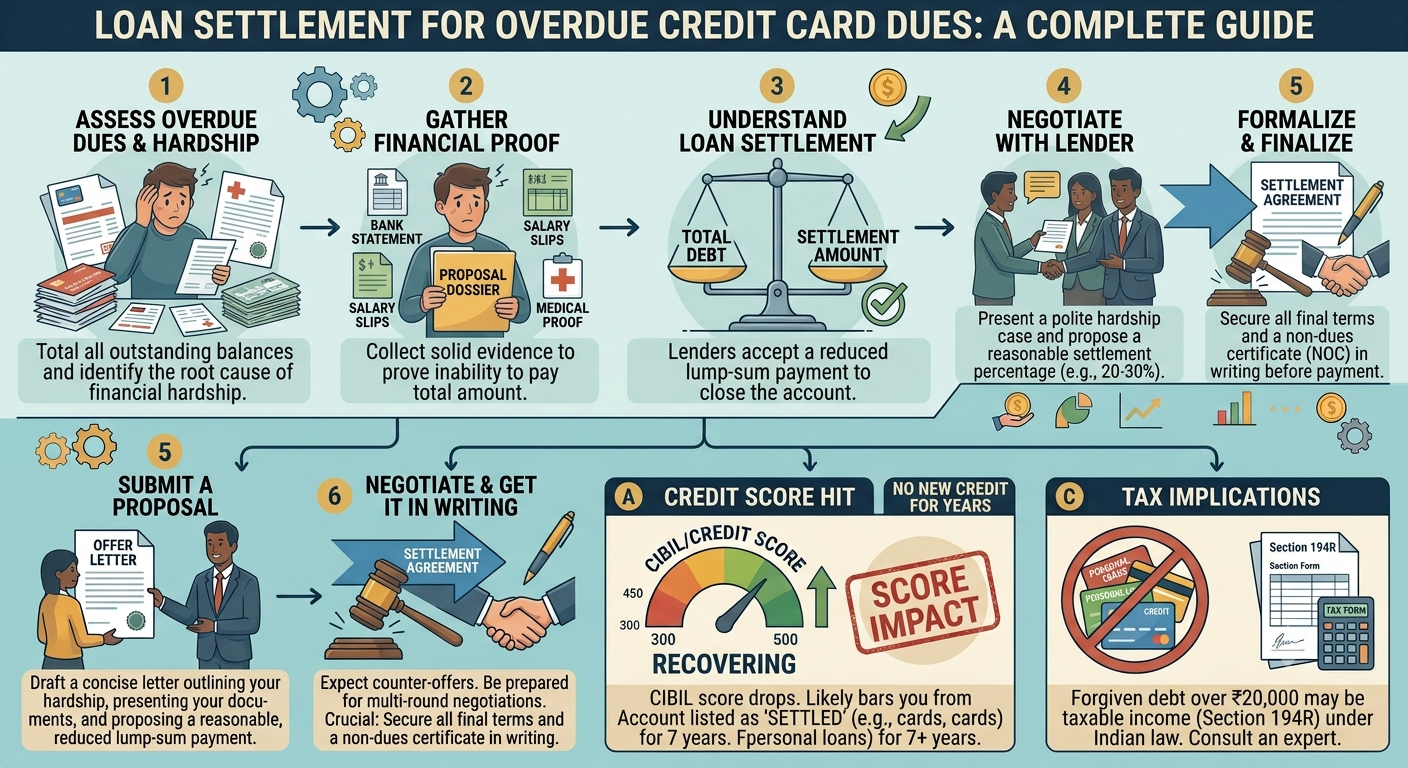
A One-Time Settlement (OTS) is an official compromise agreement between a cardholder and the bank. The bank agrees to accept a mutually negotiated reduced lump-sum payment to close the account fully, waiving the remaining accrued charges and part of the principal.
- Audit Total Claimed Dues: Obtain complete card statements to separate original principal expenditure from accumulated finance charges and penalties.
- Establish Default & NPA Status: Lenders evaluate compromise proposals after an account has been defaulted for over 90 days (classified as a Non-Performing Asset).
- Submit Evidence of Hardship: Present objective documentation showing financial distress that prevents full balance recovery.
- Negotiate One-Time Lump-Sum Terms: Offer a realistic cash settlement based on verified hardship and available pool capital.
- Secure Official Sanction & Closure: Obtain a written sanction letter on official bank letterhead prior to making any final settlement payment.
Minimum Due vs. Compromise Settlement Comparison
| Evaluation Metric | Paying Minimum Amount Due | One-Time Credit Card Settlement |
| Financial Outcome | Traps cash in compounding monthly fees | Eliminates finance charges and waives balance |
| Principal Reduction | Minimal to zero reduction in main balance | Direct discount negotiated on outstanding principal |
| Credit Report Status | Retains active account status | Marked as “Settled” on credit registry reports |
| Legal Resolution | Leaves account open for recurring charges | Complete legal closure with No Dues Certificate |
Protecting Your Rights Against Recovery Misconduct
Overdue card accounts often lead to aggressive collection efforts. Borrowers must understand their legal rights under regulatory guidelines:
- Strict Contact Guidelines: Recovery agents may only contact cardholders between standard operational hours (8:00 AM to 7:00 PM).
- Zero Harassment Tolerance: Threatening language, physical intimidation, or contacting workplace colleagues is illegal.
- Right to Legal Representation: Cardholders may direct recovery communications through authorized legal advisors or debt experts.
Navigating Credit Card Settlement with Professional Support
Managing complex negotiations with multiple card issuers while handling daily living expenses can feel overwhelming. Engaging qualified debt advisers ensures your profile is represented professionally and resolved within legal boundaries.
Partnering with an accredited loan settlement agency establishes an immediate buffer against collection calls. A dedicated loan settlement agency manages institutional communications and responds to legal notices across all your card accounts.
Utilizing comprehensive loan settlement services ensures accrued charges are audited thoroughly. Specialized loan settlement services negotiate aggressively to remove inflated finance fees and secure maximum principal discounts.
Consulting a recognized loan settlement expert protects your rights before bank credit committees. An experienced loan settlement expert leverages Reserve Bank of India (RBI) consumer protection frameworks to construct a compelling hardship representation.
Executing a structured multi-card loan settlement provides permanent relief from compounding interest. After remitting the sanctioned amount, completing a formal loan settlement ensures you receive an official No Dues Certificate (NDC) from each lender.
If mounting credit card dues threaten your financial well-being, choosing a strategic loan settlement offers a clear path toward financial recovery. Relying on an accredited loan settlement expert and utilizing trusted loan settlement services enables you to discharge card obligations safely and rebuild your financial independence.
Resolving overdue credit card dues requires legal clarity, strong evidence of financial hardship, and disciplined negotiation. By insisting on written sanction letters and leveraging expert guidance, you can discharge outstanding obligations safely and secure long-term financial stability.