
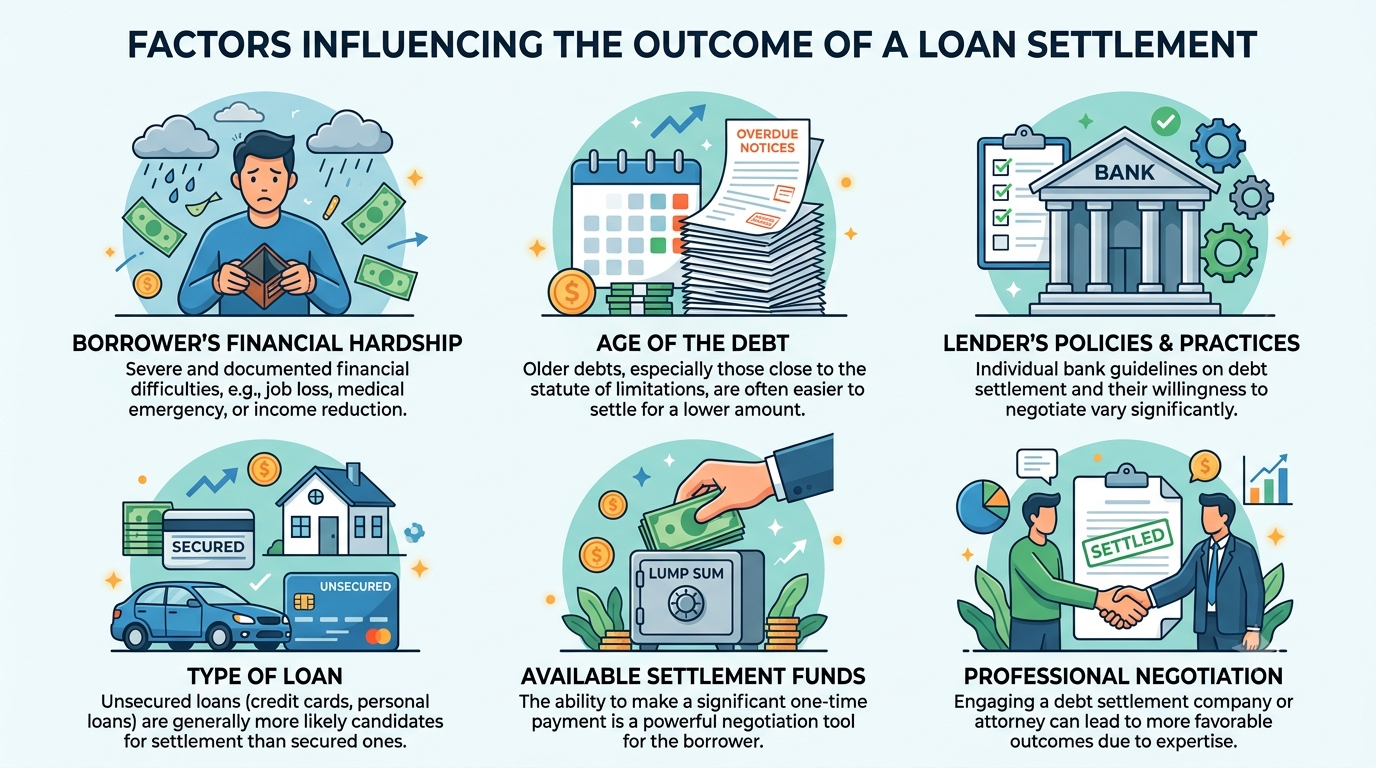
Navigating financial distress due to unforeseen events—such as unexpected job loss, critical medical emergencies, or sudden business downturns—can leave borrowers unable to keep up with monthly Equated Monthly Installments (EMIs). In such scenarios, requesting a One-Time Settlement (OTS) offers a legitimate path to resolve defaulted debts. However, the outcome of a compromise negotiation is never arbitrary; bank credit committees evaluate applications based on strict operational variables and regulatory guidelines.
Understanding the critical factors that influence negotiation results enables distressed borrowers to structure their proposals effectively and secure optimal financial relief.
1. Documented Severity of Financial Hardship
The single most influential factor in any compromise negotiation is verifiable evidence of financial distress. Lenders must be convinced that your default is involuntary rather than intentional.
- Acceptable Evidence: Medical discharge papers, job termination slips, audited loss statements, or closed business bank accounts.
- Impact on Outcome: Clear documentation significantly increases the probability of securing higher waiver percentages on total outstanding dues.
2. Loan Category: Secured vs. Unsecured Debt
The structure of the underlying loan plays a defining role in determining bank flexibility:
- Unsecured Obligations (Personal Loans & Credit Cards): Because lenders lack collateral to seize, they face higher recovery risks and protracted legal costs. Consequently, unsecured accounts yield higher waiver percentages.
- Secured Loans (Home & Vehicle Loans): Backed by physical assets, banks retain legal rights under recovery laws (such as SARFAESI) to repossess and auction property, making compromise waivers harder to secure without severe asset devaluation.
3. Duration of Default and NPA Classification
Banks evaluate compromise applications based on how long an account has remained overdue:
| Default Duration | Account Classification | Settlement Probability & Waiver Depth |
| 0 to 89 Days | Early Overdue / SMA Status | Low settlement likelihood; lenders push for regularized EMIs. |
| 90 to 180 Days | Non-Performing Asset (NPA) | Moderate flexibility; credit committees evaluate compromise options. |
| 180+ Days | Substandard / Doubtful Asset | High settlement feasibility; banks seek to clear toxic balances. |
4. Availability of Immediate Lump-Sum Funds
Settlements depend on a borrower’s ability to remit a single, negotiated payment within a short timeframe (usually 15 to 30 days). Offering immediate liquidity gives banks an incentive to write off penal interest and part of the principal balance instead of risking protracted default.
5. Type of Financial Institution
Different classes of lenders operate under varying risk tolerance profiles:
- Public Sector & Private Banks: Governed by formal internal compromise policies and strict audit trail requirements.
- Non-Banking Financial Companies (NBFCs): Often display higher flexibility for fast single-payment write-offs to clear balance sheets quickly.
Maximizing Settlement Success with Professional Support
Attempting direct negotiations with institutional credit officers while enduring personal hardship can feel overwhelming. Partnering with accredited financial advisors ensures your case is presented persuasively and negotiated within regulatory frameworks.
Engaging an established loan settlement agency provides immediate protection against aggressive collection tactics. A professional loan settlement agency manages all official communications, legal notices, and bank meetings on your behalf.
Utilizing dedicated loan settlement services guarantees a comprehensive audit of accumulated charges. Specialized loan settlement services work to eliminate unjustified penal interest and secure maximum principal discount terms.
Consulting a recognized loan settlement expert strengthens your standing before institutional credit committees. An accredited loan settlement expert evaluates your debt profile, safeguards your rights under Reserve Bank of India (RBI) consumer guidelines, and structures viable terms.
Executing a strategic loan settlement brings legal closure to spiraling debt liabilities. Once the sanctioned sum is remitted, completing a formal loan settlement ensures you receive an official No Dues Certificate (NDC), halting recovery proceedings permanently.
If mounting EMI defaults are straining your budget, seeking a structured loan settlement offers a proven path forward. Working with an experienced loan settlement expert and utilizing trusted loan settlement services allows you to discharge your debt safely and rebuild your financial independence.
Securing a favorable loan settlement requires clear proof of hardship, strategic timing, and disciplined negotiation. By insistence on official written sanction letters and leveraging expert advice, you can resolve your debts safely and secure long-term financial stability.