
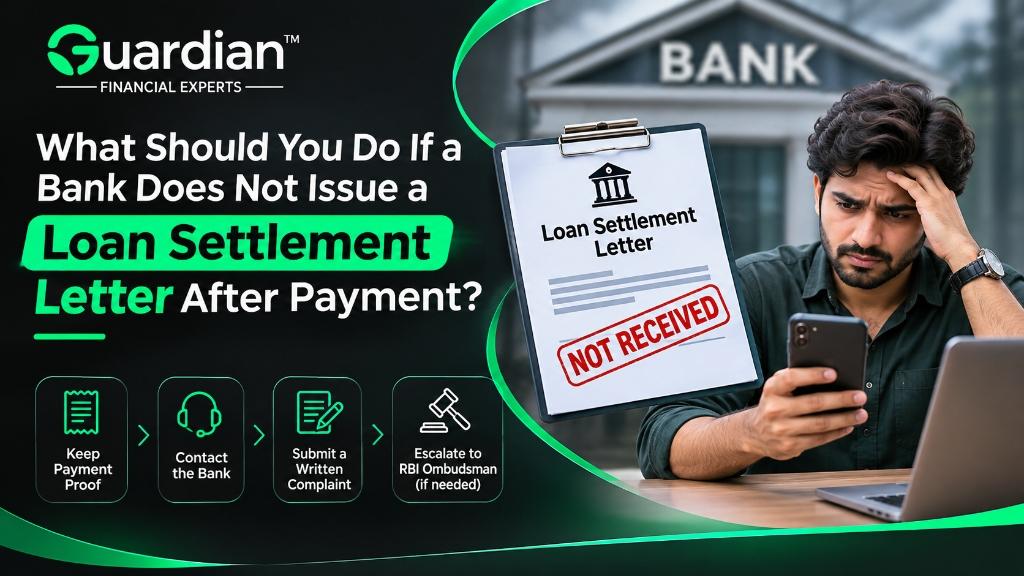
You have completed your loan settlement payment on time. The agreed settlement sum has been remitted directly into your loan account. And yet — days pass, then weeks — and the bank has not issued your loan settlement letter, settlement completion confirmation, or No Dues Certificate (NDC). This is a situation many Indian borrowers face, and it can be both frustrating and financially risky.
Without written documentary confirmation of your loan settlement, you have no formal legal proof that the account has been resolved. Recovery calls may continue. Your credit report may not be updated. And in a worst case scenario, the lender could restart collection proceedings claiming the settlement terms were not satisfied.
This guide explains clearly what a loan settlement letter is, why banks sometimes fail to issue one promptly, the exact steps you should take, your rights under the RBI Integrated Ombudsman Scheme 2026, and what documents you must always retain after completing any loan settlement.
🛡️ Important: Always remit your settlement payment directly into your designated loan account number — never to a third-party individual, recovery agent, or intermediary. Retain your UTR number and transaction receipt as primary proof of payment.
What Is a Loan Settlement Letter?
A loan settlement letter is an official written communication issued by a bank, NBFC, or financial institution confirming that a borrower has completed the agreed One-Time Settlement (OTS) payment and that the loan account has been resolved on the agreed terms.
Borrowers should understand the distinction between two related documents:
- Settlement Approval Letter (Pre-Payment): Issued before you make any payment. This letter outlines the agreed settlement amount, payment deadline, and conditions. It is issued on official bank letterhead and must be verified before you transfer any funds.
- Settlement Completion Confirmation / No Dues Certificate (NDC): Issued after the agreed payment has been received by the bank within the deadline. This document confirms that your loan account is settled and that you owe no further dues to the lender.
The No Dues Certificate (NDC) — also referred to as a No Objection Certificate (NOC) in some contexts — is the most critical document post-settlement. It is your formal proof that the lender acknowledges the debt as resolved. Without this, your loan account may remain flagged as active in the bank's internal system and in credit bureau records.
Written documentation matters because verbal assurances from collection agents or bank executives carry no legal enforceability. If a dispute arises later, only the written, signed, and stamped settlement letter issued on official bank letterhead will protect your legal position.
Why Might a Bank Not Issue a Loan Settlement Letter After Payment?
There are several genuine operational and procedural reasons why a bank may delay or fail to issue the settlement letter after receiving your payment:
- Payment Not Yet Updated in the System: Banking systems — particularly for large public sector banks with millions of accounts — can take several working days to reflect and reconcile an incoming settlement payment against a specific loan account.
- Internal Processing Delays: Many banks require their settlement approval to pass through multiple internal authority levels before the final NDC is generated. This approval chain can take 15 to 30 working days in certain institutions.
- Incorrect Loan Account Details: If the payment was credited to an incorrect loan account number or against a different borrower profile, the bank's records will show no payment against your settlement account.
- Settlement Amount Mismatch: If the amount remitted does not exactly match the sanctioned settlement figure stated in the approval letter — even by a minor rounding difference — the bank may treat the settlement conditions as unfulfilled.
- Payment Made Through an Unauthorised Channel: Settlement payments must typically be credited directly into the specific loan account number via NEFT, RTGS, IMPS, or UPI as instructed in the settlement letter. Payments made to a recovery agency's account or through unofficial channels are not recognised by the lending institution.
- Settlement Agreement Conditions Not Fully Satisfied: Some settlement letters include staged payment schedules. If a tranche was missed or delayed, the bank may consider the OTS agreement lapsed.
- Communication Gaps Between the Collection Agency and the Bank: If your negotiation was managed by an external collection or recovery agency empanelled by the bank, there can be a reporting lag before the bank's internal records are updated with the settlement status and the NDC issuance is triggered.
What Should You Do If the Bank Does Not Issue the Settlement Letter?
Step 1: Collect All Payment Receipts and Transaction Records
Immediately retrieve and organise every payment-related document. This includes your bank account statement clearly showing the debit, the UTR (Unique Transaction Reference) number, the transaction date and time, and the beneficiary account number. Screenshot all digital payment confirmations and store them in a dedicated folder.
Step 2: Review the Original Loan Settlement Approval Letter
Carefully re-read the settlement approval letter issued before your payment. Verify that the payment amount remitted matches the sanctioned sum exactly, that the payment was made within the stated deadline, that the payment was credited to the correct loan account number specified in the letter, and that all stated conditions were met.
Step 3: Contact the Bank's Customer Service Department
Reach out to the bank's official customer care through email or the registered customer helpline. Mention your loan account number, the settlement approval letter reference, the UTR number, and the payment date. Request a written update on the status of your NDC issuance. Keep a record of every interaction including the date, time, channel, and representative's name or employee ID.
Step 4: Submit a Formal Written Complaint to the Bank
If the customer service channel does not resolve your query within 7 to 10 working days, submit a formal written complaint to the branch where your loan was disbursed, the bank's official email grievance address, and the bank's customer complaint portal (if available online). Attach copies of your settlement letter, payment receipt, UTR details, and all previous communication. Obtain a written complaint acknowledgement and reference number.
Step 5: Escalate to the Bank's Grievance Redressal Officer or Principal Nodal Officer
All regulated banks and NBFCs are required by the RBI to designate a Grievance Redressal Officer (GRO) and a Principal Nodal Officer (PNO). Their contact details must be published on the bank's official website. Submit your escalation with the original complaint reference number and all supporting documents. The bank is expected to respond within the applicable timeframe stipulated under its internal grievance policy.
Step 6: Request Written Confirmation of Payment Receipt and Account Status
Even before the NDC is formally issued, you can request a written interim confirmation letter from the bank confirming that your settlement payment has been received and is being processed. This creates an on-record acknowledgement that protects your position during the processing period.
Step 7: If Unresolved, Escalate Through the RBI's Applicable Grievance Redress Mechanism
If the bank does not resolve your complaint satisfactorily within 30 days, or if you are dissatisfied with their resolution, you may be eligible to approach the Reserve Bank of India's grievance redressal mechanism, subject to the applicable scheme's eligibility and maintainability conditions. Refer to the section below for details on the RBI Integrated Ombudsman Scheme 2026.
How to File a Complaint Against a Bank for Not Issuing a Settlement Letter
When a bank fails to issue your settlement letter or NDC after receiving payment, the appropriate escalation path is:
- First, approach the bank or regulated entity directly through their official grievance channels as described above. Maintain your complaint reference number at every stage.
- Keep copies of all communications — emails, letters, portal submissions, and responses — organised chronologically with dates.
- Allow the bank's standard response period as stipulated in their grievance policy or as applicable under regulatory directions.
If the regulated entity does not resolve your complaint within 30 days of your submission, or if you are not satisfied with their resolution, you may be eligible to escalate to the RBI Integrated Ombudsman Scheme, 2026.
RBI Integrated Ombudsman Scheme, 2026
The Reserve Bank – Integrated Ombudsman Scheme, 2026 (effective from 1 July 2026) provides a centralised, cost-free grievance redressal mechanism for customers of regulated entities including commercial banks, cooperative banks, NBFCs, and payment service providers.
Under this Scheme, a borrower may generally approach the RBI Ombudsman if:
- No response has been received from the regulated entity within 30 days of submitting the complaint.
- The complaint has not been resolved to the borrower's satisfaction by the regulated entity.
Important: The Ombudsman is an independent grievance redressal authority. Eligibility and maintainability of a complaint under the Scheme are subject to the specific conditions, exclusions, and procedures prescribed in the Scheme document. Not all complaints are automatically maintainable. Borrowers should review the Scheme guidelines carefully or seek professional advice before filing.
🔗 Official RBI Complaint Management Portal:
File your complaint online at: https://cms.rbi.org.in/
For RBI regulatory information, visit: https://www.rbi.org.in/
Documents You Should Keep After Loan Settlement
Regardless of whether your bank has issued the NDC yet, you must secure and preserve the following documents immediately after completing your settlement payment:
- Original Settlement Approval / Offer Letter: The signed letter on bank letterhead specifying the settlement amount, deadline, loan account number, and conditions.
- Payment Receipts: All computerised receipts or digital payment confirmations for every tranche of the settlement payment.
- UTR / Transaction Reference Number: The Unique Transaction Reference (UTR) generated by your bank for each NEFT, RTGS, or IMPS transfer — this is your primary proof of payment.
- Bank Statements: Official bank statements covering the period of your settlement payment, showing the debit clearly against your account and the credited loan account number.
- Email and SMS Communication: All written correspondence between you and the bank, collection team, or any intermediary regarding the settlement terms and payment.
- Loan Account Number and Statements: Your loan account number and official account statements showing the outstanding balance before and after the settlement payment.
- Complaint Acknowledgements: Written acknowledgements with reference numbers for every formal complaint submitted to the bank or regulator.
- Settlement Completion Letter / NDC: Once issued by the bank, preserve the original in physical form and digital copy in a secure location.
What Happens If Your Loan Settlement Is Not Updated in Your CIBIL Report?
Even after a bank issues your No Dues Certificate, your credit report may not be updated immediately. Here is what you need to understand:
Lenders and financial institutions are required to report credit information to credit information companies — such as TransUnion CIBIL, Experian India, CRIF High Mark, and Equifax — on a periodic basis. Updates typically occur monthly, though the exact schedule varies by lender.
When you complete a negotiated loan settlement, the lender reports the account status as "Settled" rather than "Closed." This distinction is important:
- "Closed" status indicates the loan was repaid in full as per the original contract terms.
- "Settled" status indicates the account was resolved for a negotiated amount less than the full outstanding balance — a commercially recognised compromise endorsed by RBI guidelines for stressed accounts.
A "Settled" status will reflect in your credit report and will initially affect your credit score. However, it also stops the ongoing negative reporting that occurs every month while an account remains in active default — which is far more damaging over time. If you believe your credit report contains inaccurate information — for example, if the account still shows as active or outstanding after settlement — you can raise a formal dispute directly with the credit information company through their official online dispute portal.
It is important to understand that completing a loan settlement does not automatically guarantee an improvement in your credit score. Credit score improvement after settlement is a gradual process that requires disciplined financial behaviour over 12 to 24 months.
📋 Check your credit reports from all four bureaus (CIBIL, Experian, CRIF High Mark, and Equifax) approximately 45 to 60 days after completing your settlement to verify that the account status has been updated correctly.
Can a Bank Take Legal Action After Receiving the Settlement Amount?
This is a concern many borrowers have — and rightly so. The answer depends entirely on the documented terms of your settlement agreement and whether all agreed conditions were fulfilled.
When a borrower completes the full agreed settlement payment on time and in accordance with the conditions in the official settlement approval letter, the lender's basis for further recovery action is significantly weakened. A properly documented settlement is a commercially binding arrangement. However:
- If the payment was made through an unauthorised channel (not directly into the loan account), the bank may not recognise the payment as satisfying the settlement conditions.
- If the payment was made after the stated deadline, the settlement offer may have lapsed under its own terms.
- If the payment amount fell short of the agreed sum — even by a small margin — the bank may treat the OTS conditions as not satisfied.
It is also important to understand the distinction between a full repayment of a loan (where you repay the entire original outstanding balance including all contracted interest) and a negotiated settlement (where the bank accepts a reduced sum as a compromise). In a full repayment, there is no ambiguity. In a settlement, the terms of the specific approval letter govern the finality of the resolution.
If a lender continues recovery action despite documented and compliant settlement payment, borrowers should seek independent legal advice from a qualified advocate experienced in Indian banking and consumer law. Do not rely on verbal assurances in such situations.
Common Mistakes Borrowers Should Avoid
- ❌ Making payments without written settlement confirmation: Never transfer any settlement funds before receiving the official settlement approval letter on bank letterhead with an authorised signature and stamp.
- ❌ Paying an unauthorised recovery agent: Recovery agents do not have authority to collect settlement payments on behalf of a bank. All funds must be credited directly to your loan account number.
- ❌ Ignoring settlement conditions: Read the settlement letter carefully and fulfil every condition — including payment amount, payment deadline, and payment method — exactly as stated.
- ❌ Not retaining payment receipts: Your UTR number and transaction receipt are your most important protection. Store them securely, digitally and physically.
- ❌ Relying only on verbal assurances: Phone calls and verbal confirmations from collection executives or bank staff are not legally enforceable. Always get written confirmation.
- ❌ Ignoring incorrect credit report entries: If your credit report does not reflect the settled status within 60 days of payment, raise a formal dispute with the credit bureau immediately.
How Guardian Financial Experts Can Help
Navigating loan settlement documentation, communicating effectively with lenders, and understanding your rights as a borrower can be complex — particularly when you are dealing with the stress of an unresolved settlement.
Guardian Financial Experts is a professional financial advisory and debt resolution firm that helps Indian borrowers understand and manage the loan settlement process. Our team can assist you with:
- Understanding loan settlement procedures and documentation requirements.
- Reviewing your settlement approval letter and payment records for accuracy.
- Structuring formal written communication to your lender regarding NDC issuance.
- Providing guidance on appropriate escalation paths if the bank is unresponsive.
- Advising on credit report and account status concerns post-settlement.
- Supporting borrowers facing ongoing recovery harassment even after a settlement payment has been made.
- Providing awareness on personal loan settlement and credit card debt settlement processes.
Guardian Financial Experts is not a bank, lender, government authority, or RBI-authorised Ombudsman. We are a financial advisory firm. We do not guarantee settlement outcomes or specific credit score improvements.
Need Help Understanding Your Loan Settlement Documentation?
If you have completed a loan settlement but are facing difficulties obtaining the required confirmation documents, understanding your lender's communication, or checking your loan account status — Guardian Financial Experts can help you understand the available next steps.
Get Professional Guidance →Frequently Asked Questions (FAQs)
1. What should I do if the bank does not provide a settlement letter after payment?
Start by collecting your payment receipt and UTR number. Contact the bank's customer service in writing, citing your loan account number and the settlement approval letter reference. If there is no response within 10 working days, submit a formal written complaint to the branch and the bank's Grievance Redressal Officer. If the bank does not resolve the matter within 30 days, you may be eligible to approach the RBI Integrated Ombudsman Scheme (cms.rbi.org.in), subject to eligibility conditions.
2. How long does a bank usually take to issue a loan settlement confirmation?
Processing timelines vary by institution. Many banks issue settlement confirmation within 15 to 30 working days after the payment is credited and reconciled internally. However, delays can occur due to internal approval hierarchies, system processing lags, or missing documentation. Following up proactively in writing is advisable.
3. Is a payment receipt sufficient proof of loan settlement?
A payment receipt and UTR number are important evidence that funds were transferred, but they are not equivalent to a formal settlement letter or No Dues Certificate issued by the bank. The NDC is the document that formally extinguishes the debt relationship. Always pursue the bank for the NDC even if you have full payment evidence.
4. Can I complain to the RBI if the bank does not issue my NDC?
If your formal complaint to the bank remains unresolved for 30 days, or if you are dissatisfied with the bank's response, you may be eligible to file a complaint through the RBI Complaint Management System at cms.rbi.org.in, subject to the maintainability conditions of the RBI Integrated Ombudsman Scheme 2026.
5. What is the difference between a loan settlement letter and a No Dues Certificate?
A settlement letter (also called a settlement sanction letter or approval letter) is issued before payment and specifies the agreed settlement amount, deadline, and conditions. A No Dues Certificate (NDC) is issued after the bank has received and confirmed the full settlement payment — it formally states that you owe no further dues to the lender on the settled account.
6. Will my CIBIL report show Closed or Settled after loan settlement?
When a loan is resolved through a negotiated settlement for less than the total outstanding balance, lenders report the account status as "Settled" — not "Closed." A "Closed" status is used only when the loan is repaid in full as per the original contract terms. The "Settled" status is accurate and reflects the nature of the transaction. It is not an error that needs to be disputed, unless the bank reports an incorrect status.
7. Can a bank demand additional money after I complete the agreed settlement?
If you have remitted the full agreed settlement amount within the deadline and in accordance with the conditions in the official settlement approval letter, the terms of that agreement govern the resolution of your account. However, if any condition was not met — such as a delayed payment or incorrect amount — the bank may consider the settlement offer lapsed. Seek professional legal advice if a lender continues making demands after documented and compliant settlement payment.
8. What documents should I collect after completing a loan settlement?
You should retain: the original settlement approval letter, all payment receipts and UTR numbers, your bank statement showing the payment debit, all email and SMS correspondence with the bank, your loan account number and account statements, any complaint acknowledgement reference numbers, and the final settlement completion letter or NDC once issued.
Disclaimer: This article is published by Guardian Financial Experts for educational and financial awareness purposes only. It does not constitute statutory legal advice or a guarantee of any specific outcome. Loan settlement processes, documentation timelines, and regulatory eligibility conditions are subject to the policies of individual banks, NBFCs, and applicable RBI directions. Borrowers are advised to seek independent legal counsel for their specific circumstances.
Explore Bank-Specific Resolution & Debt Relief Services
Facing debt recovery notices, escalating interest, or multiple EMI defaults? Navigate our authoritative settlement guides and legal resolution procedures tailored for Indian borrowers:
HDFC Bank Loan Settlement
Personal loan & credit card OTS procedures, waiver rules, and recovery resolution.
SBI Loan Settlement Process
State Bank of India compromise settlement, NPA resolution, and Lok Adalat guidelines.
ICICI Bank Loan Settlement
Resolution for overdue credit cards, personal loans, and third-party recovery defense.
Bajaj Finance Debt Settlement
NBFC overdue loan settlement, bounce charges negotiation, and NDC documentation.
Credit Card Settlement Services
Stop 40%+ compounding APR and settle high-balance credit cards with structured waivers.
Personal Loan Settlement
Resolve multiple unsecured loans, fintech apps, and salary defaults with legal protection.
Anti-Harassment Legal Support
Enforce RBI fair practice code to halt abusive recovery calls, threats, and illegal visits.
CIBIL & Credit Score Improvement
Step-by-step roadmap to rebuild credit rating from 'Settled' status back to 750+.
Every loan case is unique. If you are experiencing EMI pressure or receiving recovery notices, our team is available for a confidential consultation.