
Managing loan repayments can become intensely difficult when unexpected financial hardships affect your cash flow. Job loss, business setbacks, medical emergencies, or inflationary challenges can make paying steep monthly EMIs impossible on time.
When borrowers in India start struggling with repayments, two primary financial avenues frequently emerge: loan restructuring and loan settlement. Although both mechanisms are designed to address acute repayment difficulties, they operate on fundamentally different legal principles and carry distinct long-term consequences for your credit history and financial freedom.
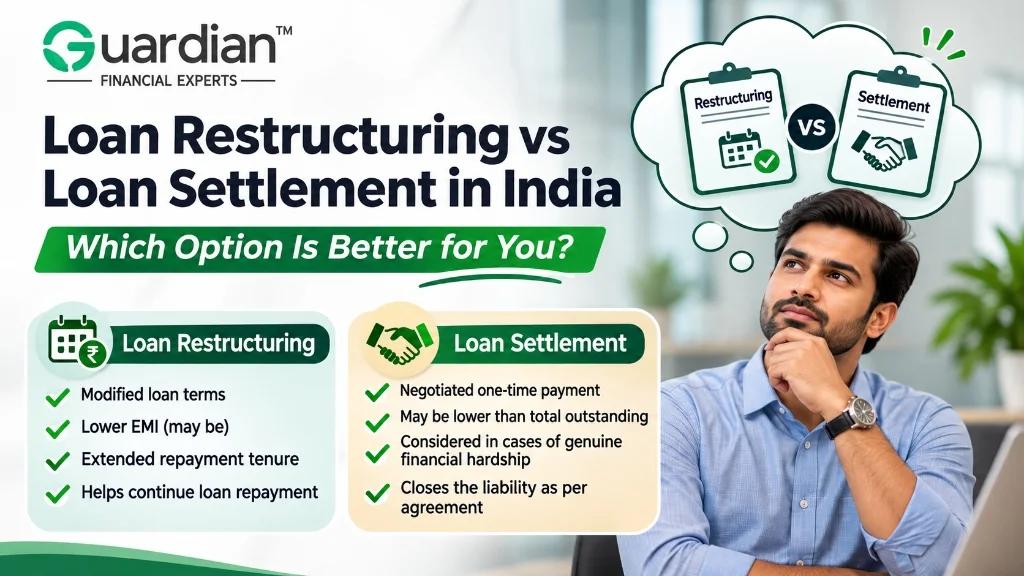
💡 Key Takeaway: Loan restructuring modifies repayment conditions so you continue paying the debt in full. Loan settlement is a negotiated compromise where the bank accepts a reduced lump sum to extinguish delinquent liability.
What Is Loan Restructuring?
Loan restructuring is a formal credit procedure wherein a regulated bank or NBFC modifies existing loan terms to make ongoing debt servicing manageable for a borrower experiencing verifiable financial stress.
Under Reserve Bank of India (RBI) prudential guidelines and individual institutional policies, restructuring can include:
- Extending Loan Repayment Tenure: For example, stretching a 36-month tenure to 60 months to immediately lower monthly EMI obligations.
- Revising the Monthly EMI Amount: Calibrating payments to align with current reduced household cash flows.
- Granting an EMI Moratorium: Providing a temporary payment holiday (typically 3 to 6 months) during medical emergencies or between jobs.
- Converting Credit Card Debt: Transforming high-interest revolving card balances into structured, lower-interest term personal loans.
The core objective of restructuring is to help the borrower maintain regular account performance without writing off principal debt.
Practical Example of Restructuring:
Suppose a borrower has an outstanding unsecured personal loan of ₹5,00,000 with a monthly EMI of ₹18,000. Following a salary pay-cut, paying ₹18,000 becomes unfeasible. Upon presenting verifiable salary slips, the bank agrees to extend the repayment tenure by 24 months, bringing the new EMI down to approximately ₹11,500. The borrower continues repaying the full loan, preserving an active repayment track record.
What Is Loan Settlement?
Loan settlement (frequently referred to as a One-Time Settlement or OTS) is a negotiated commercial compromise wherein a lender agrees to accept a lump-sum amount lower than the total outstanding balance to close delinquent accounts permanently.
Settlement is generally considered when a borrower faces acute, irreversible financial hardship (such as business insolvency, permanent medical disability, or prolonged job loss) where continuing full EMI repayment is impossible.
Under internal credit risk frameworks and the RBI Fair Practices Code, authorized bank committees review the borrower's distress profile, waive accumulated penal interest and late fees, and agree upon a legally binding settlement sum.
⚠️ Important Safety Rule: Never settle based on oral promises or WhatsApp messages from third-party recovery agents. Always demand a formal, signed Settlement Sanction Letter on official bank letterhead before paying any funds directly into your loan account.
Practical Example of Loan Settlement:
A borrower carries an outstanding credit card or personal loan liability of ₹5,00,000. Due to business closure, the account defaults past 90 days (NPA). Compounding penalties inflate the claim to ₹6,50,000. Through professional debt representation, hardship documentation is submitted to the bank's competent authority. The bank approves an OTS sanction letter to close the file for ₹2,20,000 paid in structured tranches. Upon payment, an official No Dues Certificate (NDC) is issued, ending all collection activity.
Loan Restructuring vs Loan Settlement: Key Differences
The comparative matrix below highlights the primary operational and financial distinctions:
| Parameter | Loan Restructuring | Loan Settlement (OTS) |
|---|---|---|
| Core Objective | Make EMIs manageable for continued full repayment | Permanently extinguish liability via negotiated compromise |
| Total Outstanding | Full principal + interest remains payable | Substantial waiver granted (typically 40% to 65%) |
| Monthly EMI Impact | Lowered through extended repayment tenure | Monthly EMIs terminate; settled in lump-sum or short tranches |
| Total Interest Cost | Increases over time due to extended repayment period | All future and penal interest is entirely waived |
| CIBIL Report Tag | Reported as "Restructured" or regular performance | Reported as "Settled" in credit bureau databases |
| Future Borrowing | Moderate short-term impact; recoverable with timely payments | Strict scrutiny; requires 12–18 months of credit rehabilitation |
| Closure Document | Revised Loan Sanction Agreement | Official No Dues Certificate (NDC / NOC) |
Which Option Is Better for Your Financial Situation?
There is no generic answer suitable for every borrower. The ideal path depends on the stability of your current income, aggregate debt-to-income ratio, and long-term financial goals.
1. When Should You Choose Loan Restructuring?
- Your income reduction is temporary (e.g., job change, transitional business cycle).
- You still maintain an active, reliable monthly cash flow sufficient for a recalibrated EMI.
- You intend to buy a home or apply for commercial loans within the next 2 to 3 years and wish to protect your credit reputation.
- You can comfortably absorb the higher cumulative interest that tenure extension produces.
2. When Should You Choose Loan Settlement?
- You have experienced a catastrophic or irreversible loss of income.
- Your total unsecured debt liabilities significantly exceed your annual earnings capacity.
- Aggressive recovery agency harassment and legal notices are destroying mental peace and family stability.
- Borrowing further to service existing EMIs has trapped you in a dangerous debt spiral.
- Your primary focus is complete freedom from debt with guaranteed closure.
Struggling to Decide Between Restructuring and Settlement?
Our senior financial and legal panel reviews your loan accounts, assesses your repayment eligibility, and represents you before lending banks under RBI guidelines.
Check Free Settlement & Restructuring Eligibility →How Does Loan Settlement Affect Your CIBIL Score?
When a lender accepts a negotiated partial payment, the account status in bureau reports (CIBIL, Experian, CRIF High Mark, Equifax) changes from "Standard / Closed" to "Settled". This reflects that the account was resolved for less than the full contract amount.
Key credit realities every borrower must recognize:
- Initial Score Dip: Your credit score will experience a significant drop immediately upon reporting.
- Halt of Ongoing Negative Marks: Unlike keeping accounts in prolonged delinquency (where 90+ DPD continues accumulating negative points every month), a settlement permanently freezes negative reporting.
- Rebuilding is 100% Possible: Using secured credit cards (backed by fixed deposits) and prompt utility payments, borrowers can systematically restore their score back to 750+ within 12 to 18 months.
- Converting "Settled" to "Closed": If your financial situation improves later, lenders permit paying the waived amount to convert the bureau status to "Closed".
Mandatory Checklist Before Accepting Any Settlement Offer
To avoid fraud and ensure legal validity, never make a payment without verifying these six criteria:
- Official Letterhead Sanction: The settlement sanction letter must be issued on official bank/NBFC letterhead, featuring an authorized signature, employee code, and branch stamp.
- Precise Breakdown of Amounts: Verify that the letter explicitly mentions the agreed settlement sum as "full and final compromise satisfaction of all claims".
- Strict Payment Deadlines: Adhere strictly to the sanctioned due dates; missing a deadline by even one day can nullify the settlement agreement.
- Direct Account Remittance: Never pay cash or transfer money to private agencies or advocates. Remit funds exclusively into your designated loan account number.
- Withdrawal of Litigation: Ensure the letter binds the lender to withdraw pending cases under Section 138 NI Act, Section 25 PSSA, or arbitration.
- No Dues Certificate (NDC): Demand the final NDC/NOC within 30 to 45 days of completing the payment.
Frequently Asked Questions (FAQs)
1. Is loan restructuring better than loan settlement?
Restructuring is advantageous when your income decline is temporary and you can service lower EMIs over an extended period without hurting your credit score. Settlement is better when financial insolvency makes full repayment unachievable, allowing you to extinguish debt permanently at a major discount.
2. Can a bank reject my loan restructuring or settlement request?
Yes. Commercial banks and NBFCs possess commercial discretion. Approval depends on their internal credit risk committee, documented proof of genuine financial hardship, and the asset classification of your account.
3. Can recovery agents still harass me after I request restructuring or settlement?
No legitimate lender may violate the RBI Fair Practices Code. Under RBI directives, agents cannot contact you outside 8:00 AM to 7:00 PM, use intimidation, or contact relatives. If facing harassment, learn more about anti-harassment legal protections.
4. Can I request loan restructuring after missing multiple EMIs?
Yes, but lenders evaluate non-performing assets (NPAs) strictly. Once an account exceeds 90 days past due (DPD), banks are often more receptive to a One-Time Settlement (OTS) than tenure restructuring.
5. Should I intentionally stop paying EMIs to force a settlement?
Absolutely not. Wilful default carries severe legal risks and penalties. Settlement is strictly meant for borrowers undergoing genuine financial distress, not as a convenience mechanism.
Take Control of Your Debt With Professional Advisory
Navigating banking policies, structuring financial hardship documentation, and shielding yourself from collection pressure requires seasoned expertise. At Guardian Financial Experts, our specialized team provides:
- Comprehensive debt-to-income and hardship evaluations.
- Structured representation before authorized bank nodal committees.
- Immediate cease-and-desist support against recovery harassment.
- Post-settlement credit rehabilitation guidance.
Speak Directly with a Senior Debt Advisor Today
Get a confidential evaluation of your personal loans and credit cards. Discover whether restructuring or formal settlement provides the fastest path to financial peace.
Disclaimer: This guide is for educational purposes under Indian banking conventions and does not constitute statutory legal or investment advice. Loan restructuring and compromise settlements remain subject to respective lender approval and applicable RBI Master Directions.
Explore Bank-Specific Resolution & Debt Relief Services
Facing debt recovery notices, escalating interest, or multiple EMI defaults? Navigate our authoritative settlement guides and legal resolution procedures tailored for Indian borrowers:
HDFC Bank Loan Settlement
Personal loan & credit card OTS procedures, waiver rules, and recovery resolution.
SBI Loan Settlement Process
State Bank of India compromise settlement, NPA resolution, and Lok Adalat guidelines.
ICICI Bank Loan Settlement
Resolution for overdue credit cards, personal loans, and third-party recovery defense.
Bajaj Finance Debt Settlement
NBFC overdue loan settlement, bounce charges negotiation, and NDC documentation.
Credit Card Settlement Services
Stop 40%+ compounding APR and settle high-balance credit cards with structured waivers.
Personal Loan Settlement
Resolve multiple unsecured loans, fintech apps, and salary defaults with legal protection.
Anti-Harassment Legal Support
Enforce RBI fair practice code to halt abusive recovery calls, threats, and illegal visits.
CIBIL & Credit Score Improvement
Step-by-step roadmap to rebuild credit rating from 'Settled' status back to 750+.
Every loan case is unique. If you are experiencing EMI pressure or receiving recovery notices, our team is available for a confidential consultation.