
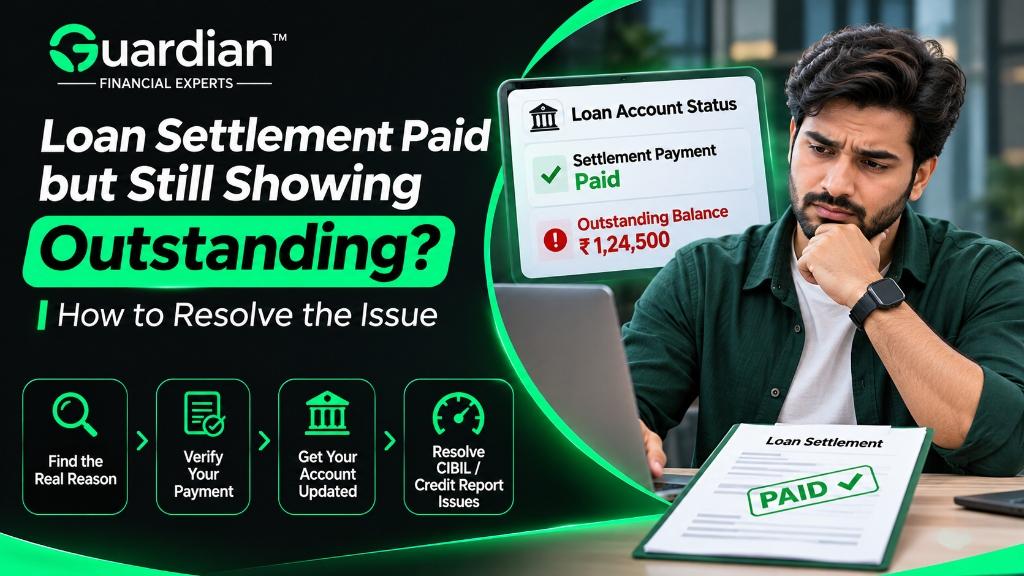
Few financial situations are as disheartening as completing a negotiated loan settlement, remitting the agreed lump sum to your lender, and discovering weeks later that your loan statement, net banking portal, or credit report still reflects a hefty outstanding balance. For many borrowers in India who made immense sacrifices to assemble settlement funds, this unexpected discrepancy causes severe anxiety, confusion, and fear of ongoing recovery actions.
Why does an outstanding balance continue to linger after a settlement payment has been deposited? Is it a clerical lag, a systemic banking oversight, or an unfulfilled contractual clause? More critically, what immediate steps must you take to ensure your payment is recognised and your credit profile accurately corrected?
Ignoring an apparent outstanding balance after settlement is a grave mistake. Left unaddressed, lingering balances can attract compound interest, trigger automated recovery notices, or lead to damaging bureau reporting. In this comprehensive operational guide, we dissect the eight primary reasons for post-settlement outstanding balances, detail the exact step-by-step resolution procedure, explain credit bureau dispute mechanisms, and provide the statutory framework under the Reserve Bank of India (RBI) Integrated Ombudsman Scheme.
💡 Crucial Understanding: A settlement payment does not automatically update every banking database instantaneously. Distinguishing between an actual unresolved debt and an administrative reporting lag is the first step toward reclaiming total peace of mind.
Why Is My Loan Still Showing Outstanding After Settlement?
When you observe an outstanding balance post-settlement, the underlying cause usually falls into one of eight distinct operational categories. Identifying the exact root cause determines the specific corrective pathway required:
- Bank Has Not Updated Its Internal Core Banking Ledger: In large commercial banks and Non-Banking Financial Companies (NBFCs), loan write-offs and settlement adjustments require specific internal approvals from regional credit committees. Until the credit adjustment voucher is manually posted by the asset recovery branch, the automated system continues computing regular balances and interest.
- Payment Reconciliation Remains Pending: When settlement funds are remitted via RTGS, NEFT, or IMPS, they frequently land in a central clearing pool or general settlement account. Reconciling that specific bulk inflow against your individual loan account number requires manual batch processing, which can encounter operational backlogs.
- Settlement Amount Was Not Received in Full: Even a minuscule deficit—such as ₹50 deducted as interbank remittance charges, TDS, or an unintended rounding difference—can prevent the automated banking system from triggering account closure, leaving the residual or full balance marked as overdue.
- Agreed Settlement Conditions Have Not Been Fully Completed: Settlement sanction letters frequently stipulate rigid deadlines or conditional stages (e.g., clearance of post-dated security cheques or payment within a 3-day window). If an instalment was paid after the sanctioned cut-off date, the bank's core banking engine may treat the One-Time Settlement (OTS) offer as null and void.
- Payment Was Deposited Through an Unauthorised Third-Party Channel: If funds were handed over in cash to an outsourced field recovery agent or deposited into an agency's private account rather than the bank's official loan account, the lending institution has no recorded credit on your file.
- Internal Delays in Issuing Settlement Documentation: Generating the final No Dues Certificate (NDC) and marking the account as closed on bank books is a secondary administrative task that often lags behind payment receipt by 2 to 4 weeks.
- Credit Bureau Periodic Reporting Lag: Banks do not communicate with credit rating agencies in real-time. Under RBI regulations, lenders report member credit data on a monthly or bi-monthly cycle. Consequently, your credit report may take 30 to 60 days to reflect changes made on the bank's ledger.
- Inaccurate or Erroneous Bureau Reporting: Occasionally, the bank updates its internal system but fails to transmit the appropriate status flags to credit bureaus, causing credit information companies to display obsolete default balances.
It is vital to distinguish between an actual unpaid contractual balance (where settlement terms lapsed) and an outdated, incorrectly reported balance (where payment was compliant but clerical processing is delayed). The former requires renegotiation, whereas the latter requires procedural correction.
Does Paying the Settlement Amount Automatically Close the Loan?
A common misconception among retail borrowers is that remitting the agreed settlement money instantaneously closes the loan account across all platforms. In commercial banking jurisprudence, this is not how debt resolution operates.
A negotiated loan settlement represents a bilateral compromise: the lender agrees to accept an amount lower than the total contractual liability in exchange for immediate recovery, waiving penal interest and legal fees under commercial expediency. This differs fundamentally from a full repayment:
- Full Loan Repayment: The borrower pays 100% of the principal, normal interest, and applicable administrative fees. The loan is marked as "Closed" on all ledgers and credit bureaus.
- One-Time Settlement (OTS): The borrower pays a mutually agreed discounted sum. The lender absorbs the remaining balance as a credit loss (waiver/haircut). The account is categorized on bank records as settled and reported to credit bureaus as "Settled" or "Post-Write-Off Settled".
Because an OTS involves writing off assets, the Settlement Sanction Agreement is paramount. The bank will not formally close the account until compliance with every covenant—deadlines, payment modes, and documentation—is verified by its audit team. Furthermore, a simple bank deposit slip or UPI screenshot is only proof of fund transfer—it does not constitute legal proof of debt extinguishment. Only the bank's formal No Dues Certificate (NDC) or Settlement Completion Letter serves as binding legal release.
⚠️ Important Credit Reality: Settling a loan does not entitle a borrower to a "Closed" bureau tag. Under RBI reporting rules, lenders are legally mandated to report the factual nature of the closure as "Settled". Do not pay fraudulent intermediaries claiming they can alter your bureau status to "Closed" overnight.
How to Resolve an Outstanding Loan Balance After Settlement
If your settlement payment has been completed but your loan account or credit report continues to indicate an active outstanding balance, follow this structured, 7-step resolution protocol:
Step 1: Collect Your Loan Settlement Payment Proof
Before contacting any banking authority, assemble an ironclad documentary file proving the execution of the payment:
- Bank Account Statement: Highlighting the exact date, debited amount, and beneficiary loan account details.
- Unique Transaction Reference (UTR) / Reference Number: The definitive interbank clearing code for NEFT, RTGS, or IMPS transfers.
- Digital Receipts & Confirmation Emails: Official acknowledgement slips generated by your net banking portal or payment gateway.
- Original Settlement Sanction Letter: The pre-payment agreement issued on bank letterhead stipulating the settlement terms.
Step 2: Verify Your Settlement Agreement Terms
Scrutinize the fine print of your original settlement approval letter. Verify:
- Did the remitted sum match the sanctioned figure down to the exact rupee?
- Was the payment executed on or before the sanctioned expiration date?
- If payment was agreed in structured instalments, were all tranches credited within their individual grace windows?
- Were there auxiliary conditions (such as withdrawing an ongoing legal complaint or returning security instruments) that required fulfillment?
Step 3: Contact the Bank or Financial Institution
Initiate contact with the lender's specialized asset recovery department or designated settlement branch manager. Quote your loan account number, provide the UTR reference, attach the settlement sanction letter, and formally request an internal ledger reconciliation. Maintain an audit log detailing the date, time, personnel name, and employee designation for every verbal or branch interaction.
Step 4: Submit a Written Request for Account Status Correction
If verbal follow-ups do not rectify the balance within 7 working days, draft a formal written representation addressed to the Branch Manager and the Central Loan Operations Hub. Your written petition must formally demand:
- Formal written verification confirming receipt of the sanctioned settlement funds.
- Accounting ledger adjustment extinguishing the lingering residual balance.
- Immediate issuance of the final No Dues Certificate (NDC) or Closure Confirmation Letter.
- Transmission of corrected member data to all four authorized credit bureaus reflecting zero outstanding balance under "Settled" status.
Step 5: Escalate the Complaint to the Bank's Grievance Department
If the branch fails to act within 10 to 14 days, escalate your complaint up the bank's statutory grievance hierarchy:
- Grievance Redressal Officer (GRO): Submit your full documentation packet along with the initial branch acknowledgement via the bank's official customer grievance portal.
- Principal Nodal Officer (PNO): If the GRO does not resolve the discrepancy within 15 days, elevate the petition to the bank's Principal Nodal Officer, whose contact information is mandatory on every regulated lender's website under RBI guidelines.
Step 6: Raise a Credit Report Dispute with Credit Bureaus
If the bank confirms internal closure but your credit report continues reflecting an active outstanding balance, file an official online dispute directly with each credit information company:
- TransUnion CIBIL Online Dispute Portal
- Experian India Consumer Dispute Desk
- CRIF High Mark Dispute Resolution
- Equifax India Dispute Redressal
Under the Credit Information Companies (Regulation) Act (CICRA), once you initiate a dispute attaching your NDC and settlement letter, the bureau is required to seek verification from the lender and update inaccurate entries within 30 days.
Step 7: Escalate to the RBI Integrated Ombudsman if Eligible
If the regulated bank or NBFC fails to resolve your grievance within 30 calendar days of lodging your formal complaint, or if they reject your compliant settlement documentation without valid grounds, you are eligible to escalate the matter to the Reserve Bank of India.
Under the Reserve Bank – Integrated Ombudsman Scheme, 2026, deficiency in banking service—including non-issuance of No Dues Certificates, failure to update credit ledgers after settlement, and continuous reporting of fictitious arrears—falls squarely within the Ombudsman's adjudicatory jurisdiction.
🏛️ Official RBI Complaint Portal:
Lodge your complaint online with all documentary attachments at: https://cms.rbi.org.in/
Review regulatory master directions at: https://www.rbi.org.in/
What Documents Are Required to Correct an Outstanding Loan Balance?
To successfully resolve an accounting discrepancy with a bank or credit bureau, maintain a well-indexed physical and digital folder containing the following ten indispensable documents:
| No. | Document Name | Purpose & Critical Details |
|---|---|---|
| 1 | Settlement Sanction / Offer Letter | Must be on official bank letterhead with authorized seal, specifying sanctioned amount and deadlines. |
| 2 | Formal Settlement Agreement | Bilateral agreement outlining terms of debt waiver and mutual release covenants. |
| 3 | Computerised Payment Receipts | Cash/cheque deposit acknowledgment or electronic payment advice for every tranche paid. |
| 4 | Bank Account Statements | Certified statement reflecting the specific debit and beneficiary account remittance. |
| 5 | UTR / Transaction Reference Proof | Unique bank clearing reference establishing irrevocable delivery of funds. |
| 6 | Original Loan Account Identifier | Loan account number, customer ID (CIF), and credit card 16-digit masked identifier. |
| 7 | Pre-Settlement Loan Statements | Statements showing the opening delinquent balance before settlement was negotiated. |
| 8 | Bank Email & Written Correspondence | Official emails exchanged with bank nodal desks or recovery managers verifying terms. |
| 9 | Complaint Reference Numbers | Docket numbers generated during initial branch, GRO, and PNO grievance filings. |
| 10 | Interim Settlement Receipt or NDC | Any preliminary acknowledgement or final No Dues Certificate issued by the lender. |
How Long Does It Take for a Bank to Update Loan Settlement Records?
Understanding the standard procedural timeline helps borrowers avoid unnecessary panic while recognizing when a delay has exceeded normal boundaries:
- Internal Ledger Reconciliation (10 to 20 Working Days): Once funds hit the bank's central pool, branch accountants match the transaction with the loan ledger, book the write-off for the residual balance, and mark the account balance as zero.
- Issuance of No Dues Certificate (15 to 30 Working Days): Following ledger adjustment, the loan operations department prints and dispatches the formal NDC. Under the Fair Practices Code, lenders are expected to deliver closure documentation in a reasonable timeframe post-settlement.
- Credit Information Bureau Reporting (30 to 45 Days): Regulated entities bundle all monthly loan account status updates into standardized data files transmitted to CIBIL, Experian, CRIF High Mark, and Equifax. If your settlement is finalized on the 5th of a month, the bank's consolidated submission may not occur until the end of that month, with credit bureau processors reflecting the update 10 to 15 days thereafter.
What to do if 45 days have passed without an update: If 45 days elapse following compliant payment and your loan account or CIBIL report still displays the pre-settlement outstanding debt, administrative latency has turned into an actionable deficiency. Immediately initiate Steps 4, 5, and 6 described above.
What If CIBIL Still Shows an Outstanding Balance After Loan Settlement?
Finding an ongoing active default on your credit report months after paying a settlement is particularly damaging. Here is what happens behind the scenes and how to address it:
Understanding Bureau Status Categories:
- Settled: The account has zero balance remaining, but reflects that the lender accepted a compromise sum less than total dues. This stops negative default reporting.
- Closed: The loan balance is zero because 100% of the contractual loan liability was repaid in full.
- Written-off: The lender marked the debt as an uncollectible loss. If an account shows "Written-off" with an ongoing active outstanding balance after you paid a settlement, the bank has committed a major reporting error.
Identifying Erroneous Bureau Reporting:
On your CIBIL or Experian report, examine two distinct fields under the specific loan account:
- Current Balance / Amount Overdue: Following settlement reconciliation, this field MUST reflect ₹0. If it displays an active balance (e.g., ₹1,24,500), the bank has failed to post the settlement write-off.
- Account Status: Should display "Settled" (or "Post-Write-Off Settled").
When you file an official dispute through CIBIL or Experian attaching your NDC, the credit bureau issues an electronic query to the lender's compliance officer. Under RBI's Credit Information Companies Master Directions, the lender is legally required to verify its books and update the bureau within 30 days. If the lender fails to respond or verifies inaccurate data, the borrower can seek statutory compensation under RBI directives.
Remember: While correcting the balance to ₹0 is essential, achieving a "Settled" status will not instantly boost your credit score to 750+. Score rehabilitation requires dedicated post-settlement credit discipline, as outlined in our guide to credit score improvement after debt resolution.
Can Recovery Agents Continue Calling After Loan Settlement?
Borrowers are often alarmed when third-party recovery tele-callers continue demanding payments after a settlement has been completed. This distressing occurrence is almost always due to an operational communication gap:
Banks frequently empanel external recovery agencies under 90-day collection mandates. If the bank's asset recovery desk settles an account internally but delays updating its centralized recovery allocation software, the outsourced collection agency remains unaware of the resolution and continues routine automated follow-ups.
How to Handle Post-Settlement Collection Inquiries:
- Do Not Panic or Argue: State calmly and firmly that the account was resolved via an official One-Time Settlement sanctioned by the bank on [Date].
- Share Document Identifiers: Provide the bank settlement letter reference number, the date of payment, and the UTR number. Never send original documents—share only digital copies.
- Demand CRM Tagging: Instruct the calling executive to note the settlement details in their collection CRM and update their team leader immediately.
- Lodge a Written Grievance if Contact Continues: If collection personnel continue calling or visit your residence after being informed of a verified settlement, this constitutes a severe violation of the RBI Fair Practices Code. File an immediate cease-and-desist complaint citing lender vicarious liability, as detailed in our Anti-Harassment Support Framework.
Common Mistakes Borrowers Should Avoid
When managing an outstanding balance issue following loan settlement, avoid these critical pitfalls:
- ❌ Ignoring an Outstanding Balance: Assuming the bank will "eventually sort it out" is dangerous. Unchecked ledger errors can lead to automated legal notices under Section 138 NI Act or Section 25 PSSA.
- ❌ Failing to Archive Payment Receipts: Losing your UTR number or transaction slips leaves you completely defenseless if the bank questions the payment.
- ❌ Relying Solely on Verbal Promises: A collection executive telling you on the phone that "the balance is cleared from our end" has zero legal standing without a stamped No Dues Certificate.
- ❌ Failing to Read the Settlement Letter Covenants: Missing a payment deadline by 24 hours can legally void an OTS offer, giving the bank grounds to reinstate the full outstanding debt.
- ❌ Neglecting Credit Bureau Reports: Failing to pull fresh credit reports from all four bureaus 60 days post-settlement allows erroneous default flags to suppress your financial profile indefinitely.
- ❌ Making Unverified Supplementary Payments: If an agent claims "You need to pay ₹10,000 extra for processing before we clear the remaining balance", never pay. Any additional demand must be authenticated via a revised official bank sanction letter.
- ❌ Discarding Complaint Acknowledgements: Retain every grievance docket number, email thread, and postal speed-post receipt—they are required when escalating to the RBI Ombudsman.
How Guardian Financial Experts Can Help
Overcoming post-settlement documentation bottlenecks, communicating with complex banking hierarchies, and resolving persistent credit bureau discrepancies requires seasoned legal and financial insight.
Guardian Financial Experts is India's trusted financial advisory and debt resolution consultancy. Our dedicated team assists distressed borrowers through structured, legally grounded frameworks:
- Settlement Compliance Audits: Reviewing your settlement sanction terms, payment UTRs, and bank statements to verify complete contractual fulfillment.
- Lender Representation & Reconciliation: Drafting formal advocate-vetted representations to bank Principal Nodal Officers to expedite ledger clearance and NDC issuance.
- Bureau Dispute Guidance: Guiding borrowers through dispute filings with TransUnion CIBIL, Experian, CRIF High Mark, and Equifax to eliminate erroneous balances.
- Anti-Harassment Legal Shield: Enforcing strict RBI recovery guidelines against agencies that continue unlawful follow-ups post-settlement.
- Portfolio Resolution Strategies: Offering comprehensive advisory across personal loan settlement, credit card debt resolution, and long-term financial rehabilitation.
Guardian Financial Experts is a private financial consultancy and legal advisory firm. We are not a banking institution, non-banking financial company, credit information bureau, government authority, or RBI-appointed Ombudsman. We do not guarantee loan write-offs, specific bureau score increases, or legal outcomes.
Still Showing Outstanding After Your Loan Settlement?
If you have completed your agreed loan settlement payment but are still facing issues with outstanding balances, settlement documentation, recovery calls, or credit report discrepancies, Guardian Financial Experts can help you understand the process and available next steps.
Get Professional Guidance →Frequently Asked Questions (FAQs)
1. Why is my loan showing outstanding after paying the settlement amount?
This typically occurs due to pending internal reconciliation within the bank's core ledger, administrative delays in approving the residual write-off, a payment amount mismatch, an unfulfilled deadline condition, payment routed through an unverified agency account, or the credit bureau's 30 to 45-day reporting lag.
2. How can I remove an outstanding loan balance after settlement?
Gather your payment receipt and UTR reference number, review your formal settlement agreement, submit a formal written reconciliation petition to your bank's branch and Grievance Redressal Officer, secure the official No Dues Certificate (NDC), and raise an online dispute with credit bureaus attaching the NDC.
3. Does a settlement payment receipt prove that my loan is settled?
No. A payment slip or bank transfer UTR is merely proof that funds were moved into an account. Legal closure requires the lender's official No Dues Certificate (NDC) or Settlement Completion Letter, which formally confirms that the bank has accepted the funds in full compromise satisfaction of all claims.
4. How long does a bank take to update loan settlement records?
Internal bank ledger reconciliation typically requires 15 to 30 working days. Credit information companies (such as CIBIL and Experian) are updated within the lender's subsequent monthly reporting cycle, usually reflecting the change within 30 to 45 days after the bank closes the account on its books.
5. Can CIBIL show an outstanding amount even after loan settlement?
Yes, if the bank has not yet transmitted the updated member data, or if there is a reporting error. Following complete settlement reconciliation, the outstanding balance field on your credit report must reflect ₹0, with the account status classified as "Settled".
6. What should I do if the bank refuses to update my loan status?
Escalate in writing to the bank's Principal Nodal Officer (PNO) with all payment receipts, UTR numbers, and the settlement letter. If the institution fails to resolve the discrepancy within 30 calendar days or rejects your documented proof without justification, file an official grievance with the RBI Integrated Ombudsman at cms.rbi.org.in.
7. Can recovery agents contact me after settlement payment?
They may occasionally contact you if the bank has lagged in updating its external agency allocation CRM. Calmly share the settlement reference number, payment date, and UTR code. If calls or visits persist after you provide proof, lodge a formal anti-harassment complaint with the bank's nodal desk citing RBI Fair Practices Code violations.
8. What is the difference between Closed and Settled in CIBIL?
"Closed" signifies that the loan was fully repaid according to the original contract without any financial haircut by the lender. "Settled" indicates that the account was resolved for a mutually agreed discounted compromise amount under an OTS, resulting in a partial waiver of dues.
9. Can I complain to RBI if my bank does not update my loan records?
Yes. Under the Reserve Bank – Integrated Ombudsman Scheme, 2026, borrowers can submit a complaint through cms.rbi.org.in if a regulated financial entity fails to rectify incorrect loan records or provide a No Dues Certificate within 30 days of receiving a formal complaint.
10. Will my credit score improve after loan settlement?
Settlement does not result in an immediate score improvement; the "Settled" tag initially lowers your credit rating. However, it permanently halts ongoing default marks, caps penal interest accrual, and allows you to rebuild your CIBIL score systematically back to 750+ over 12 to 24 months through responsible, disciplined credit management.
Disclaimer: This guide is authored by Guardian Financial Experts for consumer educational and financial awareness purposes under Indian banking conventions and the Reserve Bank of India regulatory framework. It does not constitute formal legal counsel or statutory advice. Final account closure, documentation timelines, and credit bureau updates remain subject to the respective policies of lending institutions and applicable credit reporting regulations. Borrowers are encouraged to consult qualified banking legal counsel for complex disputes.
Explore Bank-Specific Resolution & Debt Relief Services
Facing debt recovery notices, escalating interest, or multiple EMI defaults? Navigate our authoritative settlement guides and legal resolution procedures tailored for Indian borrowers:
HDFC Bank Loan Settlement
Personal loan & credit card OTS procedures, waiver rules, and recovery resolution.
SBI Loan Settlement Process
State Bank of India compromise settlement, NPA resolution, and Lok Adalat guidelines.
ICICI Bank Loan Settlement
Resolution for overdue credit cards, personal loans, and third-party recovery defense.
Bajaj Finance Debt Settlement
NBFC overdue loan settlement, bounce charges negotiation, and NDC documentation.
Credit Card Settlement Services
Stop 40%+ compounding APR and settle high-balance credit cards with structured waivers.
Personal Loan Settlement
Resolve multiple unsecured loans, fintech apps, and salary defaults with legal protection.
Anti-Harassment Legal Support
Enforce RBI fair practice code to halt abusive recovery calls, threats, and illegal visits.
CIBIL & Credit Score Improvement
Step-by-step roadmap to rebuild credit rating from 'Settled' status back to 750+.
Every loan case is unique. If you are experiencing EMI pressure or receiving recovery notices, our team is available for a confidential consultation.