
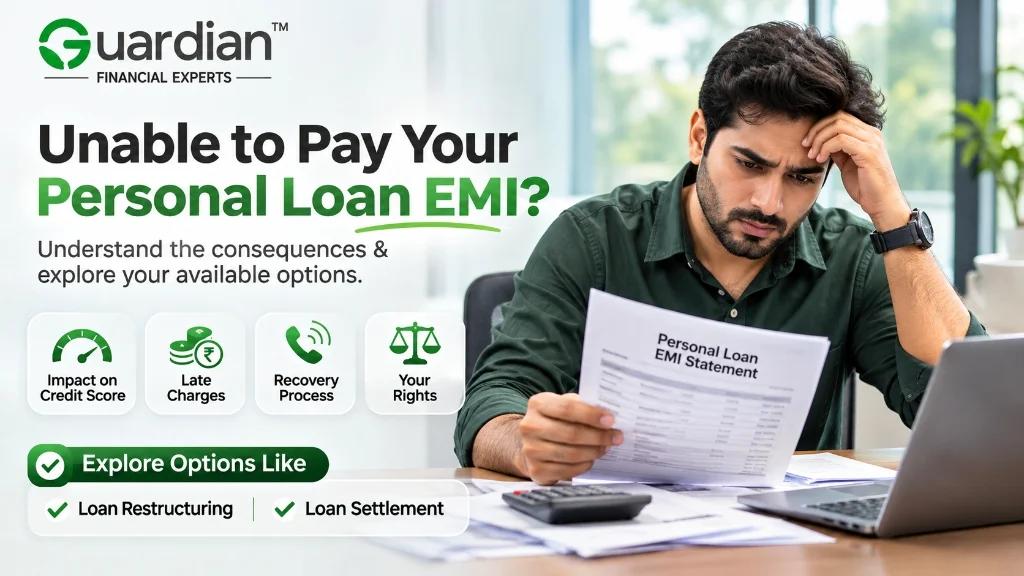
Taking a personal loan can provide urgent relief during life's critical moments—whether to cover medical treatments, higher education fees, family emergencies, or unexpected business cash-flow gaps. However, repaying hefty fixed EMIs month after month becomes difficult when sudden disruptions shake your financial stability.
Job layoffs, salary cuts, business insolvency, or health crises can suddenly push punctual borrowers into severe default. But what actually happens when you cannot pay your personal loan EMI in India?
Will your CIBIL score crash overnight? Can the bank send police or file criminal charges? Will recovery agents visit your office or call your relatives? Can you legally settle the debt for a reduced amount?
In this comprehensive guide, we dissect the statutory timeline of missed EMIs, your borrower rights under Reserve Bank of India (RBI) directives, and the practical resolution pathways available to regain debt-free peace of mind.
🛡️ Supreme Court Legal Truth: Inability to repay an unsecured personal loan due to genuine financial distress is purely a civil contractual dispute. The police have NO statutory power to arrest borrowers, and recovery agents cannot harass your family.
1. The Chronological Timeline: What Happens When You Miss EMIs
Lenders do not immediately initiate extreme measures on Day 1 of a missed payment. Banks and NBFCs operate under structured regulatory stages:
Stage 1: Day 1 to Day 30 (Minor Default / SMA-0)
- Late Payment & Penal Charges: The lender levies auto-debit bounce fees (NACH bounce) and late payment penalties.
- Soft Reminders: Automated reminder SMS, emails, and WhatsApp alerts prompt you to clear the overdue amount.
- Credit Bureau Reporting: The delayed payment is reported as 1–30 Days Past Due (DPD) to TransUnion CIBIL, causing an initial minor score decline.
Stage 2: Day 31 to Day 89 (SMA-1 & SMA-2)
- Escalated Follow-ups: In-house collection desks begin placing regular reminder calls.
- Compounding Interest: Overdue interest continues to accumulate on unpaid balances.
- Demand Notice: The lender may issue a preliminary written demand notice requesting prompt clearance.
Stage 3: Day 90+ (Non-Performing Asset - NPA Classification)
- Under RBI prudential norms, if a personal loan EMI remains unpaid for more than 90 days, the account is formally reclassified as a Non-Performing Asset (NPA).
- External Recovery Assignment: The debt file is frequently transferred to third-party recovery agencies empanelled by the bank.
- Formal Legal Recourse: The bank's legal counsel may dispatch statutory demand notices under Section 138 of the Negotiable Instruments Act (if security cheques were dishonored) or Section 25 of the Payment and Settlement Systems Act (for bounced e-mandates).
2. How Missed EMIs Impact Your CIBIL Score
Your repayment track record contributes to approximately 35% of your total credit score. When you miss payments, the reporting mechanisms trigger immediate impacts:
| Default Duration | CIBIL Report Status | Expected Score Impact |
|---|---|---|
| 1 Missed EMI (1–30 DPD) | Overdue reported in payment history grid | 15 to 40 point drop (recoverable quickly) |
| 2–3 Missed EMIs (31–89 DPD) | Special Mention Account (SMA) record | 50 to 90 point drop; credit card limits reduced |
| 90+ Days (NPA) | Sub-standard / Doubtful / Loss asset | Score drops below 600; fresh unsecured loans blocked |
Important note: While missing EMIs harms your score, maintaining delinquent accounts in open default causes perpetual ongoing damage. Resolving the account through a formal One-Time Settlement (OTS) permanently caps the negative reporting, opening the door for structured CIBIL rehabilitation back to 750+ within 12–18 months.
3. RBI Guidelines on Penal Charges (Fair Lending Practice)
In the past, lenders frequently penalized stressed borrowers by levying compounding penal interest on top of overdue interest. Under the RBI's updated circular on Fair Lending Practice – Penal Charges in Loan Accounts:
- Penalty as Charges, Not Interest: Lenders cannot levy "penal interest" that compounds the debt. Penalties must be charged as transparent, flat administrative penal fees.
- No Capitalisation: Penal charges cannot be added back to the principal balance to generate further interest.
- Reasonable and Non-Discriminatory: Charges must follow a board-approved policy and cannot be arbitrarily inflated.
4. Recovery Agents: Know Your Rights Under RBI Fair Practices Code
When collection agencies contact you, remember that you have legal rights. The RBI has placed strict vicarious liability on banks and NBFCs for the conduct of outsourced recovery personnel:
What Recovery Agents CANNOT Legally Do:
- ❌ Call outside 8:00 AM to 7:00 PM: Night calls or early morning ringing are strictly illegal.
- ❌ Contact third parties: Agents are prohibited from calling your parents, relatives, employer, or colleagues to cause social shame.
- ❌ Use abusive language or intimidation: Verbal abuse, physical threats, or shouting violates criminal laws.
- ❌ Send fake police warrants or court summons on WhatsApp: Impersonating police or sending fake court seals is a cognizable criminal offense under Sections 419, 468, and 506 IPC.
- ❌ Refuse to show credentials: Agents must carry their official bank authorization letter and IIBF Certification.
If you face aggressive recovery tactics, read our specialized Anti-Harassment Legal Shield Guide to understand how our legal team issues formal cease-and-desist notices to stop harassment within 24 to 48 hours.
5. Can the Bank Take Legal Action for Unsecured Loan Default?
Because personal loans are unsecured, lenders have no physical collateral (like a home or car) to seize under SARFAESI. However, lenders can initiate statutory civil and quasi-criminal proceedings:
- Section 138 Negotiable Instruments (NI) Act: Triggered if physical post-dated security cheques given at disbursement bounce. Borrowers receive 15 days to reply upon receipt of notice.
- Section 25 Payment and Settlement Systems Act (PSSA): Applies to electronic NACH auto-debit dishonor.
- Civil Recovery Suit / Arbitration: Filing claims for recovery before an arbitrator or civil court. (Note: Under landmark Supreme Court rulings like Perkins Eastman, banks cannot unilaterally appoint their own sole arbitrator without your consent).
- National Lok Adalat: Quarterly court-sponsored mediation sessions where banks offer deep waivers (40% to 60%) to close bad loans permanently without court fees.
6. Practical Action Plan: What to Do If You Cannot Pay Your EMI
Step 1: Conduct a Debt-to-Income Audit
List all outstanding liabilities, interest rates, and household living expenses. Identify which loans are secured (must be protected) and which are unsecured (eligible for compromise negotiation).
Step 2: Cease Taking Fresh High-Interest Loans
Never take instant digital app loans or max out credit cards to service an existing EMI. This creates a destructive debt trap.
Step 3: Evaluate Loan Restructuring
If your financial distress is temporary and you have an active income, request the bank to extend the tenure (e.g. from 36 to 60 months) to reduce the monthly EMI.
Step 4: Explore a Formal One-Time Settlement (OTS)
If you have suffered an irreversible income loss and cannot service the full principal, engage experienced debt advisors to submit a formal One-Time Settlement (OTS) petition. Lenders waive accumulated penal fees and accept a reduced lump-sum or staggered payment to close the account permanently with an official No Dues Certificate (NDC).
Struggling with Unbearable Personal Loan EMIs?
Guardian Financial Experts evaluates your loan portfolio, shields you from recovery harassment, and negotiates legally binding compromise settlements directly with authorized bank committees.
Check Your Loan Settlement Eligibility →7. Critical Mistakes Borrowers Must Avoid
- Never Switch Off Your Phone Completely: Total disappearance may cause lenders to initiate trace investigations. Instead, keep communication written and routed through legal counsel.
- Never Hand Over Physical Cash to Recovery Agents: Genuine bank representatives never accept cash without an instant official computerized receipt. All settlement funds must be remitted directly to your loan account.
- Never Agree to Oral Promises: If an agent says "Pay ₹50,000 today and we will close your ₹2,00,000 loan", demand the official Settlement Sanction Letter on bank letterhead before paying a single rupee.
- Do Not Panic Over WhatsApp Notices: Real legal notices arrive via Speed Post, Registered AD, or verified bank email domains—not random mobile numbers.
Frequently Asked Questions (FAQs)
1. Can the bank send police to my home for personal loan default in India?
No. Personal loan default is a civil contractual breach. The police have no statutory power to interfere, register an FIR, or arrest you for inability to pay an unsecured loan due to genuine financial insolvency.
2. How many EMIs can I miss before my account becomes an NPA?
Under RBI guidelines, term loan accounts are classified as Non-Performing Assets (NPAs) after remaining overdue for more than 90 consecutive days.
3. Can I settle my personal loan if I have already received a legal notice?
Yes. In fact, receiving a legal notice is often the ideal stage to settle. Most banks prefer recovering a guaranteed settlement sum out of court rather than pursuing protracted litigation that costs them time and legal fees.
4. How much waiver can I expect in a personal loan settlement?
Depending on the age of default, genuine hardship proof, and lender policies, borrowers typically achieve waivers ranging from 40% to 65% off their total accumulated dues.
5. Will settling my loan stop recovery agent calls?
Yes. Once a formal settlement agreement is executed and the sanctioned settlement payment is remitted, the lender issues a binding No Dues Certificate, which legally closes the file and terminates all collection agency mandates.
Regain Financial Peace with Guardian Financial Experts
Defaulting on a personal loan does not make you a criminal—it makes you a borrower facing economic hardship. With professional guidance, you can protect your dignity, exercise your borrower rights, and settle debt on equitable terms.
Get Confidential Legal & Financial Help Today
Speak directly with our senior debt settlement advisors to evaluate your personal loans and put an immediate stop to recovery harassment.
Disclaimer: This article is published for educational and awareness purposes under Indian banking regulations and does not constitute statutory legal advice. Loan settlement and restructuring outcomes depend upon respective bank policies and individual hardship evaluation.
Explore Bank-Specific Resolution & Debt Relief Services
Facing debt recovery notices, escalating interest, or multiple EMI defaults? Navigate our authoritative settlement guides and legal resolution procedures tailored for Indian borrowers:
HDFC Bank Loan Settlement
Personal loan & credit card OTS procedures, waiver rules, and recovery resolution.
SBI Loan Settlement Process
State Bank of India compromise settlement, NPA resolution, and Lok Adalat guidelines.
ICICI Bank Loan Settlement
Resolution for overdue credit cards, personal loans, and third-party recovery defense.
Bajaj Finance Debt Settlement
NBFC overdue loan settlement, bounce charges negotiation, and NDC documentation.
Credit Card Settlement Services
Stop 40%+ compounding APR and settle high-balance credit cards with structured waivers.
Personal Loan Settlement
Resolve multiple unsecured loans, fintech apps, and salary defaults with legal protection.
Anti-Harassment Legal Support
Enforce RBI fair practice code to halt abusive recovery calls, threats, and illegal visits.
CIBIL & Credit Score Improvement
Step-by-step roadmap to rebuild credit rating from 'Settled' status back to 750+.
Every loan case is unique. If you are experiencing EMI pressure or receiving recovery notices, our team is available for a confidential consultation.