
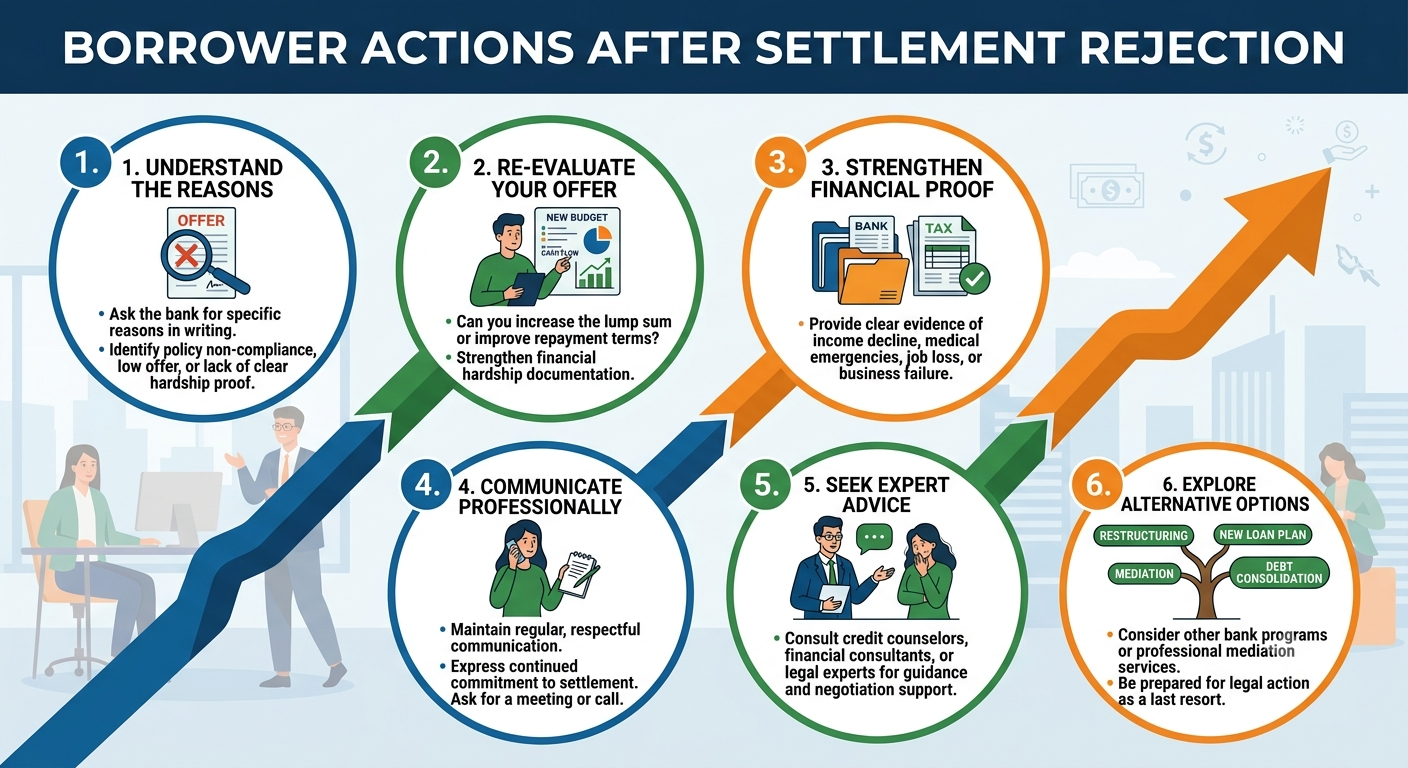
Facing default or severe financial distress can lead borrowers to seek a One-Time Settlement (OTS) with their bank. However, submitting a settlement request does not guarantee instant approval. Credit committees regularly reject initial compromise proposals if the offered amount appears too low, if hardship proof is insufficient, or if the bank suspects the default is intentional.
If your lender turns down your hardship settlement application, do not panic. A rejection is rarely the final word—it is simply a signal to refine your strategy, upgrade your evidence, and re-engage through formal regulatory channels.
Step-by-Step Recovery Plan After a Settlement Rejection
+-------------------------------------------------------------------------------+
|                    SETTLEMENT REJECTION RESPONSE WORKFLOW                     |
+-------------------------------------------------------------------------------+
| Step 1: Analyze the Written Rejection & Audit Bank Objections                 |
| Step 2: Reinforce Hardship Evidence & Financial Statements                    |
| Step 3: Revise the Lump-Sum Settlement Counter-Offer                          |
| Step 4: Escalate to Nodal Officers & Banking Ombudsman (If Needed)            |
| Step 5: Engage Professional Legal & Financial Representation                  |
+-------------------------------------------------------------------------------+
1. Analyze the Written Rejection Reason
Before taking any action, request written clarification from your lender regarding why the offer was declined. Lenders typically reject proposals for three primary reasons:
- Low Offer Amount: The proposed compromise sum falls below the bank’s internal threshold for the asset type.
- Inadequate Hardship Proof: The documentation failed to prove that non-payment was involuntary.
- Unclear Financial Position: Bank audits reveal active accounts, income sources, or secondary assets that suggest repayment capacity.
2. Reinforce Your Hardship Evidence Dossier
If your initial application lacked compelling evidence, build a more thorough financial dossier. Gather objective, unassailable proof showing prolonged financial distress, such as:
- Formal layoff letters, pink slips, or business closure certificates.
- Audited profit and loss statements showing sustained commercial losses.
- Medical discharge summaries, diagnostic reports, and hospital bills.
- 6 to 12 months of bank account statements verifying zero liquid savings.
3. Re-Evaluate and Revise Your Counter-Offer
If the bank rejected your proposal purely on monetary grounds, evaluate whether you can marginally increase your offer. You do not need to meet their full demand; increasing your offer by 5% to 10% demonstrates good faith while keeping the compromise within your reach. Consider sourcing funds through family assistance, personal asset liquidation, or provident fund withdrawals.
4. Escalate to Higher Banking Authorities
If branch-level managers remain uncooperative despite clear evidence of hardship, escalate your appeal to senior executive levels:
- Principal Nodal Officer (PNO): Write a formal grievance letter detailing your genuine willingness to settle and the branch’s refusal to consider fair terms.
- Banking Ombudsman: If you experience unfair treatment, harassment, or a complete lack of response, file an official grievance under the regulatory framework of the Reserve Bank of India (RBI).
Understanding Rejection Reasons and Action Plans
| Rejection Trigger | Root Cause | Best Remedial Action |
| Offer Below Minimum Floor | Proposed sum is too low | Increase offer marginally using family/savings support |
| Insufficient Hardship Proof | Missing legal/financial records | Submit audited ITRs, medical bills, or layoff proof |
| Suspected Willful Default | Active cash flow detected | Provide 6-month statements showing genuine lack of funds |
| Communication Breakdown | Recovery agents blocking access | Escalate proposal directly to the Principal Nodal Officer |
Essential Resources for Navigating Rejections
Overcoming a bank’s rejection requires technical financial expertise, legal advocacy, and strategic diplomacy. Use these resources to guide your appeal process:
- Re-evaluate your appeal strategy by consulting a recognized loan settlement expert.
- Explore structured options for personal, business, and credit card debts via loan settlement services.
- Learn how to calculate acceptable compromise percentages using complete loan settlement guides.
- Protect yourself from recovery harassment following a rejection by hiring a loan settlement agency.
- Review your hardship documentation and appeal letters with an accredited loan settlement expert.
- Eliminate unfair penal charges and negotiate revised terms through specialized loan settlement services.
- Manage bank legal notices and tribunal escalation supported by an established loan settlement agency.
- Understand the step-by-step process of appealing rejected applications through expert loan settlement advice.
- Safeguard your rights under regulatory guidelines with aid from a skilled loan settlement expert.
- Obtain institutional representation and escalation support using dedicated loan settlement services.
- Secure an official written Sanction Letter and No Dues Certificate (NDC) with help from a reputable loan settlement agency.
Final Thoughts
A bank’s initial rejection of a settlement proposal is rarely the end of the line. By understanding the lender’s objections, strengthening your financial evidence, making a reasoned counter-offer, and engaging expert advocates, you can turn a rejection into a successful compromise and clear your debt safely.