
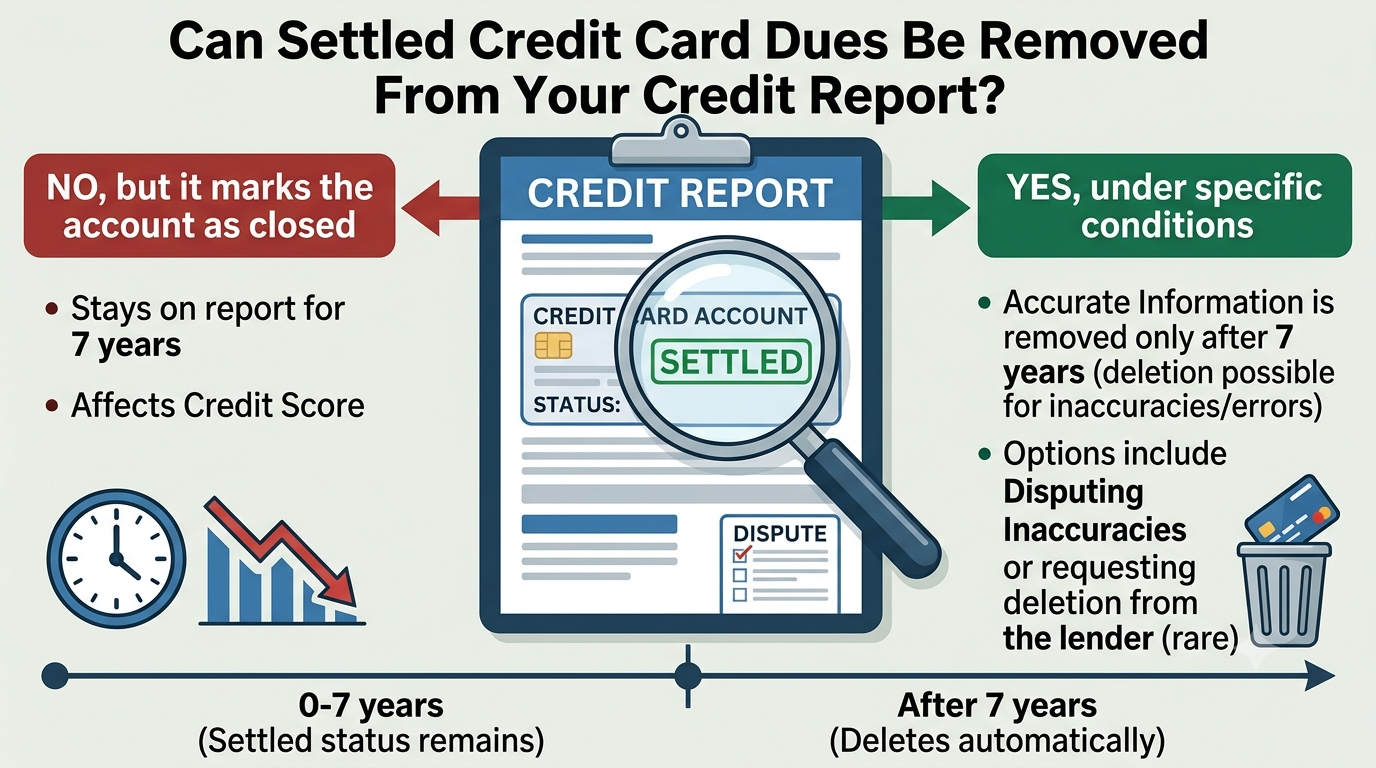
Resolving long-pending credit card debt through a One-Time Settlement (OTS) provides immediate emotional and financial relief. It halts recovery calls, waives penal charges, and stops interest from snowballing. However, once the settlement is completed, many borrowers encounter a lingering obstacle on their credit report: the dreaded “Settled” status.
Unlike accounts marked as “Closed” (which indicate complete repayment of dues), a “Settled” remark signifies that the lender accepted a reduced lump-sum payment and waived the remaining balance. Naturally, borrowers wonder: Can a settled credit card status be removed from a credit report, and if so, how?
Understanding the Reality of a “Settled” Status
When a credit card issuer agrees to a debt compromise, they report the exact transaction history to credit bureaus like CIBIL, Experian, and CRIF High Mark.
+-------------------------------------------------------------------------------+
|                       CREDIT REPORT STATUS COMPARISON                         |
+-------------------------------------------------------------------------------+
| Account Status | Meaning                                 | Credit Impact       |
+----------------+-----------------------------------------+---------------------+
| Closed         | Paid 100% of principal & interest dues  | Highly Positive     |
| Settled        | Paid reduced amount; waived portion     | Negative (3-7 yrs)  |
| Written Off    | Unpaid debt written off as total loss   | Severe Penalty      |
+----------------+-----------------------------------------+---------------------+
Credit bureaus reflect factual historical records. Because a settlement accurately shows that a balance was waived rather than paid in full, a legitimate “Settled” status cannot simply be erased or deleted via a dispute. Any agency claiming they can magically wipe an accurate “Settled” mark off your report without repayment is engaging in false promises.
How to Convert a “Settled” Status to “Closed”
While you cannot delete the historical record out of thin air, you can legally upgrade your credit status from “Settled” to “Closed” by clearing the balance that was previously waived.
Step 1: Request a Payoff Quote from Your Lender
Contact your original credit card issuer and ask for the exact waived amount (the shortfall between your settlement payment and the original total balance). Request a written quote confirming that paying this remaining principal balance will update your account status.
Step 2: Clear the Remaining Balance Dues
Pay the remaining outstanding amount directly to the bank. Retain all transaction receipts, payment acknowledgments, and bank statement proofs.
Step 3: Secure an Official No Dues Certificate (NDC)
Once the balance is cleared in full, demand an official No Dues Certificate (NDC) or NOC (No Objection Certificate) on bank letterhead. This document explicitly verifies that you no longer owe any money and that the account is fully closed.
Step 4: Bureau Reporting & Dispute Escalation
The bank must notify credit bureaus to update the account status to “Closed”. If the status remains unchanged after 30 to 45 days, file a dispute directly through bureau dispute portals with your NDC attached to force an update.
Rebuilding Your Credit Profile After Settlement
If you are unable to pay the remaining balance right away, you can still systematically rebuild your credit score over time:
- Maintain Zero Default Rate: Ensure every active account, utility bill, and existing EMI is paid on or before the due date.
- Get a Secured Credit Card: Apply for a credit card backed by a Fixed Deposit (FD). Use it for small purchases and pay the balance in full every month to generate fresh, positive credit history.
- Keep Utilization Below 30%: Keep your total credit utilization low across any active cards.
Professional Support and Guidance
Navigating bank communications, verifying balance calculations, and managing credit bureau disputes requires specialized expertise. Explore these dedicated resources for professional assistance:
- Consult a certified loan settlement expert to evaluate your credit report upgrade options.
- Explore comprehensive debt management and dispute assistance through loan settlement services.
- Learn how to structure debt resolution plans using complete loan settlement guides.
- Shield yourself from recovery issues and secure legal backing with a trusted loan settlement agency.
- Review your No Dues Documentation and bank correspondence with a recognized loan settlement expert.
- Negotiate fair terms for clearing previously waived dues using institutional loan settlement services.
- Resolve credit bureau status discrepancies supported by an experienced loan settlement agency.
- Understand the long-term impacts of debt resolution with expert loan settlement advice.
- Protect your financial rights during bank negotiations with guidance from a skilled loan settlement expert.
- Obtain complete administrative support for credit reporting updates through loan settlement services.
- Secure an official No Dues Certificate and clean closure letter through a dedicated loan settlement agency.
Final Thoughts
While a “Settled” status cannot be erased unlawfully, it is not a permanent financial roadblock. By either clearing the remaining balance to convert the remark to “Closed” or maintaining disciplined credit habits with secured credit instruments, you can overcome past settlements and rebuild a healthy credit profile.