
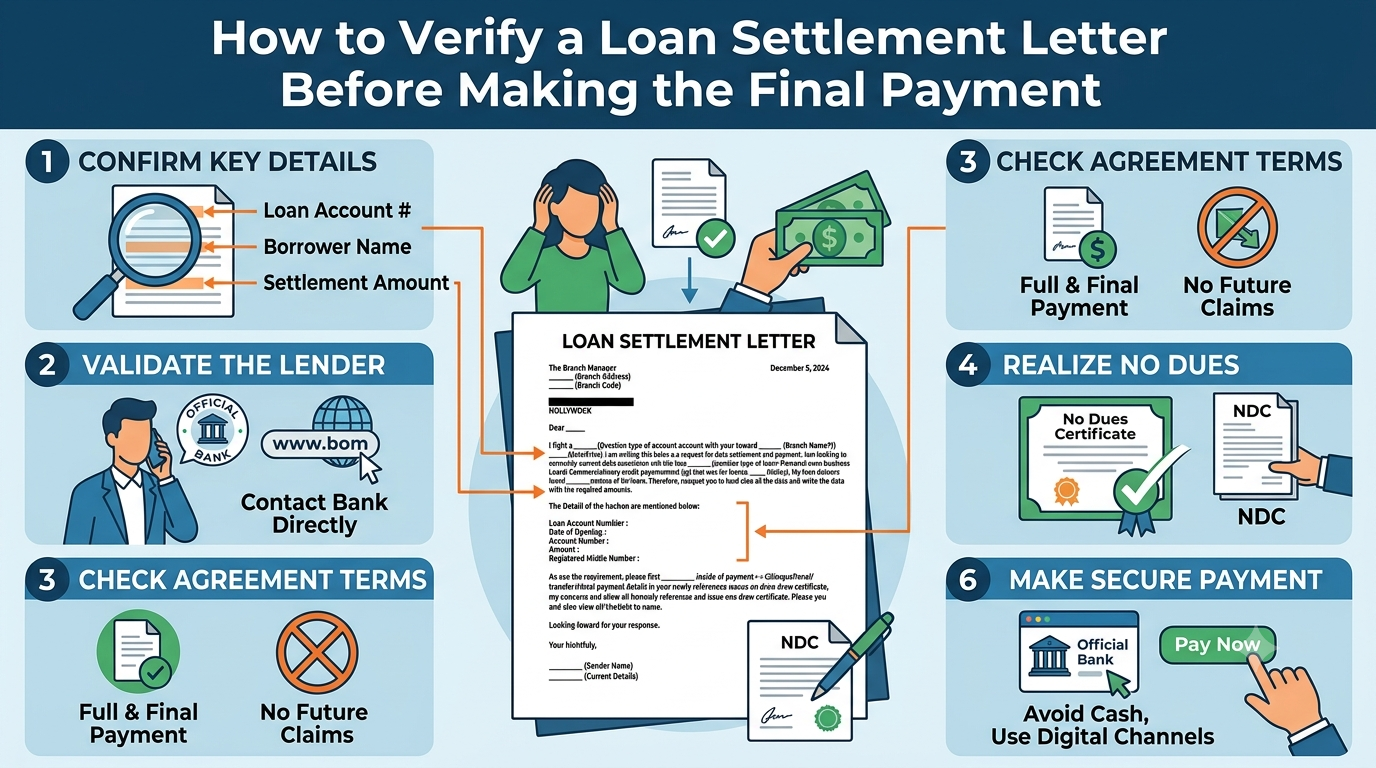
Reaching a One-Time Settlement (OTS) agreement with a bank or Non-Banking Financial Company (NBFC) is a major milestone for any borrower facing financial distress. However, depositing your hard-earned funds without thoroughly verifying the official Settlement Sanction Letter can lead to severe financial and legal complications.
Unscrupulous recovery agents sometimes issue fake settlement letters or verbal promises to collect partial payments, leaving the borrower with an active debt balance, ongoing penal interest, and potential legal notices. Learning how to authenticate a settlement letter before making your final payment is essential to protect your money and secure true financial freedom.
Step-by-Step Verification Checklist for Borrowers
Before transferring a single rupee or handing over a demand draft, run through this comprehensive checklist to ensure your settlement letter is legally binding.
+-------------------------------------------------------------------------------+
|                 SETTLEMENT LETTER VERIFICATION CHECKLIST                      |
+-------------------------------------------------------------------------------+
| Step 1: Check Official Letterhead, Stamp, and Authorized Signatures           |
| Step 2: Validate Account Details & Compromised Settlement Amount              |
| Step 3: Confirm Clear Discharge & No Dues Waiver Clauses                      |
| Step 4: Verify Payment Due Date & Specific Mode of Payment                    |
| Step 5: Direct Verification via Bank Branch or Nodal Officer                  |
+-------------------------------------------------------------------------------+
1. Inspect the Official Letterhead and Authorization
A valid settlement letter must be printed on official bank or NBFC letterhead, featuring the institution’s official logo, registered address, and Corporate Identification Number (CIN).
- Look for Signatures: It must be signed by an authorized signatory, such as a Branch Manager, Nodal Officer, or Credit Committee Head, and bear the official bank seal/stamp.
- Avoid Generic Notices: Letters sent via unverified personal emails, WhatsApp messages, or plain paper printed by external recovery agents are not legally binding contracts.
2. Confirm Accurately Stated Financial Terms
Cross-check every single figure mentioned in the document against your existing loan statements:
- Borrower & Account Identification: Ensure your full name, PAN number, and specific loan account number are 100% accurate.
- Outstanding vs. Settlement Amount: The letter must state both the current total outstanding balance and the agreed compromised settlement figure.
- Explicit Waiver Terms: Verify that the letter explicitly mentions the waiver of accumulated penal interest, late fees, and bounce charges.
3. Look for the “Full and Final Settlement” Clause
The wording of the letter dictates your future legal liability. Ensure the text contains unambiguous phrasing confirming that the payment of the settlement amount constitutes a full and final discharge of all liabilities.
If the wording suggests that the payment is merely a “partial payment,” “token amount,” or “precondition for further negotiation,” do not make the payment. The bank could treat your payment as a standard EMI installment and demand the remaining balance later.
4. Check Payment Deadlines and Payment Channels
Sanction letters usually carry strict validity windows (typically 7 to 30 days).
- Payment Due Date: Ensure the deadline is realistic and gives you enough time to arrange funds.
- Direct Payment Channels: The letter should instruct you to pay directly into your official loan account via NEFT, RTGS, Demand Draft, or official payment portals. Never make payments into personal bank accounts of recovery agents or representatives.
5. Verify Directly with the Bank Nodal Officer
Before making the payment, visit the home branch or contact the Principal Nodal Officer of the bank. Show them the settlement letter and request an independent verification in their internal system. Once the branch confirms that the sanction letter is recorded in their central database, you can safely proceed with the remittance.
Red Flags vs. Authentic Settlement Letters
| Feature | Authentic Settlement Letter | Suspicious / Fake Letter |
| Format | Official letterhead with bank seal & signature | Plain paper, text message, or unverified email |
| Payment Recipient | Bank’s official loan account / DD | Personal account or agent’s UPI ID |
| Language | Explicit “Full & Final Discharge” clause | Ambiguous “Partial Payment” phrasing |
| System Record | Verified in bank’s internal portal | Unrecorded in central banking system |
Essential Resources for Borrower Protection
Navigating complex banking documentation, avoiding fraudulent settlement traps, and negotiating fair waiver terms requires technical financial knowledge. Explore these specialized resources for legal and administrative guidance:
- Verify the legal terms of your sanction letter with a certified loan settlement expert.
- Explore end-to-end negotiation and legal verification through professional loan settlement services.
- Learn how to structure debt compromise agreements using comprehensive loan settlement guides.
- Protect yourself against recovery harassment and fake offers by partnering with a trusted loan settlement agency.
- Review your financial hardship proposal and bank letters alongside an accredited loan settlement expert.
- Eliminate unfair penal charges and secure authenticated waivers through specialized loan settlement services.
- Escalate fraudulent notices and handle bank legal communications with support from an established loan settlement agency.
- Understand bank credit committee workflows and verification protocols with professional loan settlement advice.
- Safeguard your personal assets and secure written discharge guarantees from a skilled loan settlement expert.
- Obtain institutional representation and documentation audits via professional loan settlement services.
- Achieve complete legal closure and obtain your official No Dues Certificate (NDC) with an experienced loan settlement agency.
Final Thoughts
A loan settlement letter is your primary legal protection against future debt claims. By systematically verifying its letterhead, financial terms, discharge clauses, and bank system records, you ensure that your payment provides genuine debt relief and paves the way for a smooth financial recovery.