
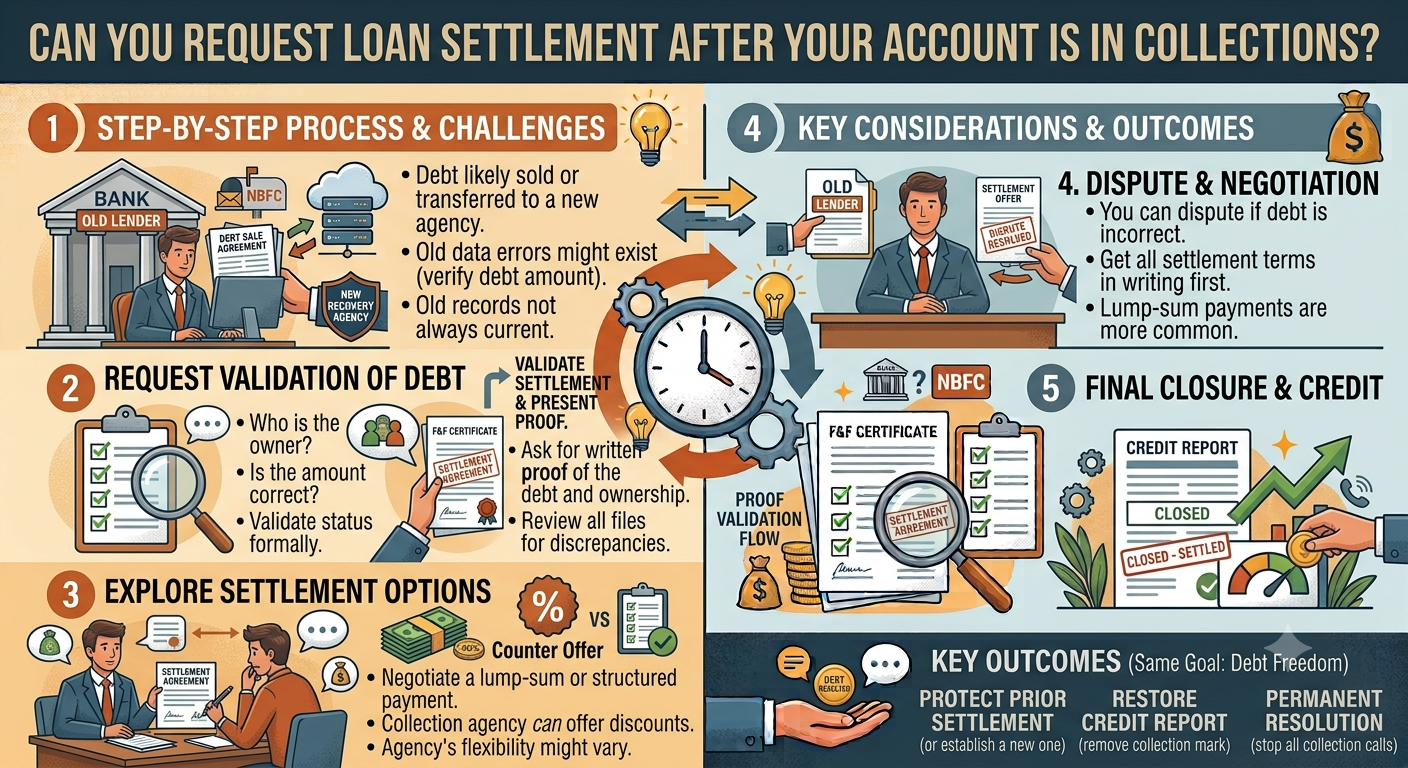
When a borrower defaults on loan Equated Monthly Installments (EMIs) or credit card dues, banks and Non-Banking Financial Companies (NBFCs) eventually shift the account from routine recovery to their collections department or third-party collection agencies. The sudden arrival of aggressive phone calls, field agent visits, and formal demand letters often makes borrowers panic, leading them to believe that all options for negotiation are off the table.
If your defaulted loan has been handed over to collections, a critical question arises: Can you still request a One-Time Settlement (OTS), or is it too late?
The short answer is yes. In fact, when an account reaches the collections phase, it enters one of the most opportune windows for negotiating a negotiated loan settlement with your lender.
Why Accounts Are Handed Over to Collections
Understanding why lenders assign defaulted accounts to collections helps demystify the process and gives you leverage during negotiations:
+-------------------------------------------------------------------------------+
|                    ACCOUNT HANDOVER & SETTLEMENT TIMELINE                     |
+-------------------------------------------------------------------------------+
| 1-30 Days Overdue   --> Soft Reminders & Late Payment Notices                   |
| 31-90 Days Overdue  --> In-House Collections & Tele-Calling Escalation          |
| 90+ Days Overdue    --> NPA Classification; External Agency Handover            |
| 90-180+ Days        --> OTS Window Opens; High Incentive for Recovery Compromise |
+-------------------------------------------------------------------------------+
When an account remains overdue past 90 days, banking guidelines require the lender to classify it as a Non-Performing Asset (NPA). Carrying NPAs forces financial institutions to allocate regulatory capital into provisions, locking up funds that could otherwise be used for active lending.
To clean up their balance sheets and avoid expensive, drawn-out litigation, banks delegate recovery tasks to specialized collections panels or third-party agencies. Because these recovery teams operate on recovery-linked incentives, they are strongly motivated to facilitate a One-Time Settlement (OTS) if a realistic lump-sum recovery offer is presented.
How to Negotiate a Loan Settlement During Collections
Navigating collections requires a structured, cautious strategy to avoid falling for verbal promises or paying unverified third parties:
1. Shift Communication to Written Channels
Avoid making verbal commitments over phone calls with field recovery agents. Request that all settlement proposals, counter-offers, and official notices be delivered via official email or written correspondence on the lender’s letterhead.
2. Establish Involuntary Financial Hardship
Lenders require verifiable proof that your default was caused by genuine, involuntary financial distress—such as job loss, medical emergencies, or business downturns—rather than willful default. Compile a hardship dossier containing income tax returns, medical bills, pink slips, or bank statements to support your settlement request.
3. Deal Directly with Nodal Officers or Legal Managers
Third-party collection agents often act as intermediaries without formal authority to grant waivers. Whenever possible, escalate your hardship application directly to the bank or NBFC’s Nodal Officer, Recovery Manager, or internal legal desk.
4. Audit Your Account Statement for Unfair Penalties
Before finalizing any settlement figure, request an official Statement of Account (SOA). Distinguish your core principal balance from accumulated penal interest, bounce charges, and late fees. Aim for a 100% waiver of penal charges alongside a fair discount on the core principal balance.
5. Demand an Official Settlement Sanction Letter
Never deposit money based on verbal assurances or WhatsApp messages from recovery agents. Payment should only be made after the bank or NBFC issues an official Settlement Sanction Letter explicitly detailing the agreed sum, payment due date, and confirmation of full legal discharge upon receipt of funds.
Collections Handover: Soft Collections vs. Agency Settlement
| Feature | Pre-NPA / Soft Collections | Post-Handover Agency Collections |
| Primary Contact | In-house tele-callers | External agency / Internal legal team |
| Account Status | Special Mention Account (SMA) | Non-Performing Asset (NPA) / Write-off |
| Settlement Incentive | Low (Bank expects full recovery) | High (Bank seeks fast capital recovery) |
| Penal Charge Waivers | Partial / Minimal | Up to 100% Waiver |
Helpful Resources for Managing Collections and Debt Resolution
Managing collection agents, auditing statement charges, and securing written sanction letters require specialized guidance and legal protection. Explore these dedicated resources for expert support:
- Evaluate your options when dealing with recovery agents with a certified loan settlement expert.
- Stop recovery harassment and negotiate structured waivers through loan settlement services.
- Learn how to handle collection agency demands using complete loan settlement guides.
- Protect yourself from improper recovery tactics by partnering with a trusted loan settlement agency.
- Review your collection notices and statement charges alongside an accredited loan settlement expert.
- Eliminate illegal bounce fees and negotiate principal discounts through specialized loan settlement services.
- Manage legal notices and arbitration threats supported by an established loan settlement agency.
- Understand Reserve Bank of India (RBI) Fair Practices Codes with professional loan settlement advice.
- Safeguard your legal rights during collection escalations with direct help from a skilled loan settlement expert.
- Obtain institutional representation and direct bank escalation via dedicated loan settlement services.
- Secure your official No Dues Certificate (NDC) and full legal discharge with an experienced loan settlement agency.
Final Thoughts
Having your defaulted loan handed over to collections is not the end of the road—it is often the catalyst that makes lenders willing to negotiate. By documenting your financial hardship, insistence on written sanction letters, dealing with authorized officers, and obtaining a formal No Dues Certificate, you can successfully negotiate a fair One-Time Settlement and permanently resolve your debt.