
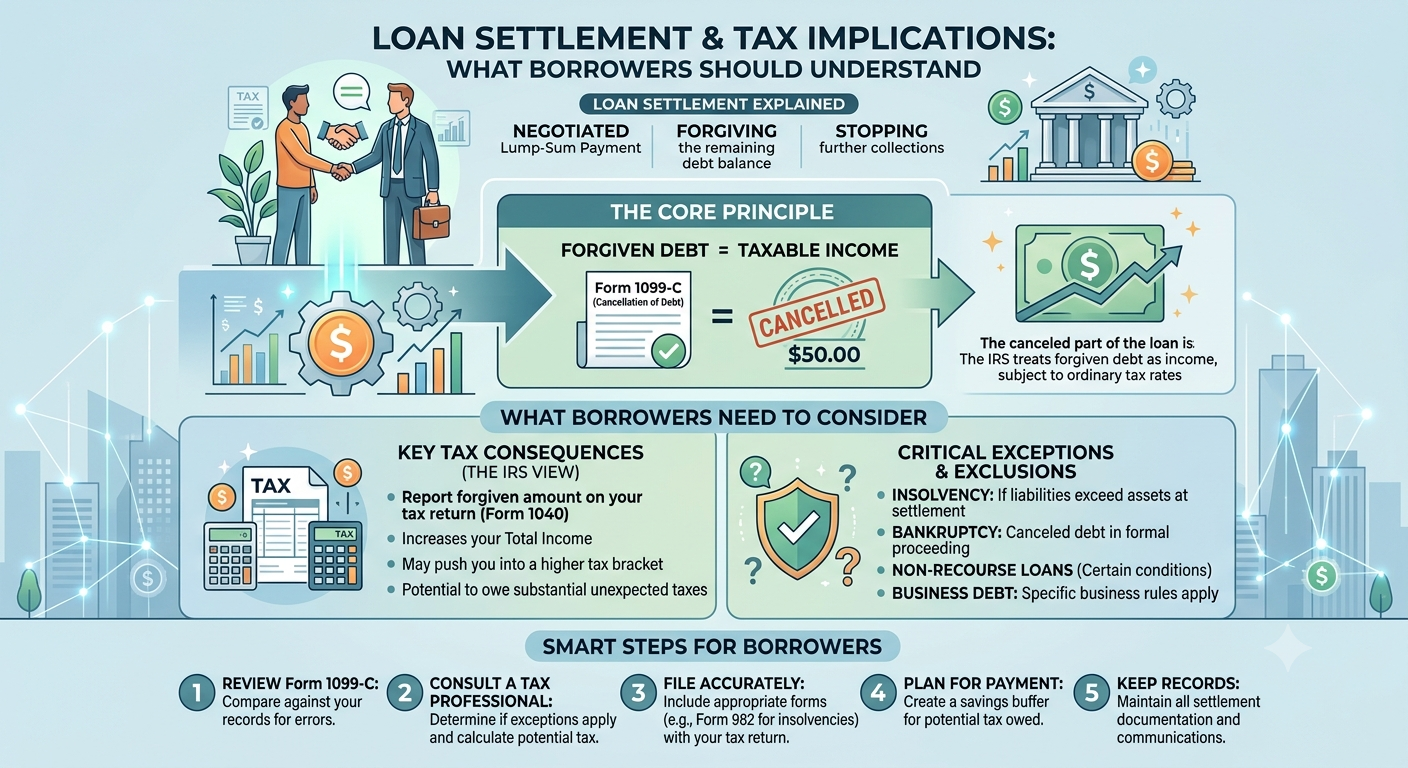
Facing severe financial distress often leaves borrowers with a single realistic path to debt relief: a One-Time Settlement (OTS). Through an OTS, banks or Non-Banking Financial Companies (NBFCs) agree to accept a lump sum lower than the total outstanding balance, writing off the remaining principal, interest, and penal charges.
While loan settlement provides immediate relief from debt traps and collection demands, many borrowers overlook the secondary financial aftermath: the potential tax implications of a written-off loan balance.
Understanding how tax authorities view forgiven debt, how the nature of your loan impacts tax liability, and how to report your settlement correctly is vital to preventing unexpected tax notices.
Is Settled or Forgiven Debt Taxable in India?
In many international jurisdictions (such as the US under IRS regulations), canceled debt is explicitly treated as taxable income. In India, the taxability of a loan settlement depends strictly on the purpose of the loan and whether it is classified as a capital receipt or a revenue receipt under the Income Tax Act, 1961.
+-------------------------------------------------------------------------------+
|                   LOAN SETTLEMENT TAXABILITY BREAKDOWN                        |
+-------------------------------------------------------------------------------+
| Loan Purpose           | Tax Classification    | Taxable Status               |
| Capital Assets / Personal| Capital Receipt       | Non-Taxable (General Rule)   |
| Working Capital / Operations| Revenue Receipt / Remission| Taxable under Sec 41(1) / 28 |
| Unclaimed Deducted Interest| Revenue Addition      | Taxable under Sec 41(1)      |
+-------------------------------------------------------------------------------+
The tax treatment of a loan waiver hinges on two distinct components: the written-off principal and the waived interest charges.
1. Tax Implications on Written-Off Principal Amount
The taxability of forgiven principal depends on the original purpose for which the loan funds were utilized:
- Personal Loans, Credit Cards, and Consumer Loans: For individual borrowers, personal loans, home loans, and credit card balances are classified as capital obligations. The landmark Supreme Court ruling (CIT vs. Mahindra & Mahindra Ltd.) established that the waiver of a loan taken for capital purposes or personal obligations does not constitute a trading liability or operational profit. Consequently, a principal waiver on personal debt is generally treated as a capital receipt and is not taxable as regular income.
- Business Working Capital Loans: If a business or self-employed professional settles an overdraft, cash credit facility, or short-term working capital loan used for daily business operations, the waived principal amount changes its character. Under Section 41(1) and Section 28(iv) of the Income Tax Act, the remission or cessation of a trading liability is treated as a revenue benefit and can be taxed as business income in the year of settlement.
2. Tax Implications on Waived Interest and Penalties
The interest component of a settled loan receives different tax scrutiny based on past tax filings:
- If Interest Was Previously Claimed as a Tax Deduction: If a business or individual claimed tax deductions on accrued interest in previous Assessment Years (e.g., under home loan interest deductions or business expenditure), the waived interest amount becomes taxable under Section 41(1). Because a tax benefit was already enjoyed, the forgiven amount must be added back to taxable income.
- If Interest Was Never Claimed as a Deduction: For personal loans or credit cards where interest was never claimed as a tax deduction, the waiver of accumulated interest and late fees carries no additional tax burden.
Key Steps to Manage Tax and Legal Risks During Settlement
To safeguard yourself from unexpected tax demands or regulatory discrepancies after completing a loan settlement, follow these essential steps:
- Audit Your Statement of Account (SOA): Obtain an official SOA from the lender to clearly separate the forgiven principal from waived interest and penal charges.
- Secure a Comprehensive Sanction Letter: Never make a settlement payment without an official Settlement Sanction Letter on the bank’s letterhead stating that the accepted sum covers all outstanding liabilities.
- Obtain a No Dues Certificate (NDC): After depositing the agreed sum, secure an official NDC confirming zero balance status to prevent future claims by recovery agencies or tax auditors.
- Consult a Tax Professional for Business Debt: If you are a business owner settling operational loans, consult a Chartered Accountant to classify the waiver correctly in your books of accounts and Income Tax Returns (ITR).
Comparison: Personal vs. Business Loan Settlement Taxability
| Parameter | Personal Loan / Credit Card Settlement | Business Working Capital Loan Settlement |
| Nature of Receipt | Capital Receipt | Revenue Receipt / Cessation of Liability |
| Taxability of Principal | Not Taxable (General Rule) | Taxable under Section 41(1) / 28(iv) |
| Taxability of Waived Interest | Not Taxable (if unclaimed) | Taxable if previously claimed as deduction |
| Governing Supreme Court Case | CIT vs. Mahindra & Mahindra | CIT vs. TV Sundaram Iyengar & Sons |
Essential Resources for Loan Settlement and Tax Planning
Navigating bank negotiations, auditing settlement tax liability, and securing valid discharge letters require specialized expertise. Explore these dedicated resources for assistance:
- Evaluate your loan settlement tax exposure with a certified loan settlement expert.
- Explore structured compromise strategies for high-balance loans via loan settlement services.
- Learn how to calculate realistic settlement percentages using comprehensive loan settlement guides.
- Protect your financial rights and stop recovery harassment through a trusted loan settlement agency.
- Review your loan statements and tax implications alongside an accredited loan settlement expert.
- Eliminate late fees and negotiate maximum principal discounts using specialized loan settlement services.
- Manage legal notices and regulatory compliance supported by an established loan settlement agency.
- Understand RBI guidelines and Income Tax Act provisions with professional loan settlement counsel.
- Safeguard your legal standing and resolve debt traps with direct help from a skilled loan settlement expert.
- Obtain institutional representation and direct bank escalations through dedicated loan settlement services.
- Secure your official No Dues Certificate (NDC) and full legal discharge with an experienced loan settlement agency.
Final Thoughts
While loan settlement provides a viable exit from severe debt, understanding its tax implications prevents surprise liabilities during tax filing season. By auditing your loan records, distinguishing capital waivers from revenue remission, obtaining formal sanction letters, and seeking expert tax guidance, you can successfully resolve your debt while staying fully compliant.