
When a borrower faces financial hardship—such as permanent job loss, medical emergencies, or severe business setbacks—missed Equated Monthly Installments (EMIs) quickly begin to multiply. Over several months or years of default, financial institutions tack on non-stop penal interest, compound interest, auto-debit bounce fines, and legal recovery charges.
As time passes, borrowers often discover that their total outstanding balance has doubled or even tripled—with accumulated interest charges far exceeding the original principal amount borrowed.
Facing a massive balance heavy with years of accrued interest can feel overwhelming. However, this situation actually gives you significant leverage during a One-Time Settlement (OTS). Understanding how banks treat aged interest charges—and how to negotiate strategically—ensures you settle your debt at a fair, manageable figure.
Understanding the Anomaly of Aged Interest
When an account enters long-term default, banks classify it as a Non-Performing Asset (NPA) and eventually write it off. Under central banking regulatory guidelines, lenders must stop recognizing uncollected interest as revenue once an account becomes an NPA.
+-------------------------------------------------------------------------------+
|                    ANATOMY OF AN AGED DEFAULT BALANCE                         |
+-------------------------------------------------------------------------------+
| [ Core Unpaid Principal ]  --> The actual money disbursed to you              |
| [ Standard Base Interest ] --> Accrued contract interest prior to default     |
| [ Penal Interest & Fines ] --> Excessive late fees, bounce fines, penalty APR |
+-------------------------------------------------------------------------------+
| GOAL IN SETTLEMENT: Strip 100% of Penal Charges + Negotiate Principal Discount|
+-------------------------------------------------------------------------------+
While system-generated statements continue to show compounding late fees and penal interest month after month, banks recognize that these inflated penalty balances are practically uncollectible. During compromise settlement negotiations, the credit committee’s primary goal is retrieving their original core principal capital, not collecting years of theoretical late fees.
Step-by-Step Strategy to Negotiate Heavy-Interest Loans
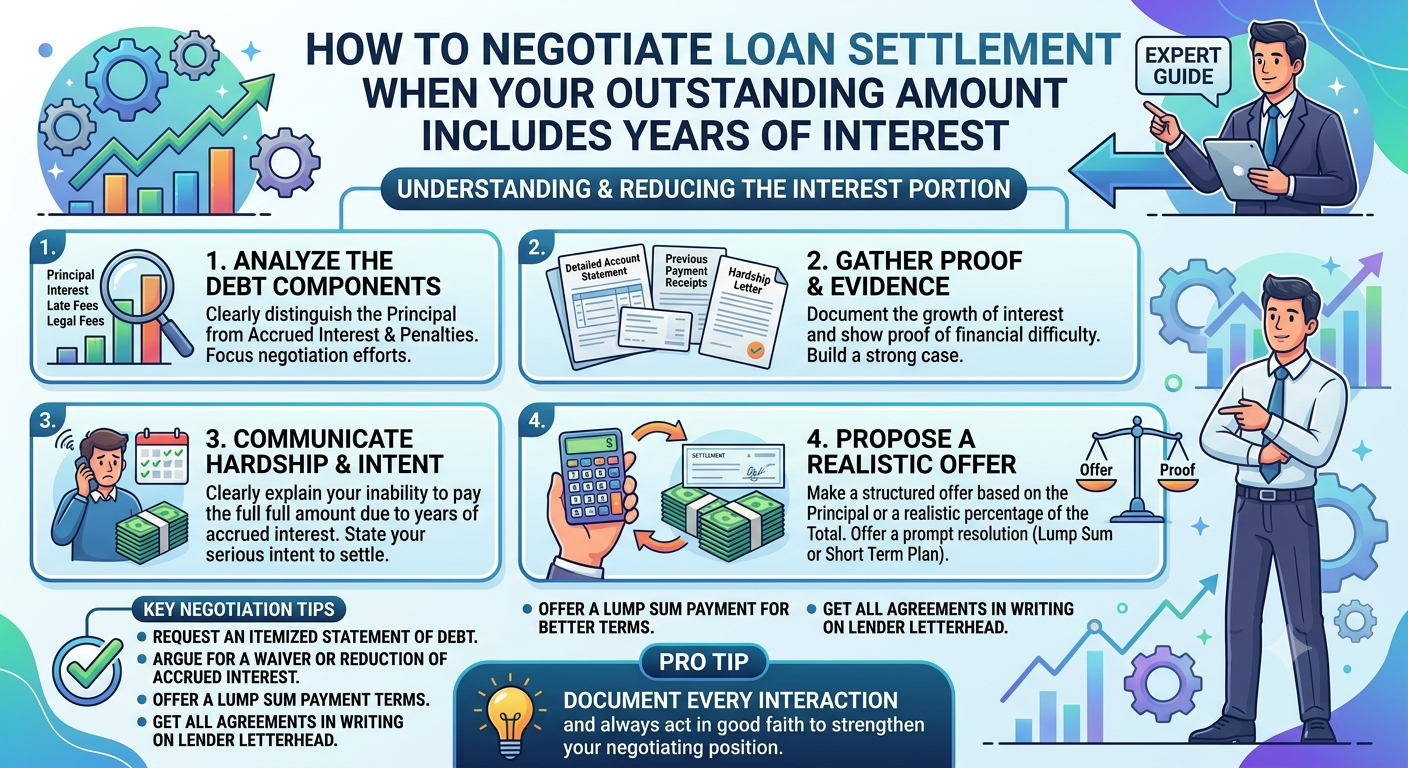
If you are ready to resolve a loan burdened by years of accumulated interest charges, follow these structured steps:
1. Audit Your Account with a Statement of Account (SOA)
Before opening negotiations or discussing numbers, demand an official, itemized Statement of Account. Carefully separate the numbers into three clear buckets:
- Original principal balance borrowed.
- Standard interest accrued prior to default.
- Accumulated penal interest, finance charges, and auto-debit bounce fees.
Your core position throughout negotiations should be a 100% waiver of all penal interest and late fees, using the actual unpaid principal as the sole baseline for your settlement offer.
2. Build a Documented Hardship Portfolio
Lenders do not grant heavy interest waivers without justification. Prepare a comprehensive hardship file containing income tax returns, bank statements, medical records, or termination notices that prove your default was completely involuntary. Establishing genuine, long-term inability to pay gives the credit committee the rationale required to approve substantial waivers.
3. Propose a Lump-Sum Settlement Based on Core Principal
Instead of negotiating off the inflated overall statement total, anchor your opening settlement offer as a percentage of the original principal balance. Depending on the age of the default and your hardship proof, initial lump-sum settlement offers typically range between 30% and 50% of the core principal amount.
4. Require an Official Settlement Sanction Letter
Never remit settlement funds based on verbal claims or informal messaging from collection agents. Always demand an official Settlement Sanction Letter printed on the bank’s official letterhead. Ensure the sanction letter clearly specifies that the agreed payment represents full and final resolution of the account, with all remaining interest, penalties, and balance claims completely waived.
Settlement Scope: Recent Default vs. Multi-Year Interest Default
| Feature | Recent Default (3–6 Months Overdue) | Multi-Year Interest Default (18+ Months Overdue) |
| Balance Composition | Mostly principal + minor late fees | Heavy penal interest & compounding fines |
| Penal Fee Waiver Potential | Partial (50% to 80%) | 100% waiver of all penal fees standard |
| Principal Discount Potential | Low to moderate | High (30% to 70% principal waivers common) |
| Primary Settlement Type | Short-term restructuring or OTS | One-Time Lump Sum Settlement (OTS) |
Essential Resources for Negotiating Loan Settlements
Auditing long-term statement calculations, removing years of accumulated penal charges, and securing binding legal release require specialized guidance. Explore these essential resources for expert assistance:
- Consult an experienced loan settlement expert to evaluate your statement of account and draft a principal-based settlement offer.
- Halt recovery pressure and negotiate 100% penal interest waivers through specialized loan settlement services.
- Understand compromise frameworks and negotiation steps using complete loan settlement guides.
- Protect your legal rights against aggressive collection efforts by partnering with a trusted loan settlement agency.
- Review your loan statements and penal charge breakdowns alongside a certified loan settlement expert.
- Eliminate compounding late fees and secure principal waivers using dedicated loan settlement services.
- Manage arbitration notices, legal summons, and formal closures supported by an established loan settlement agency.
- Learn about regulatory guidelines and borrower rights through informative loan settlement insights.
- Resolve high-interest credit card and unsecured personal loan traps with assistance from a skilled loan settlement expert.
- Obtain institutional representation during credit committee negotiations using specialized loan settlement services.
- Secure an official No Dues Certificate (NDC) and full legal discharge through a reputable loan settlement agency.
Final Thoughts
An outstanding balance inflated by years of interest and penalty fees can look intimidating, but you do not have to pay for years of uncollected fines. By auditing your statement of account, anchoring negotiations on the core principal, insisting on a formal settlement sanction letter, and seeking expert guidance, you can successfully settle your loan and move toward complete debt freedom.