
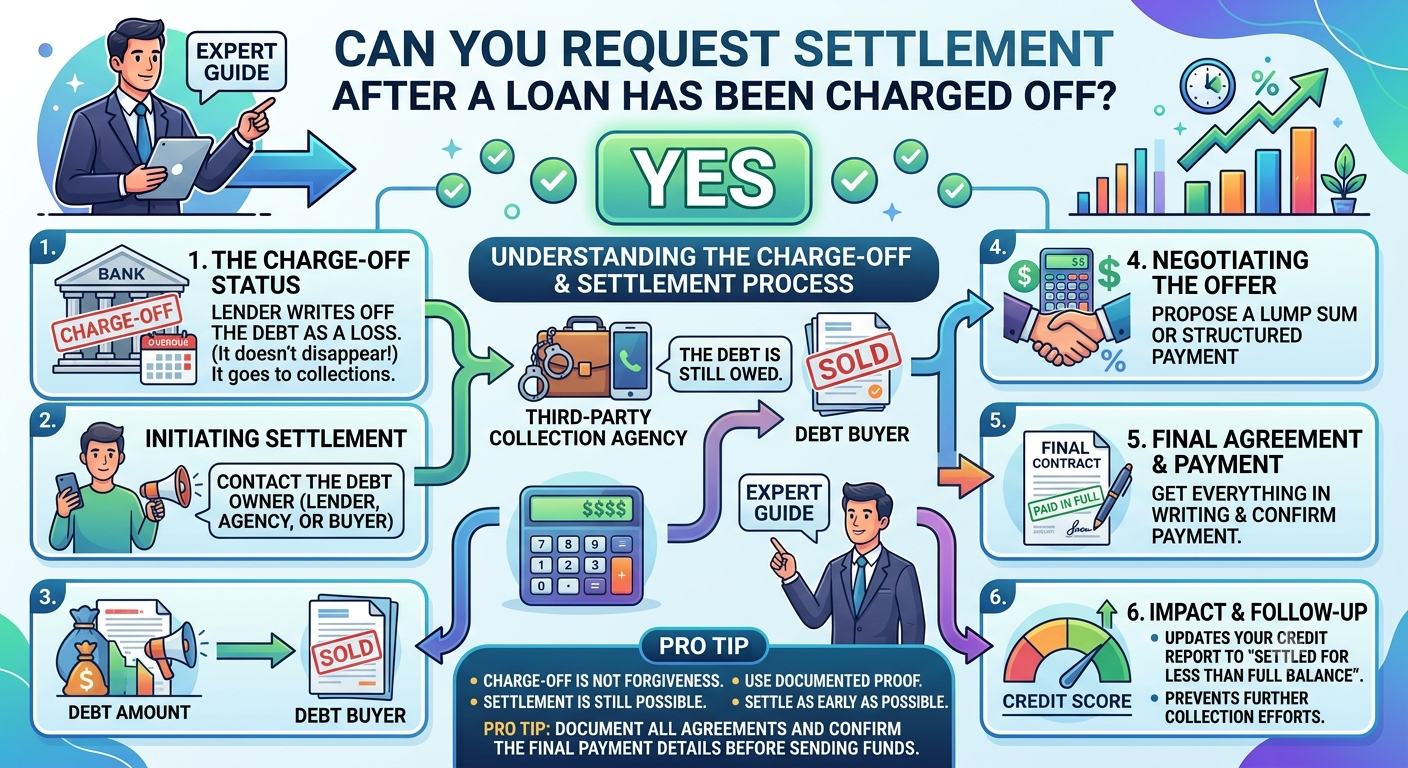
When a borrower experiences severe, long-term financial distress—such as permanent job loss, medical emergencies, or business failure—missed payments quickly pile up. Eventually, after months of missed Equated Monthly Installments (EMIs), the lender takes an accounting step and marks the account as a charged-off debt (or writes it off).
For many borrowers, seeing the term “Charged-Off” or “Written-Off” on an account statement or credit report creates immediate panic. A common question arises during this high-stress period: Can you still negotiate and request a loan settlement after your account has been charged off?
The short answer is yes. In fact, once an account is charged off, financial institutions are often far more open to accepting a discounted settlement than they were during the early days of default.
What Does “Charged-Off” Actually Mean?
There is a common misconception that a charge-off means your debt is canceled or forgiven. In reality, a charge-off is simply an accounting entry on the bank’s internal balance sheet.
+-------------------------------------------------------------------------------+
|                       THE CHARGE-OFF CYCLE                                    |
+-------------------------------------------------------------------------------+
| 1. Default Phase        --> 1 to 89 days overdue (SMA stages)                 |
| 2. NPA Classification   --> 90+ days overdue; interest income stops            |
| 3. Charge-Off / Write-Off--> 180+ days overdue; debt moved off balance sheet  |
| 4. Recovery Phase       --> Debt assigned to internal recovery or 3rd-party   |
+-------------------------------------------------------------------------------+
When an account reaches 180 days past due (or enters deep default), banking regulations require the institution to classify the loan as a loss asset and write it off from their active ledger. However, your legal obligation to repay the debt remains 100% active. The bank—or a third-party collection agency that purchases the debt—retains the full legal right to pursue recovery.
Why Lenders Are More Willing to Settle Charged-Off Debt
While a charge-off damages your credit profile, it actually gives you significant leverage when negotiating a compromise settlement. Here is why banks are willing to negotiate:
- Accounting Loss Already Recognized: Because the bank has already written off the asset and taken a tax loss, any funds recovered through a settlement go straight to their bottom line as a bad debt recovery.
- High Recovery Costs: Pursuing long legal battles in debt recovery tribunals or through civil litigation is expensive and time-consuming. Banks prefer a fast, guaranteed lump-sum cash settlement over uncertain court outcomes.
- Discounting Third-Party Agencies: Lenders often assign written-off portfolios to third-party recovery agencies or sell them to asset reconstruction companies at deep discounts. This creates substantial room for negotiating significant principal waivers.
How to Negotiate a Settlement for Charged-Off Loans
If you are ready to resolve a charged-off account, taking a structured, documented approach ensures you achieve the best financial outcome while protecting your legal rights:
1. Audit Your Account and Request a Statement of Account (SOA)
Before making any payment offers, request an official SOA. Review the breakdown to separate the original unpaid principal from accumulated penal interest, finance charges, and collection fees. When negotiating a charged-off account, your goal should be a 100% waiver of all penal interest alongside a 30% to 70% reduction in the core principal balance.
2. Verify Debt Ownership
Because charged-off accounts are frequently transferred or assigned to collection agencies, always verify who legally owns the debt. Ask for a formal Notice of Assignment before negotiating so you don’t inadvertently pay the wrong entity.
3. Prepare a Solid Hardship File
Banks require justification to approve heavy settlement discounts. Build a comprehensive hardship file containing income tax returns, medical records, or termination letters that prove your financial default was completely involuntary.
4. Secure an Official Settlement Sanction Letter
Never remit funds based on verbal promises or informal messaging from recovery agents. Always insist on a formal Settlement Sanction Letter printed on the official letterhead of the bank or asset reconstruction company. The letter must state that the agreed payment represents full and final resolution of the account with no remaining balance.
Active Loan vs. Charged-Off Loan Settlement
| Feature | Active Loan (0–89 Days Overdue) | Charged-Off Loan (180+ Days Overdue) |
|---|---|---|
| Bank Objective | Full EMI collection or restructuring | Capital retrieval & loss recovery |
| Waiver Potential | Very low | High (30% to 70% principal waivers common) |
| Primary Approach | Tenure extension / missed fee waiver | One-Time Lump Sum Settlement (OTS) |
| Legal Status | Standard default notices | High risk of legal recovery notices |
Important Resources for Resolving Charged-Off Debt
Navigating charged-off loan negotiations, handling third-party recovery teams, and ensuring complete legal discharge requires specialized financial and legal guidance. Explore these essential resources for support:
- Consult a certified loan settlement expert to assess your charged-off debt and draft a proposal.
- Halt aggressive recovery practices and negotiate structured waivers through dedicated loan settlement services.
- Understand the step-by-step negotiation process using complete loan settlement guides.
- Protect your rights against legal notices and collection pressure with a trusted loan settlement agency.
- Review your account statement and penal fee calculations alongside an experienced loan settlement expert.
- Eliminate illegal bounce fees and secure principal waivers using professional loan settlement services.
- Manage court notices, arbitration, and debt assignments through an established loan settlement agency.
- Learn about regulatory frameworks and borrower rights via informative loan settlement insights.
- Resolve high-interest credit card and personal loan traps with assistance from a skilled loan settlement expert.
- Obtain institutional representation during lender discussions with comprehensive loan settlement services.
- Secure an official No Dues Certificate (NDC) and full legal discharge through a reputable loan settlement agency.
Final Thoughts
A charged-off status on your loan is not the end of the road—it is actually an opportunity to clear long-standing debt at a significantly reduced amount. By auditing your statement of account, verifying debt ownership, insisting on a formal settlement sanction letter, and seeking professional assistance, you can settle your charged-off loan and take a confident step toward financial recovery.