
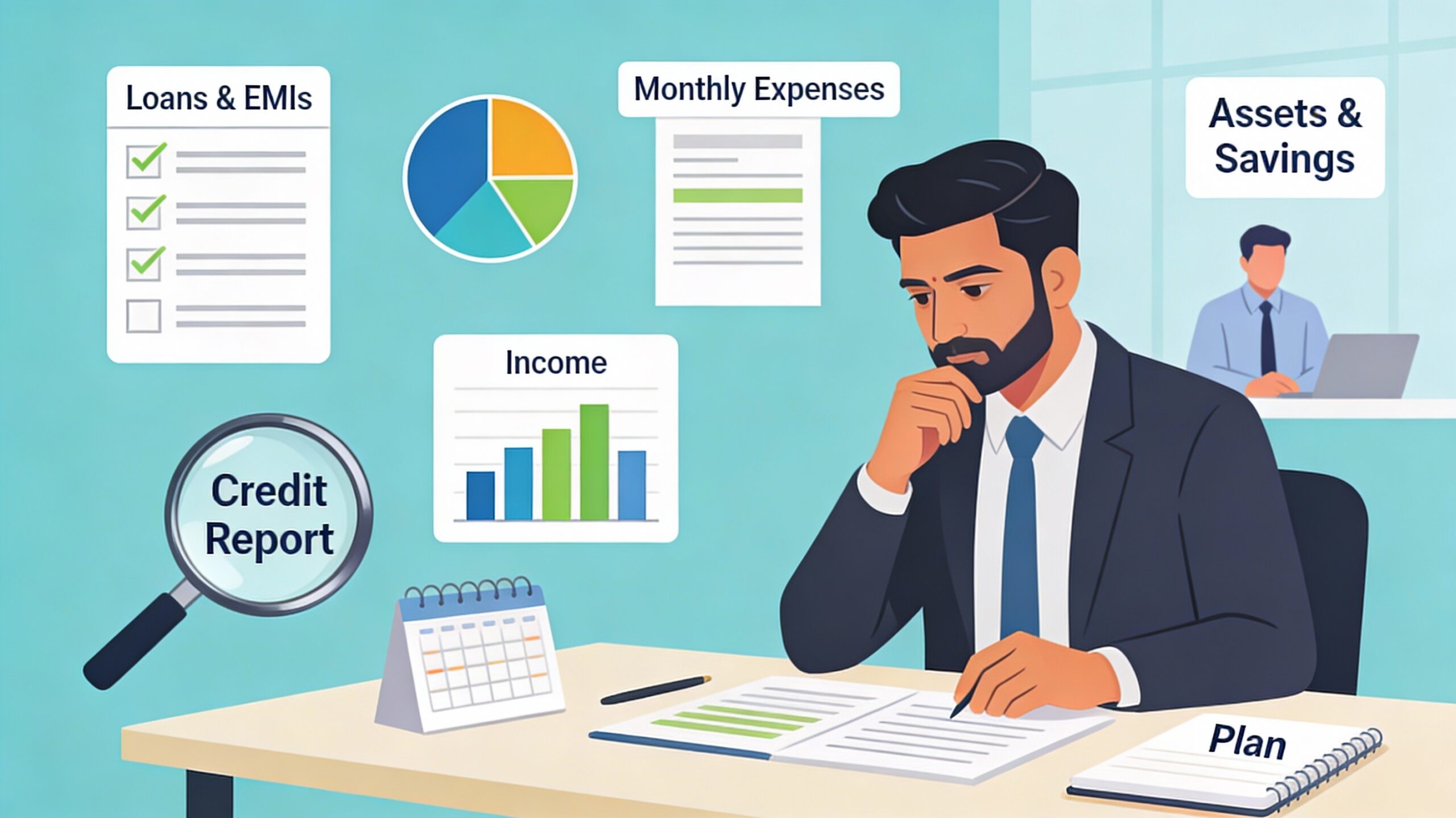
Step-by-step financial assessment before approaching a loan settlement expert ensures that the negotiation starts from a position of clarity, not panic. It also helps you decide whether settlement is truly the right option or if restructuring, balance transfer, or lifestyle changes could solve the problem instead.
Step 1: List All Your Loans and Dues
Begin by writing down every loan and credit line in one place. Include personal loans, business loans, credit cards, BNPL accounts, gold loans, and any informal borrowings you must honour.
- Create columns for lender name, type of loan, sanctioned amount, current outstanding, EMI, interest rate, and tenure remaining.
- Mark which accounts are regular, overdue (30–89 days), and those that may soon become NPAs (90+ days overdue), as these usually attract harsher recovery and can be priority candidates for settlement.
Step 2: Map Your Income and Its Stability
Next, examine how much money actually comes in and how predictable it is. For salaried individuals, this is easier; for business owners or freelancers, it needs more realistic averaging.
- Note all sources of income: salary, business profit, rental income, side gigs, and any support from family that you are sure about.
- Check how stable each source is over the next 6–12 months; this helps set a realistic budget for any lump-sum or structured settlement you might later negotiate.
Step 3: Track Monthly Expenses in Detail
Now, compare your obligations to your income by doing a full expense breakdown. This shows whether your problem is primarily cash-flow based or a deeper solvency issue.
- Separate essentials (rent, groceries, utilities, school fees, basic transport, medical) from discretionary spends (dining out, subscriptions, shopping, vacations, luxury EMIs).
- Identify how much you can cut or postpone immediately; this “freed-up” amount becomes your potential capacity to pay EMIs or accumulate a settlement fund.
Step 4: Calculate Your Debt-to-Income and EMI Burden
With income and expenses mapped, calculate your key ratios. These numbers help both you and any future expert understand how stressed your profile is.
- Compute your total monthly EMIs and divide by your net monthly income to get your EMI-to-income ratio; anything consistently above 40–50% is usually a sign of strain.
- Also compute total debt divided by annual income; a very high ratio either means you need a drastic reset (like settlement) or a long-term rehabilitation plan.
Step 5: Examine Assets, Collateral, and Liquid Reserves
Before jumping to settlement, see what you own that could legitimately support repayment or partially fund a negotiated closure.
- List all assets: bank balances, FDs, mutual funds, stocks, gold, property, vehicles, and business assets; separate what is liquid (easy to sell) from long-term or emotional assets.
- Consider whether selling or pledging some assets may be wiser than accepting a settlement that will damage your credit history for years.
Step 6: Check Your Credit Report and Current Standing
Obtain your credit report from a major bureau and read it line by line. Many borrowers underestimate how serious their record already looks.
- Look for late payment flags, written-off or “settled” accounts, and total active credit lines; note any mistakes that can be disputed and corrected.
- Understanding your current score and remarks helps you and a future expert judge how much additional harm a settlement might do versus the benefit of closing unsustainable debt.
Step 7: Prioritise Which Loans to Target
Not every loan should be settled, and not all at once. Prioritisation is critical because your funds and negotiation bandwidth are limited.
- High-interest unsecured loans (personal loans, credit cards, certain business loans) that are already overdue are often the first candidates for settlement.
- Secured loans tied to essential assets (like a home) may be better handled through restructuring, top-ups, or temporary relief rather than settlement, to avoid asset loss.
Step 8: Estimate Realistic Settlement Capacity
Now you can estimate how much you could actually offer if a lender is willing to discuss settlement. This avoids making emotional, unrealistic promises later.
- Consider how much lump sum you can raise in 1–3 months through savings, family support, asset sale, or partial withdrawals without destroying your long-term financial base.
- Remember that many settlements require a significant part of the agreed amount to be paid upfront or within a short schedule, so promises must be grounded in real cash flow.
Step 9: Decide Whether to Try Directly or Hire an Expert
With all this information, decide whether you want to negotiate directly or approach a loan settlement professional or lawyer.
- If your case involves multiple lenders, legal notices, or advanced recovery measures, a seasoned expert can structure communication, documentation, and offers more persuasively and safely.
- When you do approach an expert, sharing this pre-work—loan list, income–expense sheet, assets list, and credit report—lets them build a sharper, more credible strategy from day one.
By completing this financial assessment first, you shift from reacting out of fear to acting with clarity. That clarity helps you decide whether settlement is the right tool, how much you can genuinely commit, and how to work with an expert to negotiate a solution that closes your debt problem instead of simply postponing it.