
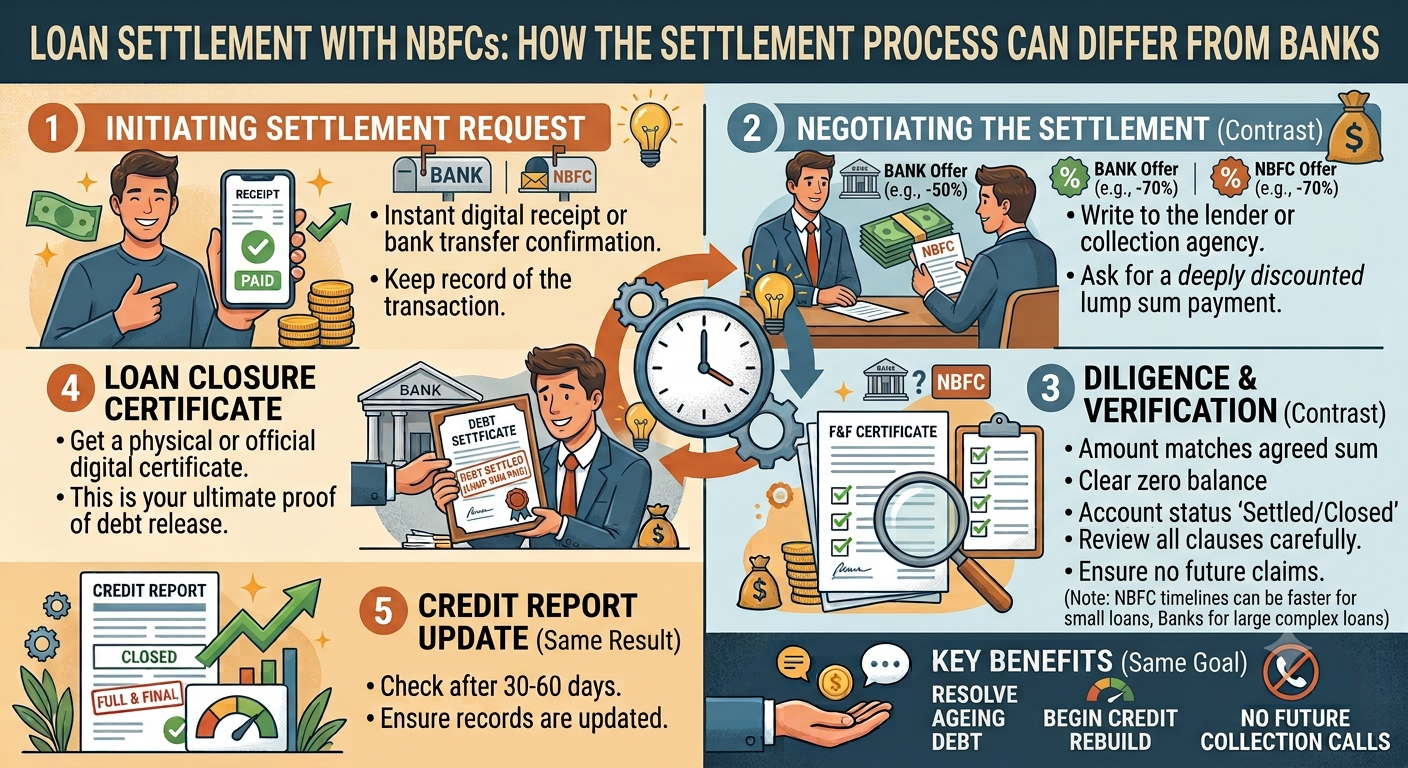
Facing financial distress and defaulting on loan repayments is a challenging experience. When seeking a One-Time Settlement (OTS) to resolve non-performing loans, borrowers often discover that settling a debt with a Non-Banking Financial Company (NBFC) differs significantly from negotiating with a traditional commercial bank.
While both banks and NBFCs operate under the regulatory umbrella of the Reserve Bank of India (RBI), their internal approval frameworks, risk appetites, and operational workflows vary. Understanding these key differences is essential for negotiating maximum principal waivers and securing complete legal discharge.
Core Differences: NBFCs vs. Traditional Banks
+-------------------------------------------------------------------------------+
|                       BANK VS. NBFC SETTLEMENT DYNAMICS                       |
+-------------------------------------------------------------------------------+
| Feature               | Commercial Banks           | NBFCs & Fintech Lenders  |
| Capital Cost          | Low (CASA Deposit Base)    | High (Wholesale Borrowing)|
| Recovery Timeline     | Slower, Bureaucratic       | Fast, Aggressive         |
| Decision Hierarchy    | Multi-Tiered Committee     | Centralized / Automated  |
| Litigation Speed      | Slower (DRT / Civil Suits) | Swift (Arbitration/Sec 25)|
+-------------------------------------------------------------------------------+
The fundamental contrast lies in their business models. Commercial banks leverage low-cost retail deposits, allowing them greater patience with delayed recoveries. NBFCs, however, rely on wholesale borrowing and institutional credit lines. Higher capital costs make NBFCs far more focused on fast liquidity and rapid balance-sheet cleanups.
How the NBFC Settlement Process Differs
1. Faster Decision-Making and Aggressive Timelines
Unlike traditional banks where settlement proposals must pass through local branches, regional managers, and zonal credit committees, NBFCs utilize streamlined decision hierarchies. Many digital NBFCs and fintech lenders use automated risk-scoring models to evaluate settlement proposals. As a result, an NBFC can approve or reject an OTS proposal within days rather than months.
2. Swift Reliance on Alternative Legal Remedies
NBFCs rarely spend years sending routine payment reminders. Instead, they quickly trigger legal enforcement under the Arbitration and Conciliation Act or initiate criminal complaints under Section 25 of the Payment and Settlement Systems Act (PSSA) for auto-debit bounces. Borrowers must handle these notices promptly to prevent ex-parte arbitration awards.
3. Higher Flexibility on Principal Waivers
Because NBFCs prioritize fast cash recovery to maintain institutional liquidity, their credit managers often enjoy wider latitude to approve deeper compromise discounts. While commercial banks often cap initial compromise offers conservatively, NBFCs are frequently willing to offer substantial waivers on aged, unsecured personal loans or digital instant loans.
4. Aggressive Third-Party Recovery Network
NBFCs frequently outsource overdue portfolio management to specialized third-party collection agencies. This can lead to persistent recovery calls and door-step visits. Borrowers negotiating with NBFCs must insist on conducting formal written communications directly with the NBFC’s nodal officers or internal legal team.
Key Steps to Settle an NBFC Loan Safely
To navigate the NBFC settlement process successfully and protect your legal rights, follow these steps:
- Request an Official Statement of Account (SOA): Obtain an itemized statement directly from the NBFC portal or home branch. Audit the breakdown to separate the base principal amount from accumulated penal interest, bounce charges, and late processing fees.
- Revoke Active NACH / Mandate Directives: Submit a written request to revoke active NACH auto-debit mandates to prevent continuous payment bounce fees.
- Submit Hardship Evidence: Provide objective documentation—such as job termination letters, salary reduction slips, or medical expense records—proving that your default was due to genuine financial hardship.
- Demand a Formal Settlement Sanction Letter: Never make a compromise payment based on verbal promises or collection agent WhatsApp messages. Always demand an official Settlement Sanction Letter printed on the NBFC’s letterhead detailing the agreed sum, payment schedule, and full balance waiver.
- Obtain a No Dues Certificate (NDC): After depositing the settlement amount directly into the official NBFC corporate account, secure your official NDC to ensure full legal discharge and update your credit registry records.
Comparison: Settlement Workflow
| Parameter | Commercial Bank Settlement | NBFC Settlement |
|---|---|---|
| Approval Timeframe | 4 to 12 Weeks | 1 to 3 Weeks |
| Primary Legal Process | Securitization / Civil Court / DRT | Arbitration / Section 25 PSSA |
| Waiver Potential | Moderate (Structured Policy) | High (Liquidity Focused) |
| Sanction Issuance | Regional / Zonal Office | Centralized Digital Systems |
Essential Resources for NBFC Loan Settlement
Navigating legal notices, auditing statement charges, and securing valid sanction letters from NBFCs requires specialized expertise. Explore these dedicated resources for guidance:
- Evaluate your eligibility for NBFC settlement waivers with a certified loan settlement expert.
- Explore structured negotiation strategies for NBFC personal and digital loans through loan settlement services.
- Learn how to calculate realistic compromise ratios using complete loan settlement guides.
- Protect yourself from aggressive recovery tactics by partnering with a trusted loan settlement agency.
- Review arbitration notices and statement charges alongside an accredited loan settlement expert.
- Eliminate illegal bounce charges and negotiate maximum principal discounts through specialized loan settlement services.
- Manage legal notices and regulatory escalations supported by an established loan settlement agency.
- Understand RBI guidelines governing NBFC digital lending with professional loan settlement advice.
- Safeguard your legal rights and resolve digital loan debts with direct assistance from a skilled loan settlement expert.
- Obtain institutional representation and direct escalation to NBFC nodal officers via dedicated loan settlement services.
- Secure your official No Dues Certificate (NDC) and full legal discharge with an experienced loan settlement agency.
Final Thoughts
Settling a loan with an NBFC requires a proactive approach due to their fast legal processes and aggressive recovery timelines. By auditing your statement, establishing direct communication with nodal officials, securing a formal sanction letter, and obtaining an official No Dues Certificate, you can successfully resolve your NBFC debt and take a firm step toward financial recovery.