
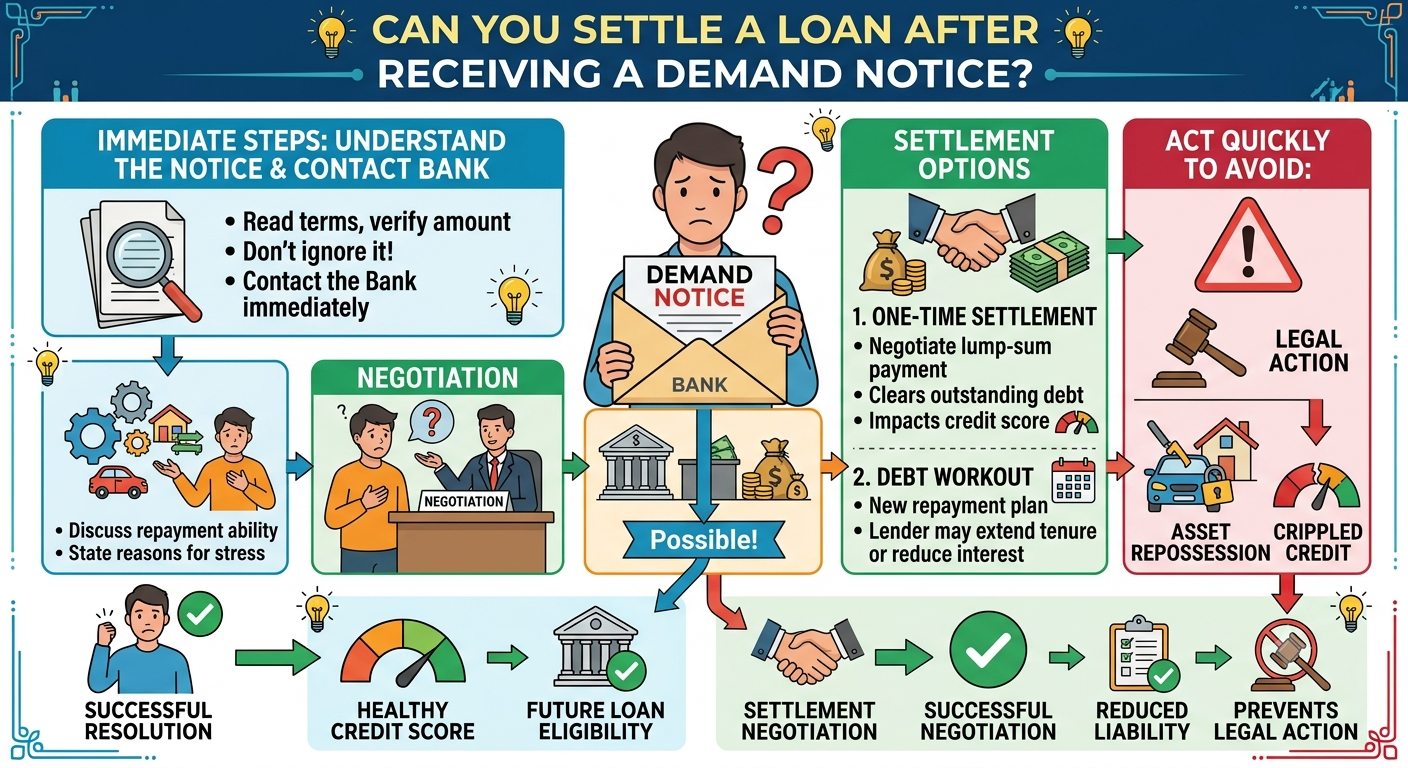
Receiving a formal demand notice or legal notice from a bank is one of the most stressful moments for any borrower. When financial hardship makes it impossible to maintain regular monthly payments, seeing official legal terminology, tight response deadlines, and warnings of impending recovery actions can trigger panic. Many borrowers immediately assume that receiving a demand notice signifies the end of all negotiation options.
However, the reality is quite different. Can you settle a loan after receiving a demand notice from the bank? Yes, absolutely. In fact, receiving a formal notice often serves as the official starting line for structured, legally sound debt settlement negotiations. Understanding how to respond strategically allows you to resolve your outstanding debt while protecting your fundamental legal rights.
Understanding What a Demand Notice Really Means
A demand notice—whether issued under Section 13(2) of the SARFAESI Act for secured loans or as a standard legal notice for unsecured credit—is a regulatory step mandated by law. It serves as a formal communication from the lender demanding full repayment of outstanding dues within a specified window, usually ranging from 15 to 60 days.
Lenders do not issue demand notices solely to initiate immediate litigation; rather, it is a formal declaration that the account is in default and that formal recovery procedures are commencing. Crucially, banks prefer avoiding long, costly court battles or prolonged asset auctions. Banking institutions are profit-driven entities, and recovering a reasonable, discounted lump sum through a One-Time Settlement (OTS) is almost always preferable to extended legal recovery.
Key Action Steps Upon Receiving a Demand Notice
- Do Not Ignore the Notice: Silence or inaction is interpreted as intentional default, which encourages banks to accelerate aggressive recovery procedures.
- Review the Financial Claims: Carefully verify the principal amount, interest rate calculations, penal fees, and administrative charges listed in the notice for discrepancies.
- Draft a Timely Formal Response: Submit an official reply detailing your genuine financial hardship (e.g., job loss, medical emergency, business failure) within the stipulated timeframe.
- Propose a Realistic Settlement Plan: Request a formal compromise discussion to settle the outstanding liability via a lump-sum payment based on your current financial capacity.
Stages of Post-Notice Settlement Resolution
| Stage | Bank Action | Borrower Strategic Response | Primary Goal |
| Notice Issuance | Serves demand notice with payment deadline | Acknowledges receipt and provides proof of hardship | Halts automated legal escalation |
| Response & Review | Reviews hardship documentation and financial capacity | Submits realistic One-Time Settlement (OTS) proposal | Opens formal compromise dialogue |
| Negotiation & Sanction | Issues formal Settlement Sanction Letter | Verifies terms, waivers, and payment timelines | Secures binding written agreement |
| Final Discharge | Receives settled payment and closes file | Obtains No Dues Certificate (NDC) & updates bureaus | Achieves full legal release from liability |
Navigating Legal Notices with Professional Expertise
Responding to a bank demand notice requires precise financial presentation, strong legal grounding, and expert negotiation skills. Missteps during this critical phase can compromise your bargaining position or accelerate court proceedings.
Partnering with a recognized loan settlement agency provides critical support when dealing with legal departments. A professional loan settlement agency handles complex legal correspondence, shields you from harassment, and ensures all responses adhere strictly to regulatory frameworks.
Engaging specialized loan settlement services guarantees that your case is framed accurately under RBI compromise guidelines. Trusted loan settlement services review your overall liabilities, challenge unjust penal interest additions, and structure a viable settlement package.
Consulting an accredited loan settlement expert gives you leverage when negotiating directly with bank officials. A skilled loan settlement expert presents your financial condition convincingly to credit committees to secure maximum waivers on interest and principal charges.
Executing a timely loan settlement after a demand notice neutralizes legal risks and brings closure to spiraling debt. Once an agreed loan settlement sum is remitted, the lender issues a formal Settlement Sanction Letter followed by a No Dues Certificate (NDC), permanently closing the file.
If you are currently facing legal pressure from lenders, seeking a tailored loan settlement prevents further compounding of unmanageable obligations. Working alongside a dedicated loan settlement expert safeguards your rights, while comprehensive loan settlement services allow you to achieve debt relief and rebuild your financial future.
Conclusion
Receiving a demand notice from a bank is a serious matter, but it does not mean you are out of options. By acting quickly, presenting verifiable proof of hardship, and enlisting expert guidance, you can negotiate an affordable settlement, eliminate your outstanding liabilities, and regain your peace of mind.