
Completing a loan settlement is a significant milestone for any borrower striving to break free from debt distress. After enduring months of financial hardship, intensive negotiations, and making substantial sacrifices to arrange settlement funds, remitting the agreed lump sum brings an immense sense of relief. However, transferring the funds is not the final step of the debt resolution journey. Without formal, written documentary confirmation from your lender, your financial liability remains legally vulnerable.
Among all post-settlement documents, the No Dues Certificate (NDC)—often interchangeably referred to as a No Objection Certificate (NOC) or Closure Certificate—is the single most vital legal instrument you must obtain. An NDC serves as irrefutable evidence that your contractual obligations with the lending institution have been brought to a conclusive end and that the lender holds no further claims, liens, or legal rights against you.
Yet, tens of thousands of Indian borrowers discover months later that despite paying their settlement in full, automated recovery notices continue, bank ledgers continue charging penal interest, or credit bureaus still display active default balances. In this comprehensive master guide, we explore the precise legal meaning of a No Dues Certificate, evaluate why it is indispensable after a negotiated loan settlement, dissect the differences between settlement agreements and NDCs, provide a step-by-step resolution protocol if your bank delays issuance, and clarify the exact impact of an NDC on your CIBIL score under the Reserve Bank of India (RBI) regulatory framework.
🛡️ Essential Financial Rule: A payment receipt or bank transfer UTR only proves that money moved out of your account. Only an official No Dues Certificate issued directly by the bank proves that the lender has accepted that payment in full legal satisfaction of your loan account.
What Is a No Dues Certificate (NDC)?
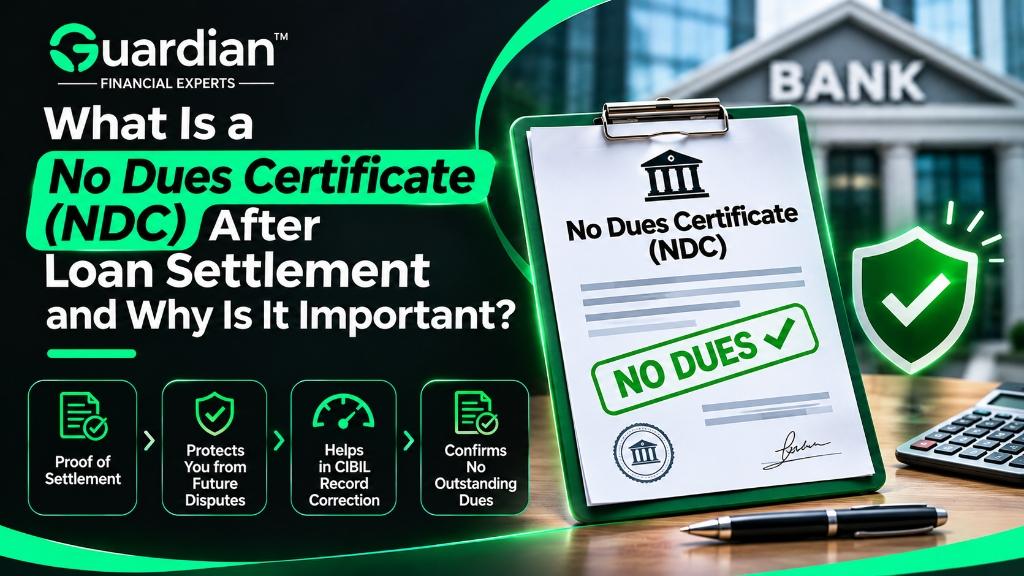
A No Dues Certificate (NDC) is an official legal document issued on the letterhead of a bank, Non-Banking Financial Company (NBFC), or financial institution certifying that a specific borrower has fulfilled all financial obligations associated with a designated credit facility and that zero outstanding balance remains due under that account.
The core purpose of an NDC is to serve as conclusive proof of debt extinguishment. In the context of unsecured retail borrowing—such as personal loans and credit card accounts—the NDC acts as an unconditional financial discharge. For secured borrowings (such as auto loans or housing mortgages), the NDC serves as the legal authorization allowing the borrower to retrieve original pledged property deeds or remove hypothecation marks from the Regional Transport Office (RTO) vehicle registration certificate.
Information Generally Included in an Authentic NDC:
An authentic NDC issued by a regulated Indian financial entity typically contains the following vital operational data points:
- Borrower Identifiers: Full legal name, registered permanent address, and customer relationship number (CIF / Customer ID).
- Loan Account Identification: Complete loan account number, sanctioned facility type, and masked 16-digit credit card number (where applicable).
- Lender Authentication: Official bank or NBFC branding, branch name, corporate office details, and registered trademark.
- Account Status Certification: Clear, unambiguous language certifying that the account has been settled/closed and that no further dues, charges, or liabilities are payable by the borrower.
- Outstanding Dues Information: Explicit declaration that the outstanding principal, interest, penal fees, and legal charges stand at ₹0.00.
- Date of Issuance & Authorization: Date of issue, unique document reference number, and authorized signatory details with branch stamp and employee designation.
Lenders issue NDCs either electronically via password-protected digital letters bearing cryptographically verifiable QR codes, or physically as signed, stamped documents dispatched via registered post or handed over at the home branch. Retaining physical and digital copies indefinitely is essential for every borrower's lifelong financial security.
Difference Between NDC and Loan Settlement Letter
Retail borrowers frequently confuse pre-payment settlement letters with post-payment closure certificates. These documents fulfill entirely distinct legal functions across the debt resolution timeline. Relying on an offer letter as proof of closure—or assuming a payment receipt equates to an NDC—is one of the most perilous mistakes in debt management.
| Document Name | Timing of Issuance | Primary Purpose & Legal Function |
|---|---|---|
| Settlement Offer Letter | Before payment is remitted | Explains agreed settlement terms, approved compromise amount, payment deadlines, and bank payment instructions. |
| Settlement Agreement | Prior to execution of settlement | Records agreed mutual covenants, dispute withdrawal terms, and legal commitments binding both borrower and lender. |
| Payment Receipt / UTR Slip | At the time funds are transferred | Confirms payment was debited and credited to the designated account; proves fund transmission only. |
| Settlement Completion Letter | 10 to 20 days post-payment | Confirms completion of settlement obligations and that the compromised figure was credited per sanctioned terms. |
| No Dues Certificate (NDC) | 15 to 30 days post-reconciliation | Confirms relevant account status, certifies zero balance, and releases borrower from all further monetary claims. |
| Loan Closure Letter | Upon 100% full contractual repayment | Generally confirms standard loan closure where the entire contractual principal and interest were paid in full. |
Crucial Distinction: Negotiated Settlement vs Full Repayment: It is imperative to comprehend that negotiated loan settlement and full loan repayment are fundamentally distinct in banking jurisprudence. In a full repayment, the borrower repays 100% of the loan per schedule, receiving a standard Loan Closure Letter. In an One-Time Settlement (OTS), the lender accepts a discounted sum and writes off the remaining balance as a credit loss. The resulting NDC reflects that the account has been resolved under compromise terms. For connected guidance on post-payment delays, review our comprehensive analysis on what to do if a bank does not issue a loan settlement letter after payment.
Why Is a No Dues Certificate Important After Loan Settlement?
Securing an NDC is not an optional clerical courtesy—it is a critical protective shield. The six primary reasons why an NDC is indispensable include:
- Written Proof of Concluded Account Status: Banking personnel rotate frequently, and asset recovery branches are regularly reorganized. Verbal assurances given by a recovery manager or branch executive are legally unenforceable. The NDC is permanent, objective written proof that your account was resolved with institutional authority.
- Protection Against Future Payment Disputes: Banks periodically sell non-performing loan pools to third-party Asset Reconstruction Companies (ARCs) or assign them to external collection agencies. If an account has been settled internally but lacks an NDC, an external agency may mistakenly initiate aggressive recovery demands years down the line. Presenting an NDC immediately invalidates such claims.
- Assistance in Resolving Lingering Balances: In core banking engines, interest continues accruing automatically until an administrative write-off voucher is posted. If your online portal shows an outstanding balance post-settlement, having the NDC allows you to demand immediate ledger zeroing. For a complete troubleshooting framework, consult our guide on loan settlement paid but still showing outstanding.
- Documentary Support for Credit Report Disputes: Credit Information Companies (such as TransUnion CIBIL, Experian, CRIF High Mark, and Equifax) do not accept payment receipts as proof of debt resolution. To correct an erroneous default balance or update your status from overdue to "Settled", bureaus mandate an official bank-issued NDC.
- Maintenance of Clean Lifetime Financial Records: When applying for visas, clearing government employment background screenings, or applying for specialized commercial licenses, historical default records can trigger adverse vetting. An NDC demonstrates that all past financial liabilities were fully resolved.
- Confirmation of Completed Settlement Obligations: An NDC confirms that you satisfied every contractual stipulation—including strict payment deadlines, correct account credit, and compliance with all terms of the settlement agreement.
What Details Should an NDC Contain?
Before archiving your No Dues Certificate, scrutinize the document to verify that all mandatory elements are accurately stated. An incomplete or erroneously drafted NDC can be rejected by credit bureaus or future lenders. Ensure your certificate includes:
- Borrower's Full Legal Name: Must exactly match your Aadhaar, PAN card, and loan application records.
- Primary Loan Account Number: The exact 12-to-16-digit account identifier against which EMI deductions occurred.
- Bank or Financial Institution Name: Full registered corporate entity name, including branch address and IFSC/MICR codes where applicable.
- Relevant Loan Reference: Clear indication of whether the facility was an unsecured personal loan, consumer durable credit, business overdraft, or revolving credit card account.
- Explicit Account Status: Definitive language confirming that the account stands closed/settled with zero claim remaining. Phrases such as "in full and final satisfaction of all claims" provide the highest degree of legal safety.
- Outstanding Dues Information: Explicit numeric statement confirming that current balance, overdue interest, and penal charges stand at ₹0.00.
- Date of Issuance: Clear calendar date validating when the bank formally closed its books on the facility.
- Authorized Issuer & Verification Details: Signature, full name, employee code, and branch seal of the bank's authorized signatory, or a cryptographically verifiable digital signature / QR validation link.
When Should You Request an NDC After Loan Settlement?
Understanding the standard procedural flow prevents premature panic while establishing a disciplined timeline for borrower follow-ups:
Step-by-Step Request Protocol:
- Complete Payments Precisely as Sanctioned: Ensure the exact agreed amount is credited on or before the sanctioned cut-off date through official banking channels (NEFT/RTGS/IMPS).
- Verify Settlement Conditions: Confirm that auxiliary conditions—such as clearing post-dated cheques, closing linked overdraft accounts, or submitting legal withdrawal petitions—have been completed.
- Collect Receipts and UTR References: Download bank debit advices and obtain computerized payment deposit slips showing successful credit to the loan account.
- Submit a Written Formal Request to the Lender: Within 3 to 5 working days of payment verification, dispatch a formal written request via registered email and physical branch submission demanding ledger reconciliation and NDC generation.
⚠️ Regulatory Clarification: While the Reserve Bank of India (RBI) mandates that lenders release original property documents within 30 days of full loan repayment for secured loans, there is no universal, single statutory deadline across all commercial banks for unsecured loan settlement NDCs. Standard banking turnaround ranges from 15 to 30 working days to accommodate internal audit committee write-off approvals.
What Should You Do If the Bank Does Not Issue an NDC?
If weeks have passed since your settlement payment was credited and the lending institution has failed to provide your No Dues Certificate, follow this structured, 7-step escalation protocol:
Step 1: Collect Payment Proof
Gather all evidentiary documents: certified bank account statements reflecting the debit, Unique Transaction Reference (UTR) codes, computerized deposit slips, and electronic payment confirmation receipts.
Step 2: Review the Settlement Agreement
Carefully audit your pre-payment settlement sanction letter. Confirm that the exact sum was remitted without even a one-rupee shortfall, that the payment date was strictly within the sanctioned validity period, and that funds were credited directly to the official loan account number rather than an unverified collection agency account.
Step 3: Contact the Bank
Visit the home branch or contact the central loan operations desk in writing. Quote your loan account number, provide transaction dates and UTR references, attach your settlement sanction letter, and request an immediate status update on ledger reconciliation.
Step 4: Submit a Formal Written Request
If verbal or branch follow-ups do not yield results within 7 to 10 working days, submit a formal registered representation to the Branch Manager. Formally demand: (a) written confirmation of payment receipt, (b) ledger zeroing, and (c) issuance and delivery of the official No Dues Certificate. Secure a signed receiving copy or postal speed-post delivery acknowledgment.
Step 5: Escalate to the Bank's Grievance Department
If the branch remains non-responsive, escalate your petition up the statutory internal grievance hierarchy mandated by the Reserve Bank of India:
- Grievance Redressal Officer (GRO): Lodge an online complaint through the bank's official grievance web portal, attaching all documents and your initial branch submission copy.
- Principal Nodal Officer (PNO): If the GRO fails to resolve the issue within 15 days, elevate the grievance directly to the bank's Principal Nodal Officer, whose contact information is published on the bank's website under regulatory requirements.
Step 6: Request Correction of Inaccurate Account Information
Simultaneously request that the lender verify its internal accounting entries and update all credit information companies. Inaccurate reporting of settled accounts as active overdue debt constitutes a clear deficiency in service.
Step 7: Approach the RBI Grievance Mechanism if Eligible
If the regulated bank or NBFC fails to resolve your grievance within 30 calendar days of lodging your formal complaint, or if they reject your legitimate request without valid justification, you are legally entitled to escalate the complaint to the Reserve Bank of India.
Under the Reserve Bank – Integrated Ombudsman Scheme, 2026, deficiency in banking service—including unwarranted delay in issuing closure documentation, non-issuance of No Dues Certificates, and continuing to report fictitious arrears post-settlement—falls within the Ombudsman's adjudicatory jurisdiction.
🏛️ Official RBI Grievance Redressal Mechanism:
Lodge your complaint online through the RBI Complaint Management System (CMS) at: https://cms.rbi.org.in/
Review official banking regulatory directions and guidelines at: https://www.rbi.org.in/
Eligibility & Procedure: To maintain an eligible complaint before the RBI Ombudsman, the borrower must have first submitted a formal written grievance to the regulated entity, allowed the mandatory 30-day response window to elapse, and ensure the dispute is not already sub-judice before a civil court or debt recovery tribunal.
Does an NDC Automatically Improve Your CIBIL Score?
One of the most persistent myths among borrowers is the expectation that obtaining a No Dues Certificate will trigger an instant surge in their CIBIL score back to 750+. Understanding the mechanics of credit reporting is essential for realistic financial planning:
1. "Closed" vs "Settled" Status:
- "Closed" Status: Indicates that the borrower paid 100% of the contractual principal, normal interest, and charges according to original repayment terms. This status has a positive, strengthening impact on credit health.
- "Settled" Status: Reflects that the lending institution agreed to accept a compromised amount lower than the total contractual liability, writing off the residual balance. Under RBI reporting rules, lenders are statutorily required to report the factual nature of the closure.
2. The True Credit Impact of a Settlement:
An NDC does not transform a "Settled" account into a "Closed" account. A settlement will initially reflect as a negative remark on your credit profile because the lender absorbed a financial haircut. However, securing the NDC achieves three invaluable credit objectives:
- It permanently stops monthly default reporting: The account stops accumulating 30, 60, 90+ Days Past Due (DPD) marks.
- It reduces your total outstanding balance to zero: Eliminates high debt utilization ratios that severely drag down credit scores.
- It caps penal interest accrual: Prevents uncontrolled liability expansion.
3. Identifying and Disputing Inaccurate Credit Information:
Following loan settlement and receipt of your NDC, pull comprehensive credit reports from all four RBI-licensed credit bureaus:
Examine the "Current Balance" and "Amount Overdue" fields. Following settlement reconciliation, these fields must display ₹0. If an active outstanding balance continues to display, raise an online dispute through the bureau's dispute portal, uploading your NDC as primary documentary evidence. For complete post-settlement recovery strategies, explore our guide to credit score improvement and CIBIL rebuilding.
Documents You Should Keep After Loan Settlement
Never discard settlement paperwork once the NDC arrives. Create a secure physical binder and an encrypted cloud backup containing this definitive 10-point document checklist:
- ✅ Settlement Offer / Sanction Letter: Original letter on bank letterhead stipulating the approved settlement terms, amount, and deadlines.
- ✅ Bilateral Settlement Agreement: Signed agreement detailing mutual covenants, terms of waiver, and liability releases.
- ✅ Computerized Payment Receipts: Official bank deposit receipts, NEFT/RTGS transaction confirmations, and electronic clearing slips.
- ✅ Bank Account Statements: Certified statement for the month of payment showing the exact debit and beneficiary loan account credit.
- ✅ Unique Transaction Reference (UTR) Records: The interbank clearing identifier proving irrevocable transmission of funds.
- ✅ Settlement Completion Confirmation: Interim bank acknowledgement confirming receipt and acceptance of settlement funds.
- ✅ No Dues Certificate (NDC) or NOC: Official, signed, and stamped certificate declaring zero outstanding dues.
- ✅ Bank Email & Written Correspondence: Full archive of emails exchanged with branch managers, nodal officers, and recovery teams.
- ✅ Complaint & Escalation Acknowledgements: Docket numbers, complaint reference IDs, and responses from internal grievance desks or the RBI Ombudsman.
- ✅ Updated Credit Bureau Reports: Certified credit reports pulled 60 to 90 days post-settlement confirming balance reflects ₹0.
Common Mistakes Borrowers Should Avoid
Navigating post-settlement documentation requires rigorous attention to detail. Avoid these critical pitfalls:
- ❌ Assuming a Payment Receipt Is an NDC: A deposit slip or UTR receipt only proves money was sent; it does not constitute legal proof that the bank accepted the payment as full settlement.
- ❌ Not Checking Settlement Conditions: Failing to adhere strictly to payment deadlines or neglecting auxiliary terms can cause the bank to revoke the OTS agreement and demand full original dues.
- ❌ Relying on Verbal Confirmations: An oral assurance from a collection agent that "your account is closed on our screen" has zero evidential value without an official stamped document.
- ❌ Not Requesting Written Confirmation: Waiting passively for months without formally requesting the NDC allows administrative lags to harden into systemic errors.
- ❌ Ignoring Credit Report Errors: Assuming the bank will update CIBIL without verification can leave damaging default marks active for years.
- ❌ Deleting Payment Records: Discarding transaction receipts or bank statements leaves you defenseless if an audit discrepancy arises in the future.
How Guardian Financial Experts Can Help
Navigating complex banking bureaucracies, securing settlement documentation, and ensuring accurate credit bureau reporting requires seasoned financial and legal expertise.
Guardian Financial Experts is India's premier financial consulting and debt resolution advisory firm. Our team of experienced advocates, financial strategists, and banking specialists assists borrowers across India through ethical, transparent, and structured frameworks:
- Loan Settlement Advisory & Negotiation: Structuring viable, advocate-led compromise negotiations across personal loan settlement, credit card debt resolution, and distressed commercial borrowings.
- Settlement Documentation Audits: Scrutinizing settlement sanction letters, terms, and conditions to ensure absolute legal enforceability before any payment is remitted.
- NDC Expedited Procurement: Liaising directly with bank credit operations hubs and Principal Nodal Officers to ensure swift ledger reconciliation and timely NDC dispatch.
- Credit Report Dispute Resolution: Assisting clients in identifying bureau reporting errors and filing structured disputes with TransUnion CIBIL, Experian, CRIF High Mark, and Equifax.
- Anti-Harassment Legal Shield: Enforcing strict adherence to the RBI Fair Practices Code to protect borrowers against unlawful collection conduct, as detailed in our anti-harassment support services.
- Grievance Escalation Support: Drafting formal representations for bank grievance desks and guiding eligible borrowers through the RBI Integrated Ombudsman complaint procedure.
Statutory Regulatory Disclaimer: Guardian Financial Experts is a private financial consulting and legal advisory consultancy. We are not a banking institution, non-banking financial company (NBFC), credit information bureau, government authority, or RBI-appointed Ombudsman. We do not provide banking credit facilities, do not guarantee loan write-offs or specific percentage reductions, and do not guarantee specific credit bureau score modifications. All debt compromise outcomes and documentation turnaround times remain subject to the independent evaluation and credit policies of the respective lending institutions.
Completed Your Loan Settlement? Make Sure You Have the Right Documents.
Understanding loan settlement documentation is an important part of protecting your financial records. If you need guidance regarding settlement confirmation, NDC requirements or credit report discrepancies, Guardian Financial Experts can help you understand the process and available next steps.
Get Professional Guidance →Frequently Asked Questions (FAQs)
1. What is a No Dues Certificate after loan settlement?
A No Dues Certificate (NDC) is an official legal instrument issued by a lending institution confirming that a settled loan account has satisfied all agreed compromise conditions and that the lender holds no further financial claim, lien, or liability against the borrower.
2. Is an NDC mandatory after every loan settlement?
While some lenders issue an equivalent "Settlement Completion Letter", securing formal written confirmation (NDC or closure certificate) is essential. Without it, you lack legal proof of debt extinguishment if ledger discrepancies or collection errors arise later.
3. Is a settlement letter the same as an NDC?
No. A settlement offer letter is issued before payment, specifying the agreed discounted sum and payment deadline. An NDC is issued only after payment has been received and verified by the bank, confirming that all settlement obligations are fulfilled.
4. How can I get an NDC from my bank?
After remitting the full agreed settlement amount, submit a formal written request to your branch or credit operations center attaching your payment receipt, UTR reference number, and approved settlement letter, requesting ledger closure and NDC dispatch.
5. What should I do if the bank refuses to issue an NDC?
Submit a formal grievance to the bank's Grievance Redressal Officer and Principal Nodal Officer (PNO) with payment proof. If the lender fails to resolve the issue within 30 days or rejects your request without lawful cause, escalate to the RBI Integrated Ombudsman at cms.rbi.org.in.
6. Can I use a payment receipt instead of an NDC?
No. A payment receipt or UTR number only proves that money was transferred. An NDC is the bank's authoritative legal acknowledgement that the debt is fully settled and that you are released from contractual obligations.
7. Does an NDC mean my CIBIL account will show Closed?
No. When an account is resolved under a compromise settlement for less than full dues, credit bureaus report the account status as "Settled", with the current balance updated to ₹0. "Closed" status is reserved exclusively for loans repaid in full per original terms.
8. How long does it take to receive an NDC?
Internal bank reconciliation and NDC generation typically take between 15 to 30 working days following verified receipt of full settlement funds. If 30 days elapse without documentation, submit a formal written reminder to the branch.
9. Can I get an NDC after credit card settlement?
Yes. Upon paying the agreed settlement amount for an outstanding credit card balance within the stipulated window, the issuing bank must close the card account, deactivate the credit line, and issue a formal No Dues Certificate.
10. What should I do if my loan still shows outstanding despite having an NDC?
Submit a certified copy of your NDC to the bank's customer service desk demanding internal ledger zeroing. Simultaneously, raise an online dispute with TransUnion CIBIL, Experian, CRIF High Mark, and Equifax attaching the NDC to correct your credit report balance to ₹0.
Disclaimer: This guide is authored by Guardian Financial Experts for consumer educational and financial awareness purposes under Indian banking conventions and the Reserve Bank of India regulatory framework. It does not constitute formal legal counsel or statutory advice. Final account closure, documentation timelines, and credit bureau updates remain subject to the respective policies of lending institutions and applicable credit reporting regulations. Borrowers are encouraged to consult qualified banking legal counsel for complex disputes.
Explore Bank-Specific Resolution & Debt Relief Services
Facing debt recovery notices, escalating interest, or multiple EMI defaults? Navigate our authoritative settlement guides and legal resolution procedures tailored for Indian borrowers:
HDFC Bank Loan Settlement
Personal loan & credit card OTS procedures, waiver rules, and recovery resolution.
SBI Loan Settlement Process
State Bank of India compromise settlement, NPA resolution, and Lok Adalat guidelines.
ICICI Bank Loan Settlement
Resolution for overdue credit cards, personal loans, and third-party recovery defense.
Bajaj Finance Debt Settlement
NBFC overdue loan settlement, bounce charges negotiation, and NDC documentation.
Credit Card Settlement Services
Stop 40%+ compounding APR and settle high-balance credit cards with structured waivers.
Personal Loan Settlement
Resolve multiple unsecured loans, fintech apps, and salary defaults with legal protection.
Anti-Harassment Legal Support
Enforce RBI fair practice code to halt abusive recovery calls, threats, and illegal visits.
CIBIL & Credit Score Improvement
Step-by-step roadmap to rebuild credit rating from 'Settled' status back to 750+.
Every loan case is unique. If you are experiencing EMI pressure or receiving recovery notices, our team is available for a confidential consultation.