
When facing severe financial hardship, managing monthly debt obligations can quickly become overwhelming. Borrowers who struggle to pay their regular Equated Monthly Installments (EMIs) often encounter two primary debt relief mechanisms offered by financial institutions: Loan Restructuring and Loan Settlement.
While both options aim to alleviate financial distress, they operate under fundamentally different frameworks, carry distinct financial consequences, and impact your credit profile in entirely different ways. Understanding the core differences between these two pathways is essential before deciding which approach aligns best with your financial situation.
Understanding Loan Restructuring
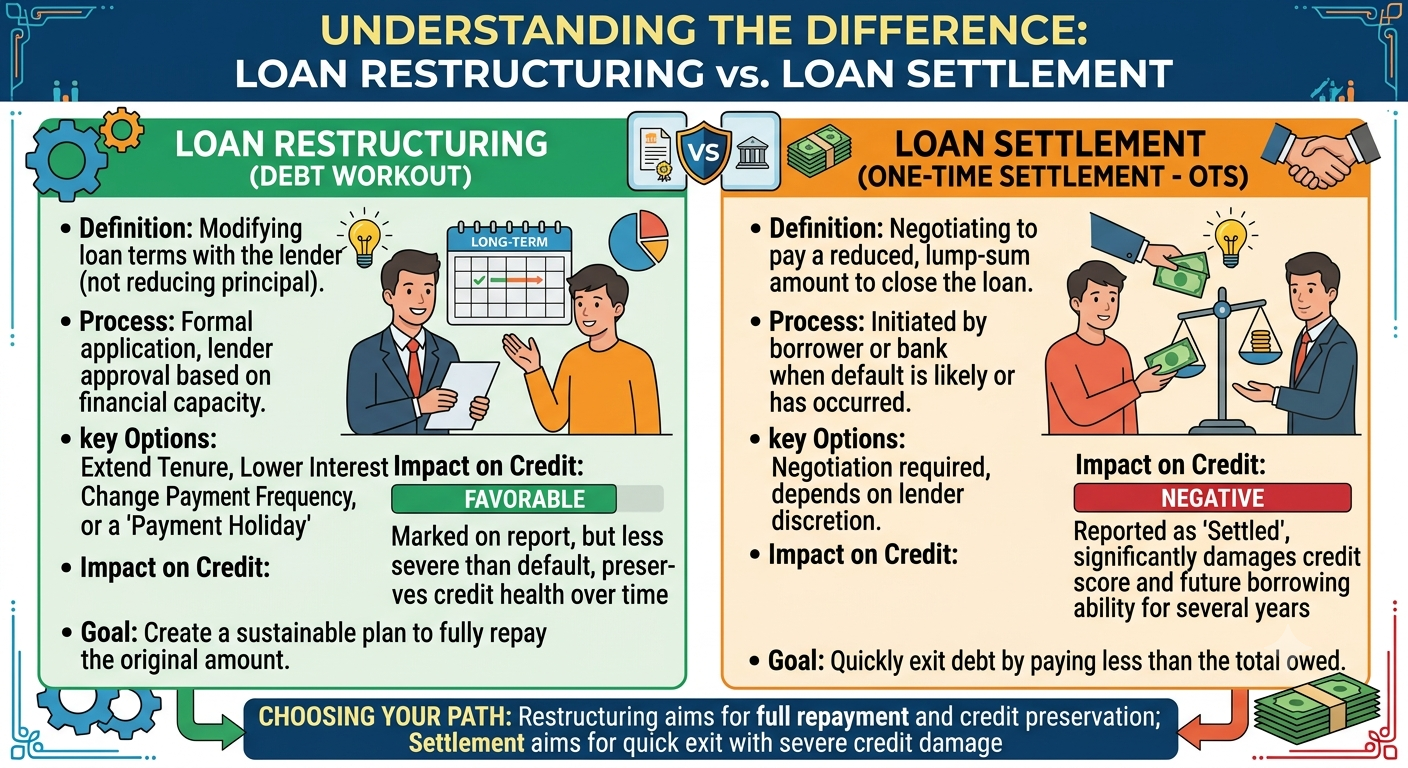
Loan Restructuring is an arrangement in which the lender modifies the existing terms of your loan to make repayment more manageable. This process does not reduce the principal amount owed. Instead, the financial institution alters the loan structure to reduce your immediate monthly outflow.
Common methods of loan restructuring include:
- Extending the Loan Tenure: Spreading the remaining principal over a longer period reduces monthly EMI amounts, though it increases the overall interest paid over time.
- Interest Rate Reduction: Lowering the interest rate temporarily or permanently to reduce financial pressure.
- EMI Moratorium: Allowing a temporary pause on principal or interest repayments during periods of acute financial hardship.
Restructuring is ideal for borrowers experiencing temporary income disruptions who still possess the capacity to repay the entire principal amount over time.
Understanding Loan Settlement
Loan Settlement, often referred to as a One-Time Settlement (OTS), is a financial compromise reached when a borrower is entirely unable to repay the full outstanding balance due to severe, permanent financial hardship.
In a settlement scenario, the lender agrees to accept a discounted, lump-sum payment that is lower than the total outstanding balance. Once this mutually agreed sum is paid, the lender forgives the remaining principal, interest, and penal charges, formally closing the account.
While a settlement provides immediate financial relief by discharging unmanageable liabilities, the lender reports the account as “Settled” rather than “Closed” to credit bureaus like CIBIL, which impacts the borrower’s credit score in the short-to-medium term.
Key Differences: Loan Restructuring vs. Loan Settlement
| Core Feature | Loan Restructuring | Loan Settlement |
| Principal Repayment | Full principal amount is paid | A portion of principal/interest is waived |
| Repayment Structure | Extended monthly EMIs | Reduced lump-sum payment |
| Impact on Credit Score | Minimal impact if terms are met | Account marked as “Settled” on bureau |
| Best Suited For | Temporary financial hardship | Severe or permanent inability to repay |
Navigating Your Relief Options with Professional Guidance
Deciding between restructuring and settlement requires a thorough evaluation of your current cash flow, long-term financial stability, and total debt burden. Negotiating effectively with financial institutions can be challenging without proper knowledge of banking guidelines and borrower rights.
Working with an established loan settlement agency provides critical support throughout the resolution process. A dedicated loan settlement agency evaluates your overall financial standing, communicates directly with bank representatives, and protects you from aggressive collection practices.
Engaging professional loan settlement services ensures that your case is framed accurately under regulatory guidelines. Comprehensive loan settlement services analyze accrued penal interest, negotiate maximum possible waivers, and ensure all legal documentation is executed correctly.
Consulting an experienced loan settlement expert helps you understand whether restructuring or settlement is the right choice for your circumstances. A skilled loan settlement expert represents your interests before credit committees to secure favorable terms and formal written approval.
Executing a structured loan settlement allows borrowers facing severe distress to permanently discharge unmanageable liabilities. Once an agreed loan settlement payment is completed, the bank issues a formal No Dues Certificate (NDC), granting legal closure and peace of mind.
If you are overburdened by debt, opting for a professional loan settlement offers a clear path toward financial recovery. With the assistance of an accredited loan settlement expert and reliable loan settlement services, you can resolve outstanding obligations systematically and begin rebuilding your financial future.
Both loan restructuring and loan settlement serve as valuable financial tools for borrowers in distress. Restructuring protects your credit profile by modifying repayment terms, while settlement provides immediate relief from unmanageable debt through a negotiated lump-sum payment. Evaluating your long-term capacity and seeking expert guidance will ensure you make the right choice for your financial freedom.