
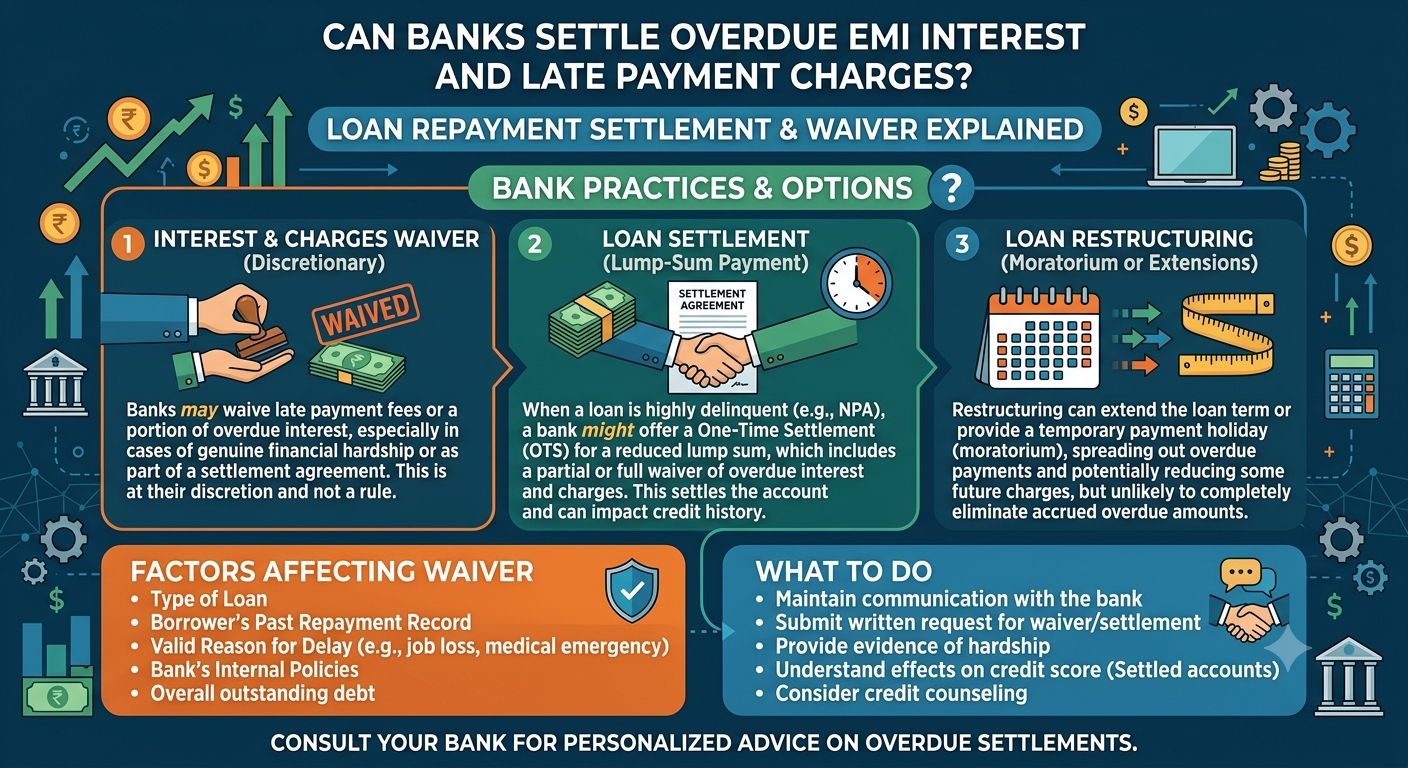
Falling behind on your Equated Monthly Instalments (EMIs) can quickly trigger a compound cycle of financial stress. When a few missed payments pile up, banks don’t just ask for the base amount—they start adding overdue interest, late payment penalties, penal interest, and administrative charges. Over time, these extra fees can accumulate into a sum that feels impossible to clear.
If you are facing mounting debt, a common question arises: Can banks actually settle overdue EMI interest and late payment charges?
The short answer is yes. Banks and Non-Banking Financial Companies (NBFCs) frequently offer concessions or complete waivers on penal interest and late fees through structured settlements. Understanding how this process works can help you break free from the debt trap.
Why Do Penalties and Late Charges Mount So Quickly?
When you miss an EMI deadline, your lender incurs administrative and risk-management costs. To encourage timely payments and mitigate risk, financial institutions impose two main types of extra charges:
- Late Payment Fees: Fixed or slab-based charges penalizing you for paying past the due date.
- Penal Interest: An additional percentage (typically 1% to 3% per month) calculated on the overdue amount over and above your base loan interest.
Because penal interest compounds over unpaid periods, a relatively small overdue principal can snowball into a massive sum within 6 to 12 months.
How Loan Settlement Works for Interest and Penalty Waivers
Banks prefer recovering their money over writing off loans completely. When a loan defaults past 90 days, it is classified as a Non-Performing Asset (NPA). At this stage, lenders know that recovering 100% of the dues might be unrealistic.
During negotiations, banks distinguish between two parts of your outstanding balance:
- The Principal & Base Interest: The core amount you borrowed plus standard interest. Lenders aim to recover as much of this as possible.
- Penal Charges & Late Fees: Ancillary fees added due to default. This is the easiest component to negotiate down or extinguish entirely.
In most settlement discussions, lenders are willing to waive 80% to 100% of accumulated late payment fees, penalty charges, and overdue interest if you agree to clear the agreed-upon principal balance through a one-time settlement (OTS).
Steps to Secure an EMI Interest and Late Fee Waiver
Navigating negotiations directly with a bank require a structured approach:
1. Identify Genuine Hardship
Banks do not grant waivers without valid cause. You must prove that your default was caused by circumstances beyond your control, such as job loss, critical medical emergencies, business downturns, or family crises.
2. Request a One-Time Settlement (OTS)
Submit a formal written request to your lender asking for a waiver on all penal interest and late charges while proposing a manageable lump-sum payment toward the remaining core balance.
3. Seek Professional Guidance
Negotiating with aggressive collection recovery teams can be daunting. Partnering with a dedicated loan settlement agency gives you an advocate who understands banking norms and legal rights. Expert agencies prevent harassment and handle end-to-end communication with bank officials.
Helpful Resources for Loan Settlement
Navigating default and recovery requires clear knowledge of options, strategies, and legal rights. Explore these essential resources for comprehensive advice on settling your liabilities:
- Learn the fundamental mechanics of settling debts by speaking to a certified loan settlement expert.
- Explore tailored solutions for personal, credit card, and business default through comprehensive loan settlement services.
- Understand your borrower rights during default using this detailed loan settlement advice guide.
- Review professional relief approaches offered by a established loan settlement agency.
- Consult a trained loan settlement expert to build a structured debt recovery roadmap.
- Evaluate one-time settlement options through specialized loan settlement services.
- Stop recovery agent harassment by engaging a legitimate loan settlement agency.
- Understand the impact of settlements on your CIBIL score with loan settlement strategic help.
- Compare various debt relief procedures offered by a qualified loan settlement expert.
- Get dedicated representation for complex bank negotiations through professional loan settlement services.
The Impact on Your Credit Score
While getting late fees and overdue interest waived provides immediate financial relief, it is important to understand the trade-off.
When a loan is settled for an amount lower than the full contractual obligation, the lender reports the account status to credit bureaus (such as CIBIL) as “Settled” rather than “Closed”. A “Settled” status will temporarily lower your credit score and remain on your credit history for several years.
However, if you are struggling with severe financial hardship, resolving the underlying debt and stopping the cycle of growing penalties is almost always better than remaining in active default. Once your financial situation stabilizes, you can take deliberate steps to rebuild your credit score.
Take Control of Your Financial Future
Banks are frequently willing to waive late charges, penal interest, and overdue fees—provided you present a solid, credible settlement plan. You do not have to navigate intimidating bank negotiations alone.
By working with experienced professionals, you can negotiate fair settlement terms, secure waivers on excessive charges, and gain a clear path toward becoming debt-free.