
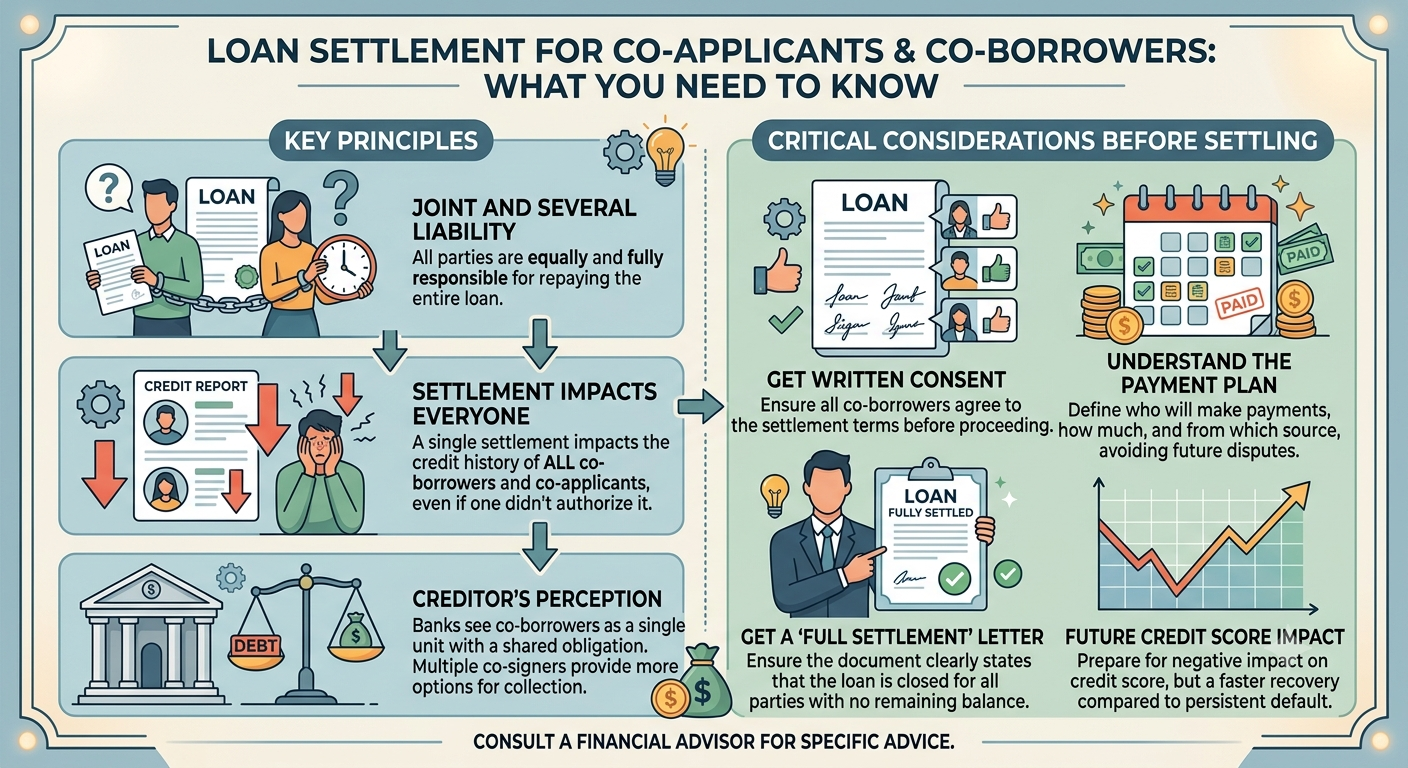
Taking out a loan with a co-applicant or co-borrower—whether a spouse, business partner, or family member—is a common strategy to boost loan eligibility, secure higher sanction amounts, or lower interest rates. However, when financial distress hits and monthly EMIs are defaulted, managing joint liability becomes exceedingly complex.
When joint loans enter default, borrowers often explore a One-Time Settlement (OTS) to compromise the debt and avoid legal fallout. Understanding how loan settlement affects co-borrowers, joint credit scores, and legal obligations is vital before entering negotiations with banks or Non-Banking Financial Companies (NBFCs).
The Legal Framework of Joint Loan Liability
Under banking laws and contract regulations, co-applicants and co-borrowers share “joint and several liability.” This legal principle dictates that both parties are individually and collectively responsible for 100% of the outstanding loan balance, regardless of who utilized the funds.
+-------------------------------------------------------------------------------+
|                       JOINT AND SEVERAL LIABILITY REALITY                     |
+-------------------------------------------------------------------------------+
| Primary Applicant Defaults  --> Lender retains 100% legal right to pursue     |
|                                  Co-Borrower / Guarantor for full recovery.    |
| Single Party Settles        --> Settlement does NOT automatically discharge   |
|                                  Co-Borrower unless explicitly framed.        |
+-------------------------------------------------------------------------------+
If the primary borrower experiences job loss, medical crises, or business failure, the lender turns directly to the co-borrower for full EMI recovery, legal notices, and asset attachment proceedings.
Key Impacts of Loan Settlement on Co-Borrowers
1. Dual Impact on Credit Scores
Credit bureaus like CIBIL, Experian, and CRIF High Mark link joint loans to the PAN cards of both applicants. If a joint loan is settled for a reduced amount, the remark “Settled” appears on the credit reports of both the primary borrower and the co-borrower, causing a significant drop in credit scores for both individuals.
2. Legal Action Against Both Parties
When joint loans default past 90 days and enter Non-Performing Asset (NPA) status, lenders issue legal notices—such as Section 138 cheque bounce notices or SARFAESI Act recovery notices—addressed to both co-applicants simultaneously.
3. Partial vs. Full Joint Settlement Traps
A critical trap occurs when one co-borrower attempts to settle “their share” of the loan without involving the other. Lenders rarely accept partial discharge; any compromise payment made by one applicant will merely be treated as a partial payment toward the total joint debt, leaving the co-borrower exposed to ongoing recovery efforts for the remaining balance.
Step-by-Step Settlement Strategy for Joint Loans
To ensure a settlement provides complete legal discharge for both co-applicants, follow a structured negotiation protocol:
- Unify the Hardship Strategy: Both co-borrowers must align on the settlement request. Submit a joint financial hardship dossier detailing why neither party can service the full debt load.
- Demand Joint Release in the Sanction Letter: Ensure the bank’s official Settlement Sanction Letter explicitly names both co-applicants and states that the agreed compromised sum releases both parties from all future liabilities.
- Obtain Individual No Dues Certificates: After payment is remitted directly into the bank’s official account, secure two separate No Dues Certificates (NDCs) or a joint NDC explicitly confirming zero outstanding dues for both PAN numbers.
Comparison: Individual vs. Joint Loan Settlement
| Parameter | Individual Loan Settlement | Joint Loan Settlement |
| Legal Liability | Restricted to primary borrower | Joint and several across both applicants |
| Credit Report Impact | Single credit score affected | Both co-borrowers’ credit scores drop |
| Sanction Letter Requirement | Single borrower discharge clause | Explicit joint discharge clause required |
| Recovery Agent Exposure | Primary borrower targeted | Primary borrower, co-borrower, and guarantor targeted |
Essential Resources for Co-Borrower Protection
Navigating joint legal liabilities, negotiating dual-party releases, and protecting co-borrowers from recovery harassment requires technical legal advocacy and banking expertise. Explore these specialized resources for guidance:
- Evaluate joint liability and defense strategies with a certified loan settlement expert.
- Explore tailored joint debt compromise solutions through professional loan settlement services.
- Learn how to structure joint hardship applications using complete loan settlement guides.
- Protect both co-applicants from aggressive recovery calls by partnering with a trusted loan settlement agency.
- Review your joint sanction letters and legal notices alongside an accredited loan settlement expert.
- Eliminate unfair penal charges and secure dual-party principal waivers through specialized loan settlement services.
- Manage SARFAESI notices and joint court summons supported by an established loan settlement agency.
- Understand bank credit committee policies regarding co-borrower releases through expert loan settlement advice.
- Safeguard the personal assets and legal rights of both applicants with help from a skilled loan settlement expert.
- Obtain institutional representation and documentation audits via dedicated loan settlement services.
- Secure official No Dues Certificates for both co-borrowers with assistance from a reputable loan settlement agency.
Final Thoughts
Settling a joint loan requires careful coordination between both co-applicants. By understanding joint and several liability, insisting on explicit joint discharge clauses in your sanction letter, and securing No Dues Certificates for both parties, co-borrowers can successfully resolve defaulted debts and move forward toward financial recovery.