
When facing overwhelming financial distress, defaulted EMIs, or aggressive debt recovery calls, a One-Time Settlement (OTS) often serves as the most practical path to financial recovery. However, one of the most pressing questions borrowers ask is: How long does the entire loan settlement timeline take from start to finish?
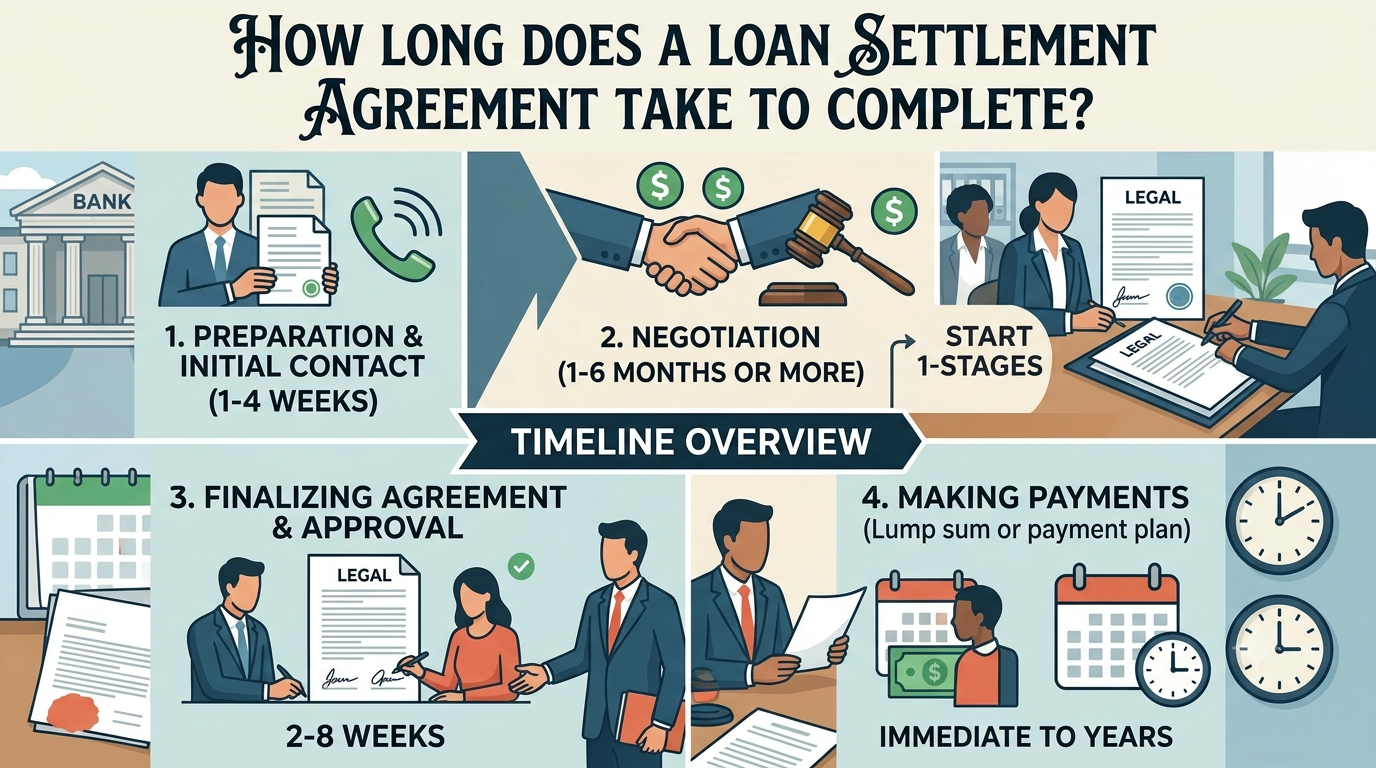
While every banking institution operates under distinct internal policies, a standard loan settlement process typically takes 3 to 6 months to complete. Factors such as the default duration, the complexity of your financial hardship, and the efficiency of your legal negotiations play a pivotal role in determining the final timeline.
Key Stages and Timeline Breakdown of Loan Settlement
Understanding each phase of the settlement journey helps borrowers navigate negotiations with realistic expectations and strategic clarity.
+-------------------------------------------------------------------------------+
|                        LOAN SETTLEMENT TIMELINE                               |
+-------------------------------------------------------------------------------+
| Phase 1: Initial Default & Account Classification     | Days 1 to 90          |
| Phase 2: Strategic Assessment & Hardship Filing       | Weeks 1 to 3          |
| Phase 3: Banking Committee Negotiations               | Weeks 4 to 8          |
| Phase 4: Formal Sanction Letter Issuance              | Weeks 8 to 12         |
| Phase 5: Payment Execution & No Dues Certificate      | Weeks 12 to 16+       |
+-------------------------------------------------------------------------------+
Phase 1: Account Classification (Days 1 to 90)
Before formal settlement negotiations begin, lenders usually wait until an account passes 90 days of non-payment, at which point it is classified as a Non-Performing Asset (NPA) under banking norms.
Lenders rarely enter compromise discussions during early delinquency (30 to 60 days overdue) because their primary focus remains on full recovery. Once an account reaches NPA status, credit managers recognize that a negotiated compromise is often preferable to prolonged litigation or total write-offs.
Phase 2: Hardship Evaluation and Dossier Filing (Weeks 1 to 3)
Once your account enters NPA status, formal settlement preparation begins. In this stage, you must build a bulletproof hardship dossier demonstrating genuine inability to pay.
Key activities during this window include:
- Gathering proof of financial distress (e.g., medical bills, job loss notices, or audited business loss reports).
- Auditing outstanding balances, penal interest, late fees, and bounce charges.
- Drafting a legal hardship proposal with a realistic lump-sum offer.
Phase 3: Credit Committee Negotiations (Weeks 4 to 8)
This is typically the longest phase of the process. Your hardship proposal must pass through multiple levels of approval within the bank or Non-Banking Financial Company (NBFC), including the Nodal Officer, Recovery Head, and Credit Sanction Committee.
During these weeks, counter-offers are exchanged. Lenders evaluate your asset holding, current income, and liquidation value to decide the maximum discount they can offer on the principal amount.
Phase 4: Sanction Letter Issuance (Weeks 8 to 12)
Once an agreement is reached, the bank generates an official Settlement Sanction Letter on bank letterhead. Reviewing this document carefully is critical:
- Verify the exact compromised settlement amount.
- Confirm the strict payment due date.
- Ensure a clause guarantees full debt discharge and the issuance of a No Dues Certificate (NDC) upon payment.
Phase 5: Payment Execution & Legal Closure (Weeks 12 to 16+)
After the sanction letter is issued, the borrower completes the payment either in a single lump sum or through agreed short-term installments (usually within 30 to 90 days). Once funds clear, the bank terminates pending legal notices and issues an official No Dues Certificate, bringing the loan agreement to formal completion.
Factors That Can Speed Up or Delay the Timeline
- Unsecured vs. Secured Debt: Unsecured personal loans and credit cards settle significantly faster than home loans or LAP (Loan Against Property), where legal title checks and property valuations add several weeks.
- Availability of Lump-Sum Funds: Having settlement funds ready accelerates the closing phase immediately after approval.
- Professional Representation: Navigating institutional bureaucracy alone can lead to delays or unfair terms, whereas experienced advocates streamline communications.
Helpful Resources and Guidance
To help you navigate each step of the negotiation process, protect your rights, and secure favorable settlement terms, consult these expert resources:
- Gain clarity on bank negotiation procedures by consulting an experienced loan settlement expert.
- Explore customized debt relief programs for personal loans and credit cards through loan settlement services.
- Learn how to evaluate realistic settlement discounts and timelines using complete loan settlement resources.
- Protect yourself from aggressive recovery calls by partnering with a trusted loan settlement agency.
- Review your legal options and hardship documentation with a certified loan settlement expert.
- Waive illegal penal charges and negotiate optimal principal reductions through specialized loan settlement services.
- Manage legal notices and tribunal proceedings safely under the guidance of a dedicated loan settlement agency.
- Understand the step-by-step process of clearing defaults through professional loan settlement advice.
- Safeguard your assets and credit recovery roadmap with direct assistance from a skilled loan settlement expert.
- Obtain complete administrative and legal backing from professional loan settlement services.
- Secure your official No Dues Certificate and complete legal discharge with an established loan settlement agency.
Final Thoughts
While completing a loan settlement agreement requires patience and structured negotiation across 3 to 6 months, it provides an invaluable opportunity to stop spiraling debt, end interest accumulation, and halt legal actions. By understanding the timeline and working with seasoned legal professionals, borrowers can navigate the process smoothly and achieve lasting financial freedom.