
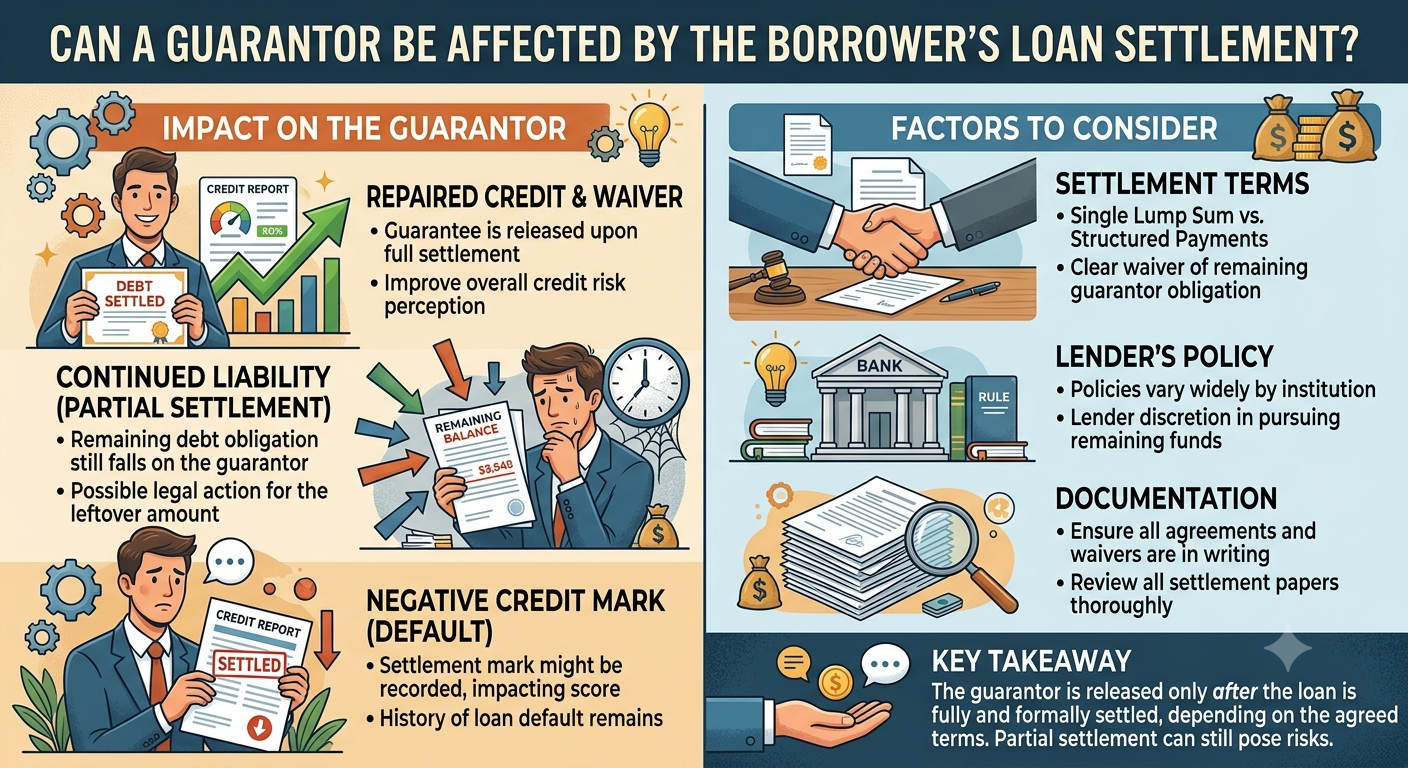
When a primary borrower defaults on a loan, the consequences ripple far beyond their personal finances. One individual who often finds themselves caught in the crossfire is the guarantor. While guaranteeing a loan for a friend, family member, or business partner may seem like a routine act of support, the legal and financial liabilities attached to a guarantee are profound.
When a defaulted loan undergoes a One-Time Settlement (OTS), primary borrowers often assume that resolving the debt frees everyone involved. However, the critical question remains: Can a guarantor still be affected by the primary borrower’s loan settlement?
The short answer is yes. Unless the settlement agreement is explicitly structured to discharge both the primary borrower and the guarantor, the guarantor faces serious legal exposure, credit score damage, and ongoing recovery actions.
Understanding the Legal Liability of a Guarantor
Under contract law and banking regulations, a guarantor does not merely act as a character reference. A guarantor provides a legally binding undertaking to fulfill the borrower’s obligation if the primary debtor fails to pay.
+-------------------------------------------------------------------------------+
|                       GUARANTOR LEGAL LIABILITY REALITY                       |
+-------------------------------------------------------------------------------+
| Primary Borrower Defaults   -->  Lender acquires immediate legal right to     |
|                                  demand 100% repayment from the Guarantor.    |
| Primary Borrower Settles    -->  If the Sanction Letter omits the Guarantor, |
|                                  lenders can pursue the Guarantor for the     |
|                                  waived/unpaid balance.                       |
+-------------------------------------------------------------------------------+
This legal relationship is defined as co-extensive liability. The lender is not obligated to exhaust all legal remedies against the primary borrower before targeting the guarantor; they can initiate recovery proceedings against either party simultaneously.
Key Ways a Borrower’s Settlement Impacts the Guarantor
1. Severe Credit Score Impact
Credit reporting agencies (such as CIBIL, Experian, and CRIF High Mark) link guaranteed loans directly to the guarantor’s profile. When the primary loan defaults or gets settled for a compromised amount, the remark “Settled” or “Written-Off” is reflected on the guarantor’s credit report as well, leading to a sharp decline in their credit score.
2. Risk of Recovery Action for the Waived Balance
If a primary borrower negotiates a settlement independently without securing a full joint discharge, the lender may treat the unpaid balance as an outstanding liability against the guarantor. The bank retains the legal right to demand the remaining shortfall from the guarantor unless a complete discharge clause is included in the sanction letter.
3. Exposure to Legal Notices and Tribunal Actions
When an account enters Non-Performing Asset (NPA) status, recovery notices—including demand notices under the SARFAESI Act or Debt Recovery Tribunal (DRT) summons—are issued to both the primary borrower and the guarantor.
How to Protect a Guarantor During Loan Settlement
To ensure that a One-Time Settlement provides full legal immunity to the guarantor, follow these critical steps during negotiations:
- Include Guarantor Discharge in the Hardship Proposal: The primary borrower must submit a hardship petition that explicitly requests full release for both the borrower and the guarantor.
- Verify the Settlement Sanction Letter: Ensure the official Settlement Sanction Letter issued by the bank explicitly names the guarantor and confirms that upon receipt of the settlement sum, all claims against the guarantor are fully extinguished.
- Secure Dual No Dues Certificates: After the settlement funds are paid directly into the bank’s account, obtain an official No Dues Certificate (NDC) or No Objection Certificate (NOC) that clearly frees both the borrower and the guarantor from all ongoing liabilities.
Guarantor Impact: Settlement vs. Full Repayment
| Impact Factor | Standard Full Repayment | Borrower Loan Settlement (OTS) |
| Credit Report Status | Account marked “Closed” | Account marked “Settled” on guarantor profile |
| Ongoing Legal Liability | Completely extinguished | Extinguished only if explicitly named in Sanction Letter |
| Future Borrowing Capacity | Preserved / Enhanced | Impaired due to credit score drop |
| Recovery Agent Calls | Stopped immediately | Stopped only after joint NDC issuance |
Helpful Resources and Expert Guidance
Navigating guarantor liability, negotiating joint releases with credit committees, and auditing bank sanction letters requires technical legal knowledge and financial advocacy. Explore these dedicated resources for support:
- Evaluate guarantor legal exposures and defense options with a certified loan settlement expert.
- Explore tailored joint release and debt negotiation plans through loan settlement services.
- Learn how to structure complete guarantor releases using comprehensive loan settlement guides.
- Protect guarantors from aggressive recovery harassment by partnering with a trusted loan settlement agency.
- Review your guarantee agreements and bank notices alongside an accredited loan settlement expert.
- Waive illegal penal charges and secure full guarantor discharges through specialized loan settlement services.
- Manage SARFAESI notices and DRT proceedings supported by an established loan settlement agency.
- Understand banking guidelines and co-extensive liabilities with expert loan settlement advice.
- Safeguard your personal assets and credit recovery path with direct assistance from a skilled loan settlement expert.
- Obtain institutional representation and sanction letter audits via professional loan settlement services.
- Secure an official No Dues Certificate (NDC) for both borrower and guarantor with an experienced loan settlement agency.
Final Thoughts
A guarantor is heavily affected by a primary borrower’s loan default and subsequent settlement. By ensuring the guarantor is explicitly included in all negotiation discussions, insisting on precise legal phrasing in the Settlement Sanction Letter, and securing an official No Dues Certificate, both parties can successfully resolve the debt and achieve lasting financial recovery.