
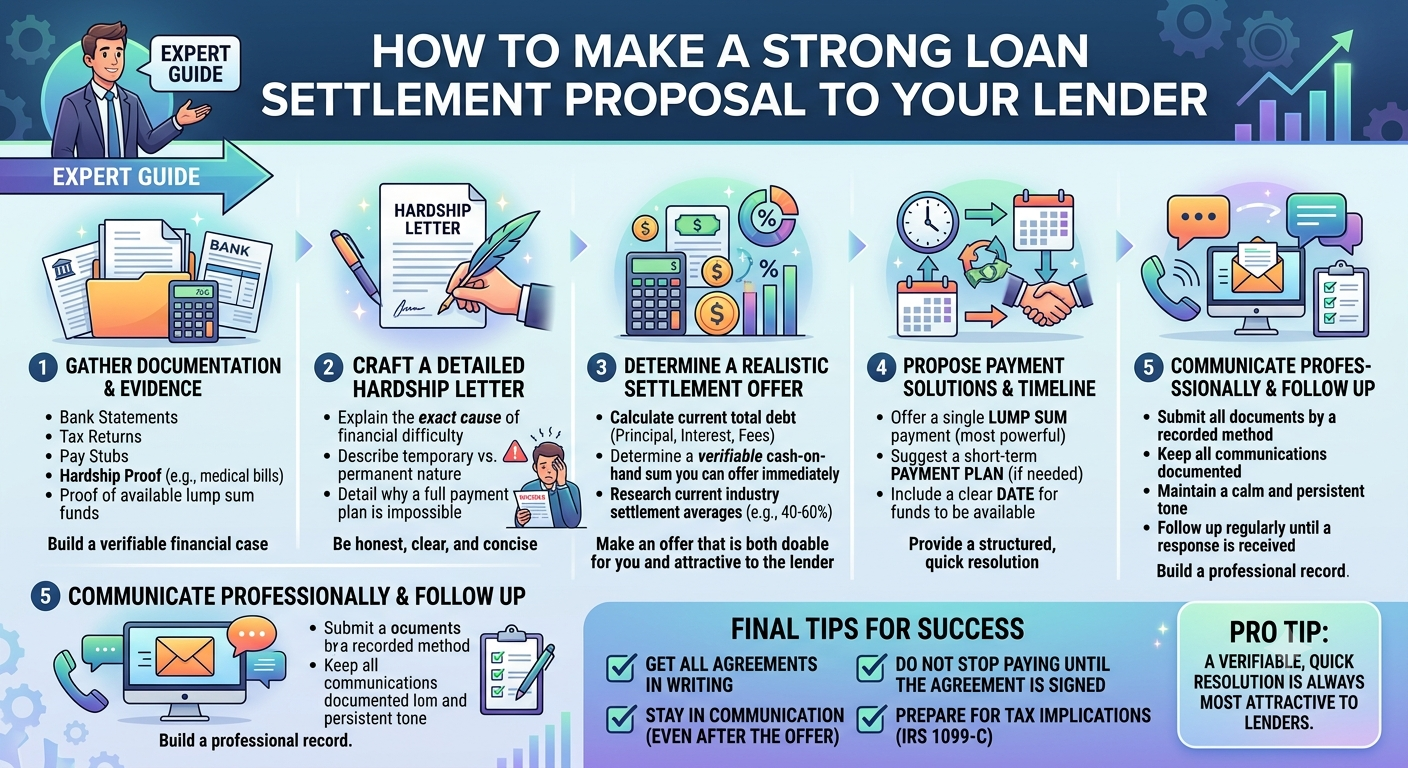
When financial hardships—such as job loss, medical emergencies, or severe business downturns—make regular debt payments impossible, entering into a One-Time Settlement (OTS) can provide a realistic path forward. A settlement allows a borrower to pay a mutually agreed discounted lump-sum amount to extinguish their debt, while the lender waives accumulated penal charges and a portion of the principal balance.
However, banks and Non-Banking Financial Companies (NBFCs) do not grant debt waivers easily. To succeed, you must submit a well-crafted, documented, and professional Loan Settlement Proposal.
Understanding how to construct a strong proposal increases your chances of securing maximum waivers while ensuring full legal discharge from your liabilities.
The Architecture of a Convincing Settlement Proposal
A loan settlement proposal is more than just an offer to pay a lower sum. It is a formal legal and financial petition presented to the credit committee or Nodal Officer of the financial institution.
+-------------------------------------------------------------------------------+
|                    LOAN SETTLEMENT PROPOSAL WORKFLOW                          |
+-------------------------------------------------------------------------------+
| Section 1: Borrower Details & Account Summary (Loan ID, Original Sum, DPD)    |
| Section 2: Statement of Genuine Involuntary Financial Hardship                |
| Section 3: Financial & Audit Breakdown (Core Principal vs. Penalties)          |
| Section 4: Specific Settlement Offer (Lump Sum Figure & Payment Timeline)     |
| Section 5: Demands for Waiver, Legal Case Withdrawal & No Dues Certificate   |
+-------------------------------------------------------------------------------+
Key Elements of an Effective Settlement Proposal
To maximize your leverage during negotiations, your written proposal should incorporate these essential components:
1. Detailed Account and Debt Summary
Begin by stating your complete identification details, loan account number, home branch, original loan sanction amount, and current overdue status (Days Past Due or DPD). Establishing clarity up front ensures your file is processed quickly by the bank’s recovery department.
2. Unassailable Evidence of Financial Hardship
Banks are legally mandated by regulatory frameworks to distinguish between genuine, involuntary defaulters and willful defaulters. Your proposal must clearly detail the unexpected events that led to your default. Attach verifiable supporting documents, such as:
- Employment termination or pink slips.
- Medical diagnosis reports and hospital bill receipts.
- Audited financial statements showing severe business losses.
- Bank statements reflecting reduced income streams.
3. Audit Breakdown of Core Principal vs. Penalties
Request an official Statement of Account (SOA) and break down your total outstanding balance. Clearly separate your core unpaid principal balance from accumulated penal interest, late payment fines, and auto-debit bounce fees. Request a 100% waiver of all penal charges and present a discounted compromise offer focused solely on the core principal.
4. Clear Lump-Sum Offer and Repayment Schedule
Specify the exact amount you are capable of paying to settle the debt in full. Start your opening offer at 25% to 35% of the total claim (or roughly 40% to 50% of the core principal), allowing room for counter-negotiation. Clearly state how you plan to fund this payment (e.g., support from family or asset liquidation) and commit to a strict remittance timeline upon receipt of a formal sanction letter.
5. Demand for Legal Withdrawals and Official Clearance
Explicitly state that your payment is contingent upon the bank issuing an official Settlement Sanction Letter on bank letterhead. Ensure the proposal mandates that, upon payment:
- All active legal proceedings (Section 138 cheque bounce complaints, Section 25 PSSA cases, DRT filings) will be unconditionally withdrawn.
- An official No Dues Certificate (NDC) or No Objection Certificate (NOC) will be issued.
- The account status will be updated across credit bureaus (CIBIL, Experian, High Mark) with zero balance owing.
Settlement Proposal: Weak vs. Strong Approach
| Element | Weak / Informal Approach | Strong / Structured Proposal |
| Communication Mode | Verbal calls with collection agents | Formal written proposal to Nodal Officer / Legal Desk |
| Hardship Proof | Verbal claims without documentation | Attached pink slips, medical records, or tax returns |
| Financial Target | Vague requests to “reduce total debt” | Itemized SOA audit asking for 100% penal waiver |
| Legal Terms | Verbal promise of case closure | Mandatory written sanction letter & court case withdrawal |
Essential Resources for Structuring Your Settlement Proposal
Drafting a legal response, auditing loan statements, and presenting a strong hardship file to bank credit committees require specialized financial and legal support. Explore these dedicated resources for expert assistance:
- Consult an experienced loan settlement expert to evaluate your hardship dossier and draft a proposal.
- Protect yourself from recovery harassment and negotiate structured waivers through loan settlement services.
- Learn how to structure compromise offers using complete loan settlement guides.
- Safeguard your legal rights and halt agent harassment with help from a trusted loan settlement agency.
- Review your loan statements and penal charges alongside an accredited loan settlement expert.
- Eliminate illegal bounce fees and secure principal discounts through professional loan settlement services.
- Manage court case withdrawals and arbitration notices supported by an established loan settlement agency.
- Understand bank recovery policies and regulatory frameworks with expert loan settlement guidance.
- Resolve high-interest credit card and personal debt traps with support from a skilled loan settlement expert.
- Obtain institutional representation during lender negotiations using comprehensive loan settlement services.
- Secure an official No Dues Certificate (NDC) and full legal discharge with an experienced loan settlement agency.
Final Thoughts
A strong loan settlement proposal is your most effective tool for resolving overwhelming debt. By documenting your financial hardship, auditing your statement of account, submitting a clear lump-sum offer, demanding formal sanction letters, and seeking expert guidance, you can negotiate a fair resolution and take a firm step toward financial freedom.