
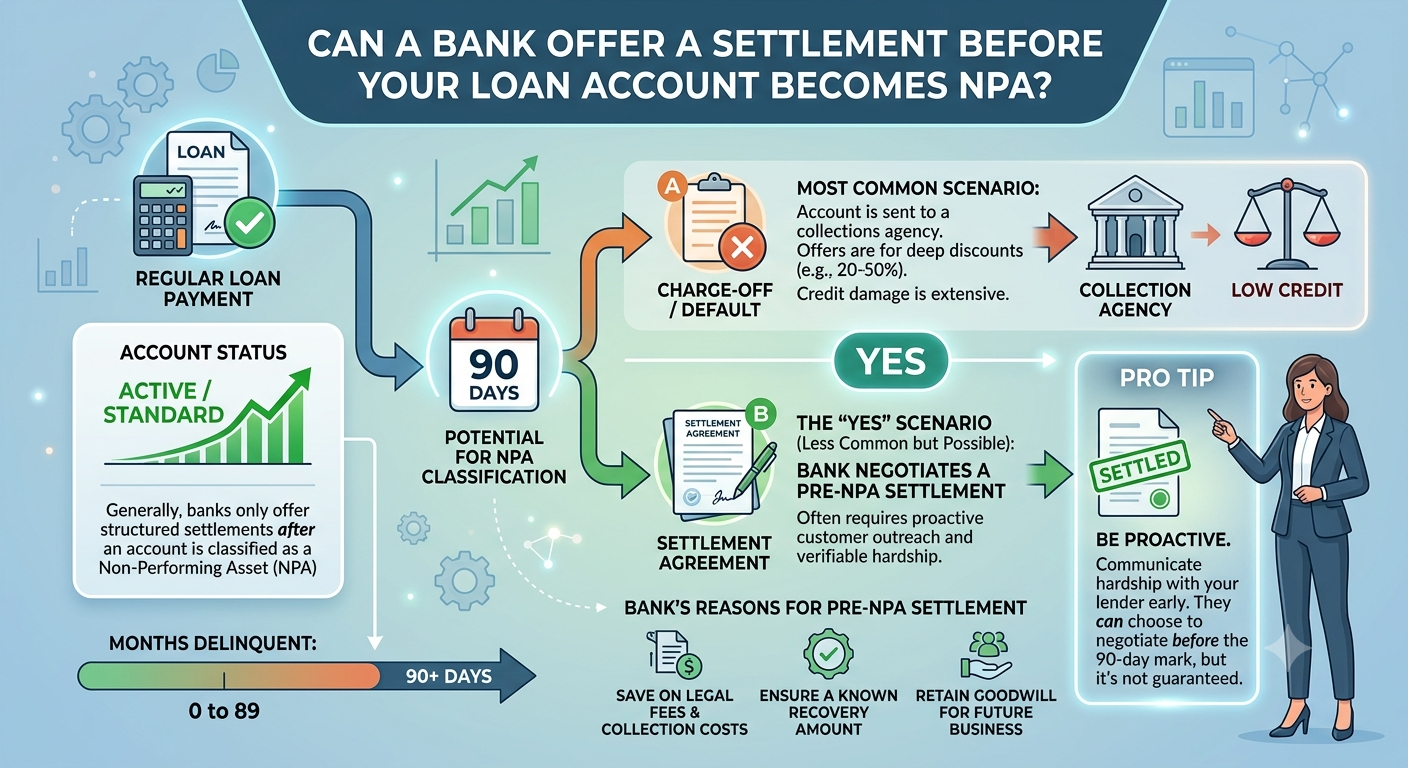
When borrowers face sudden financial challenges—such as job loss, medical emergencies, or severe business downturns—meeting regular Equated Monthly Installment (EMI) deadlines becomes increasingly difficult. As missed payments accumulate, anxiety builds over impending default. A common question among struggling borrowers is: Can a bank offer a settlement before your loan account officially becomes a Non-Performing Asset (NPA)?
Understanding how lenders handle pre-NPA stages, Reserve Bank of India (RBI) frameworks, and early compromise options can help you resolve debt before aggressive recovery actions begin.
What Happens Before a Loan Account Becomes an NPA?
Under standard banking regulations, a loan is categorized as a Non-Performing Asset when EMI payments remain unpaid for 90 consecutive days. Before reaching this 90-day threshold, the account passes through designated Special Mention Account (SMA) sub-categories:
+-------------------------------------------------------------------------------+
|                       PRE-NPA STAGES & TIMELINE                               |
+-------------------------------------------------------------------------------+
| SMA-0 : Overdue 1 to 30 Days    --> Initial missed payment & SMS reminders    |
| SMA-1 : Overdue 31 to 60 Days   --> Soft collection calls & late fee warnings  |
| SMA-2 : Overdue 61 to 90 Days   --> Formal warning notices & high NPA risk    |
| NPA   : Overdue 90+ Days        --> Account classified as NPA; Legal action   |
+-------------------------------------------------------------------------------+
During the SMA stages (0 to 60 days), banks generally prioritize full recovery, loan restructuring, or EMI tenure extensions. Because the account is not yet classified as an NPA, financial institutions are typically reluctant to grant a principal waiver, as doing so requires immediate loss provisioning on their balance sheets.
Can You Settle Before the 90-Day NPA Threshold?
While rare, pre-NPA loan settlements are legally and operationally possible, particularly under specific conditions:
- Compromise Settlement Frameworks: Guidance issued by regulatory authorities allows financial institutions to enter into compromise settlements or technical write-offs for accounts experiencing severe, irreversible financial distress—even before formal NPA classification.
- Proactive Proof of Irrecoverability: If a borrower provides definitive proof that future income recovery is impossible (such as permanent medical disability or terminal business closure), a bank may initiate an early settlement to avoid legal fees and prolonged recovery efforts.
- High-Stress SMA-2 Accounts: When an account reaches SMA-2 status (61–90 days overdue), the lender’s risk department recognizes the imminent transition to an NPA. In select cases, early compromise offers may be evaluated to recover maximum principal before mandatory provisioning kicks in.
However, in the majority of retail loan cases, banks wait for the account to complete the 90-day cycle into NPA status before issuing an official One-Time Settlement (OTS) sanction letter.
Pre-NPA Options vs. Post-NPA Settlement
| Parameter | Pre-NPA Phase (1–89 Days Overdue) | Post-NPA Phase (90+ Days Overdue) |
| Primary Bank Objective | EMI restructuring or full recovery | Debt resolution & capital retrieval |
| Likelihood of Principal Waiver | Very Low | High (30% to 70% waivers typical) |
| Impact on Credit Bureau | Reported as “Overdue” / “SMA” | Reported as “Settled” / “Written Off” |
| Primary Settlement Offer | Tenure extension / EMI lowering | One-Time Lump Sum Settlement (OTS) |
Strategic Steps to Approach Your Lender Early
If you are struggling with payments during the pre-NPA stage, taking early, structured steps can protect your legal standing and prepare you for negotiations:
1. Compile an Unassailable Hardship File
Do not rely on informal phone conversations. Assemble a comprehensive hardship dossier containing medical records, income tax returns, termination letters, or audited loss statements. Verifiable evidence demonstrates that your default stems from genuine distress rather than willful default.
2. Request a Statement of Account (SOA)
Obtain an official SOA to inspect accrued fees. Separate your true unpaid principal from accumulated penal interest, bounce fees, and late charges. In any negotiation, your objective should be a 100% waiver of penal fees alongside a reasonable reduction in the base principal balance.
3. Escalate Directly to Nodal Officers
Avoid negotiating exclusively with tele-callers or collection agents who lack authority to grant waivers. Direct formal hardship applications to the bank’s Nodal Officer, Recovery Department, or internal legal desk.
4. Secure a Formal Written Settlement Sanction Letter
Never deposit money based on verbal assurances or informal communications. Payment should only be remitted after receiving an official Settlement Sanction Letter printed on bank letterhead, explicitly detailing the compromised sum, payment deadline, and confirmation of account closure.
Essential Resources for Loan Settlement & Recovery Resolution
Navigating lender negotiations, reviewing settlement terms, and addressing recovery issues require specialized legal and financial expertise. Explore these dedicated resources for assistance:
- Consult an experienced loan settlement expert to evaluate your pre-NPA options and hardship dossier.
- Protect yourself from aggressive recovery tactics through structured loan settlement services.
- Understand the step-by-step negotiation process using detailed loan settlement guides.
- Safeguard your legal rights and halt harassment with a reputable loan settlement agency.
- Review your account statement and penal charges alongside a certified loan settlement expert.
- Eliminate illegal bounce fees and secure principal waivers using dedicated loan settlement services.
- Handle bank notices and legal escalations with guidance from an established loan settlement agency.
- Learn about regulatory guidelines and borrower rights via informative loan settlement insights.
- Resolve high-interest credit card and personal debt traps with support from a skilled loan settlement expert.
- Obtain institutional representation during lender discussions through expert loan settlement services.
- Obtain your official No Dues Certificate (NDC) and full legal discharge with an experienced loan settlement agency.
Final Thoughts
While banks prefer restructuring or full recovery during the pre-NPA stage, early settlement discussions remain viable under documented financial distress. By preparing a clear hardship dossier, communicating in writing with authorized officers, insisting on formal sanction letters, and seeking expert guidance, you can navigate pre-NPA challenges and secure a sustainable financial resolution.