
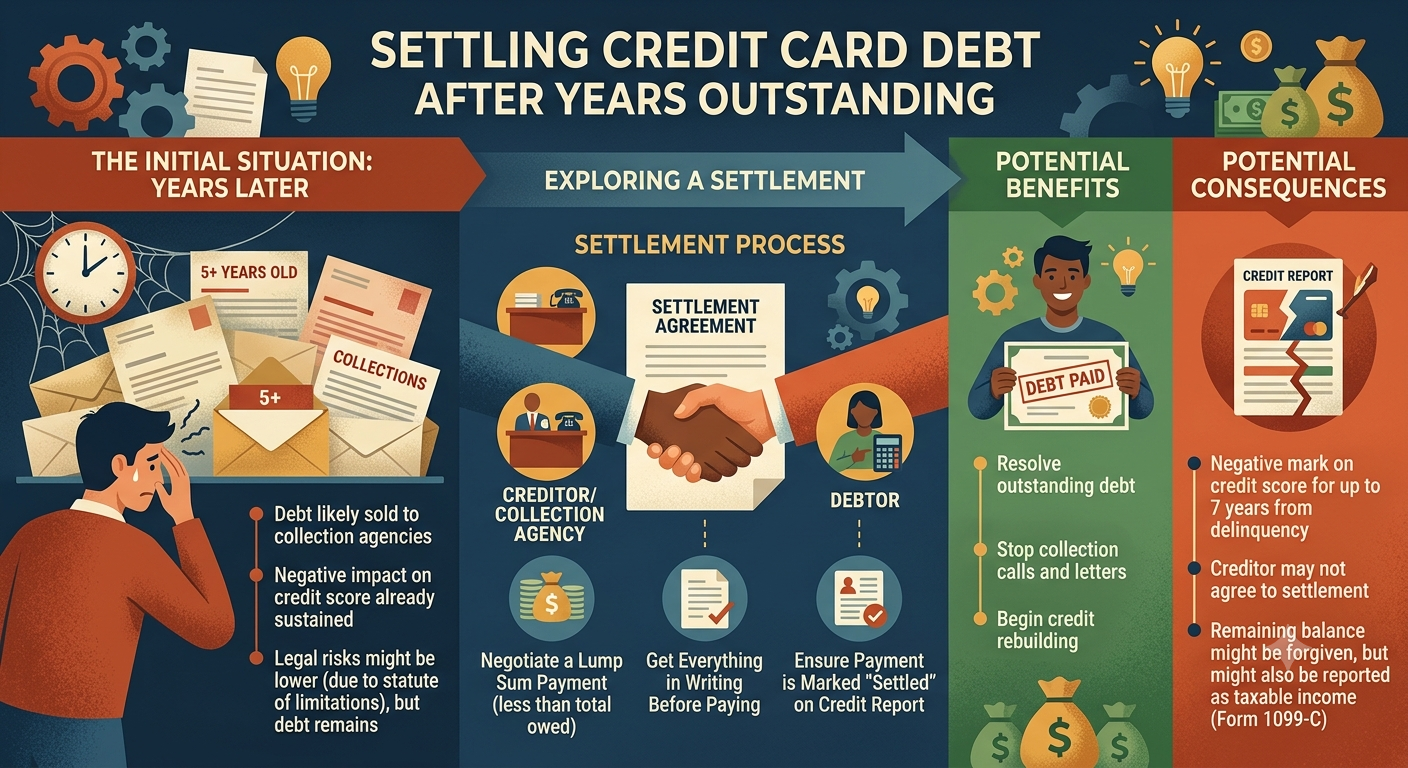
Carrying credit card debt for years can feel like an unending financial burden. Unpaid balances compound rapidly due to soaring interest rates, late fees, and penal charges. Borrowers often face relentless recovery calls, formal legal notices, and severe damage to their credit scores.
If you have defaulted on a credit card for years, you might wonder: Is it still possible to settle the debt, or is it too late?
The short answer is yes. Banks and credit card issuers are often highly motivated to negotiate a One-Time Settlement (OTS) on long-overdue accounts to recover at least a portion of their funds rather than writing them off completely.
Why Banks Agree to Settle Old Credit Card Dues
When a credit card account remains unpaid for several years, it undergoes specific institutional classifications under banking regulations.
+-------------------------------------------------------------------------------+
|                      OLD CREDIT CARD DEBT EVOLUTION                           |
+-------------------------------------------------------------------------------+
| Standard Account (0-90 Days Overdue)    | Full Recovery Focus                 |
| Non-Performing Asset (NPA) (90+ Days)   | Initial Recovery & Legal Notices    |
| Written-Off / Loss Asset (1+ Years)     | Compromise & Settlement Openings    |
+-------------------------------------------------------------------------------+
- Classification as a Loss Asset: After prolonged non-payment, banks classify the debt as a “Written-Off” or “Loss Asset.” While writing off the debt removes it from the bank’s active balance sheet, the legal obligation to repay remains.
- High Cost of Litigation: Pursuing legal recovery or arbitration for unsecured credit card debt is expensive and time-consuming for lenders.
- Capital Provisioning Relief: Holding bad debts requires banks to set aside capital provisions. Settling old accounts allows banks to clear bad debts, improve asset quality, and release tied-up capital.
Key Challenges When Settling Aged Credit Card Debt
While settling old credit card dues is entirely possible, aged accounts present unique obstacles:
- Inflated Balances: Over several years, original balances can double or triple due to accumulated penal interest and administrative fees. Negotiations must focus on discounting these artificial penalties to settle near the original principal amount.
- Third-Party Recovery Agencies: Old debts are frequently assigned to external recovery agencies. These agents may use aggressive tactics or offer unverified verbal settlement terms that the bank later rejects.
- Statute of Limitations Risks: Depending on local jurisdiction laws, lenders have a limited legal window (typically three years from the default date) to file civil recovery suits. However, making a partial payment or signing an acknowledgment of debt can reset this limitation clock.
Step-by-Step Approach to Settling Old Credit Card Debt
To secure a valid settlement and avoid common traps, follow a structured process:
Step 1: Verify the Genuine Outstanding Balance
Request an updated, itemized statement of account directly from the bank’s central nodal office—not from third-party recovery agents. Distinguish between the base principal amount and added interest/penalties.
Step 2: Prepare Hardship Documentation
Compile clear proof showing why the debt was unpaid for years (e.g., job loss, medical emergencies, or business failure) and demonstrate your current inability to pay the full inflated balance.
Step 3: Issue a Formal Settlement Proposal
Submit a written compromise offer proposing a realistic lump-sum payment (often starting at 25% to 40% of the total claim). Emphasize that this payment is contingent upon a full balance waiver and an official sanction letter.
Step 4: Verify the Sanction Letter & Pay Directly
Never pay based on verbal promises. Obtain a formal Settlement Sanction Letter on bank letterhead, verify its authenticity, and make the payment directly to the bank’s official account.
Step 5: Obtain the No Dues Certificate
After payment clears, obtain a formal No Dues Certificate (NDC) confirming full legal discharge of the debt.
Comparison of Debt Resolution Options for Old Cards
| Option | Financial Impact | Credit Report Status | Best Suited For |
| Full Repayment | High cash outlay | Account marked “Closed” | Those looking to restore credit quickly |
| One-Time Settlement | 30%–60% savings | Account marked “Settled” | Those facing severe long-term hardship |
| Ignoring the Debt | Ongoing legal risks | Account marked “Written Off” | Not recommended under any circumstance |
Essential Resources for Settling Aged Debt
Navigating bank bureaucracy, auditing inflated statements, and securing legal discharge on old credit card accounts requires specialized guidance. Use these expert resources to navigate the process:
- Evaluate your eligibility for aged debt waivers with a certified loan settlement expert.
- Explore structured options for old credit card balances through professional loan settlement services.
- Learn how to calculate realistic compromise percentages using complete loan settlement guides.
- Protect yourself from aggressive recovery agency calls by partnering with a trusted loan settlement agency.
- Review your financial hardship dossier with an experienced loan settlement expert.
- Waive accumulated penal interest and late fees using specialized loan settlement services.
- Manage legal notices and arbitration threats supported by an established loan settlement agency.
- Understand bank credit committee policies on written-off accounts through expert loan settlement advice.
- Safeguard your assets and legal rights during negotiations with aid from a skilled loan settlement expert.
- Obtain institutional representation and direct bank escalation via dedicated loan settlement services.
- Secure your official No Dues Certificate (NDC) and legal discharge letter with help from a reputable loan settlement agency.
Final Thoughts
Settling a credit card after years of non-payment is one of the most effective ways to close a painful financial chapter. By negotiating directly with authorized bank channels, verifying settlement letters, and securing proper legal paperwork, you can eliminate lingering debt and start rebuilding your financial life.