
Running a business in India comes with inherent commercial risks, cash flow volatility, and unexpected market shifts. When market demand falls, working capital gets blocked, or major clients delay payments, small and medium enterprise (SME) owners often struggle to meet monthly Equated Monthly Installment (EMI) obligations. As default periods lengthen, compounding interest, penal charges, and recovery notices create severe pressure.
When business recovery becomes unviable, a One-Time Settlement (OTS) offers a legal mechanism to compromise the debt, eliminate penal charges, and resolve commercial liabilities. Understanding the exact timing and eligibility criteria for requesting a business loan settlement is critical for entrepreneurs seeking financial recovery.
Understanding the Banking Framework for Commercial Loan Settlement
Under Reserve Bank of India (RBI) guidelines, banks and Non-Banking Financial Companies (NBFCs) maintain explicit frameworks for compromising non-performing accounts. Lenders recognize that commercial failure is a reality of enterprise, making negotiated compromise settlements preferable to protracted legal proceedings.
+-------------------------------------------------------------------------------+
|                    BUSINESS LOAN DEFAULT TIMELINE & OTS ELIGIBILITY           |
+-------------------------------------------------------------------------------+
| Standard Account (0-90 Days Overdue)    | Early Delinquency; Full Recovery Focus |
| Non-Performing Asset (NPA) (90+ Days)   | OTS Negotiations Open                 |
| Loss Asset / DRT Proceedings (1+ Years) | Maximum Discount & Compromise Window  |
+-------------------------------------------------------------------------------+
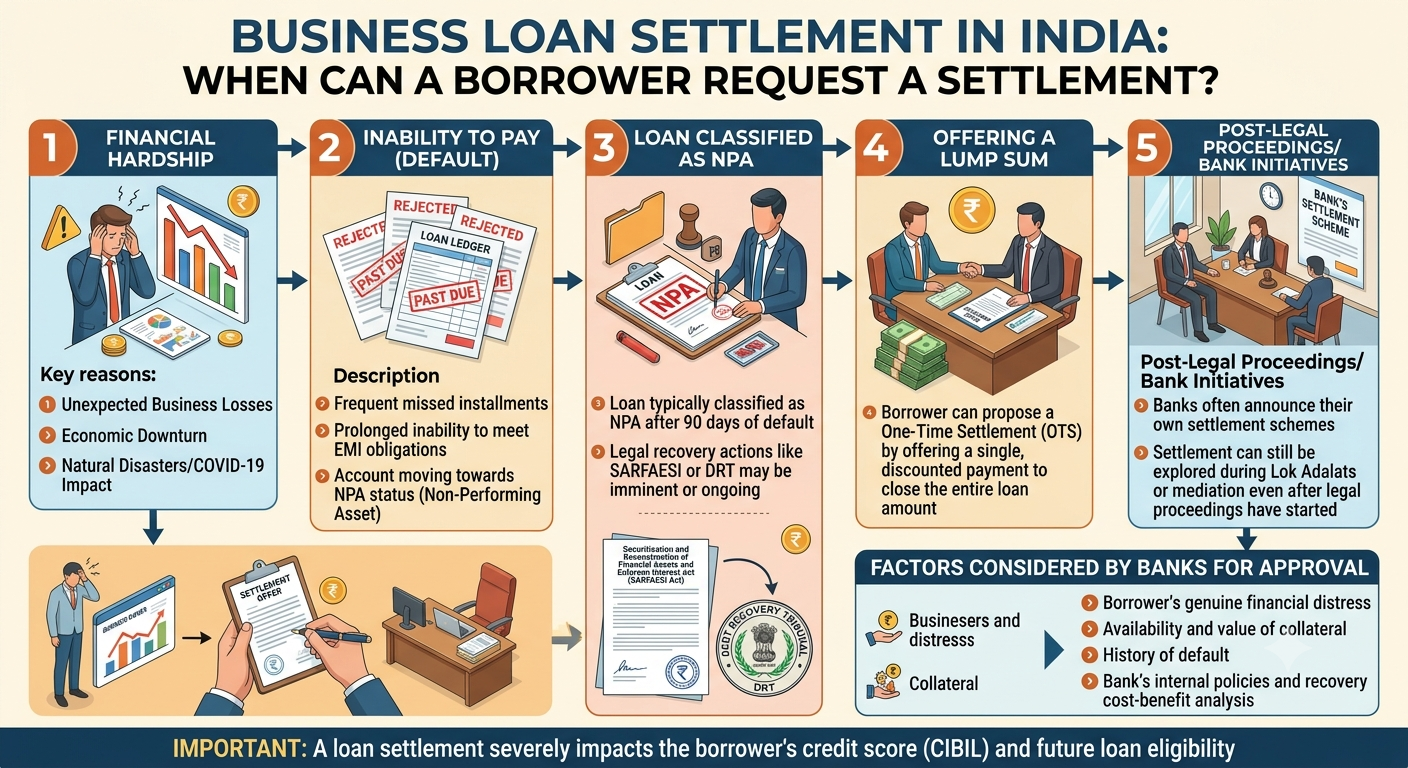
Key Triggers: When Can a Borrower Request a Settlement?
Borrowers cannot request a settlement the moment they face temporary cash flow tightness. Lenders evaluate compromise proposals under specific institutional conditions:
1. Account Classification as a Non-Performing Asset (NPA)
Banks typically do not enter settlement discussions during early default (SMA-0, SMA-1, or SMA-2 stages, spanning 1 to 90 days). Negotiations formally open once an account crosses 90 days of non-payment and is classified as an NPA. At this stage, credit committees recognize the risk of total loss and become open to restructuring or settlement.
2. Evidence of Involuntary Financial Hardship
Lenders require clear proof that non-payment stems from genuine commercial loss rather than willful default. Borrowers can initiate settlement discussions when they can document:
- Severe revenue contraction verified by audited Profit & Loss statements and GST returns.
- Major client insolvency, cancelled contracts, or unrecoverable trade receivables.
- Operational disruptions caused by health crises, partnership disputes, or regulatory shifts.
3. Exhaustion of Business Restructuring Options
A settlement request is most viable when alternative debt resolution options—such as EMI tenure extension, moratorium requests, or working capital restructuring—have failed to restore account health.
Step-by-Step Approach to Initiating a Business Loan Settlement
- Audit Total Business Liabilities: Compile an itemized list of all outstanding debts, distinguishing base principal balances from penal interest, bounce fees, and late charges.
- Build a Hardship Dossier: Gather official documents including tax filings, bank statements, client cancellation notices, and legal correspondence.
- Draft a Formal Compromise Proposal: Submit a written proposal to the bank’s Nodal Officer or Recovery Manager, detailing the commercial losses and offering a realistic lump-sum settlement figure.
- Obtain an Official Sanction Letter: Ensure all agreed terms, payment deadlines, and balance waivers are documented in a formal sanction letter printed on bank letterhead before remitting funds.
Unsecured vs. Secured Business Loan Settlements
| Feature | Unsecured Business Loans | Secured Loans (LAP / Machinery) |
| Collateral Underlying | None | Real estate, plant, or machinery |
| Negotiation Flexibility | High (Up to 50%–75% discount) | Moderate (Focus on penal fee waivers) |
| Legal Escalation Risk | Section 138 (Cheque Bounce) | SARFAESI Act asset possession |
| Average Timeline | 2 to 4 Months | 4 to 8 Months |
Essential Resources and Professional Assistance
Navigating institutional credit committees, responding to recovery notices, and securing favorable compromise terms requires technical expertise and legal advocacy. Explore these specialized resources for guidance:
- Gain strategic advice on managing commercial defaults by consulting a certified loan settlement expert.
- Explore tailored relief plans for working capital and business loans through loan settlement services.
- Learn how to structure debt compromise agreements using comprehensive loan settlement guides.
- Protect your business from recovery harassment and legal action by partnering with a trusted loan settlement agency.
- Review your hardship documentation and bank proposal alongside an experienced loan settlement expert.
- Eliminate unfair penal charges and negotiate optimal principal discounts through specialized loan settlement services.
- Manage SARFAESI notices and Debt Recovery Tribunal (DRT) proceedings supported by an established loan settlement agency.
- Understand bank credit committee workflows and compromise thresholds with professional loan settlement advice.
- Safeguard your personal assets and business reputation with direct assistance from a skilled loan settlement expert.
- Obtain institutional representation and documentation audits via professional loan settlement services.
- Achieve complete legal closure and obtain your official No Dues Certificate (NDC) with an experienced loan settlement agency.
Final Thoughts
Requesting a business loan settlement at the right time—specifically after account NPA classification and backed by clear proof of involuntary loss—enables self-employed entrepreneurs to resolve overwhelming commercial debt safely. By following a structured approach and seeking expert guidance, business owners can protect their legal rights and lay the groundwork for future financial recovery.