
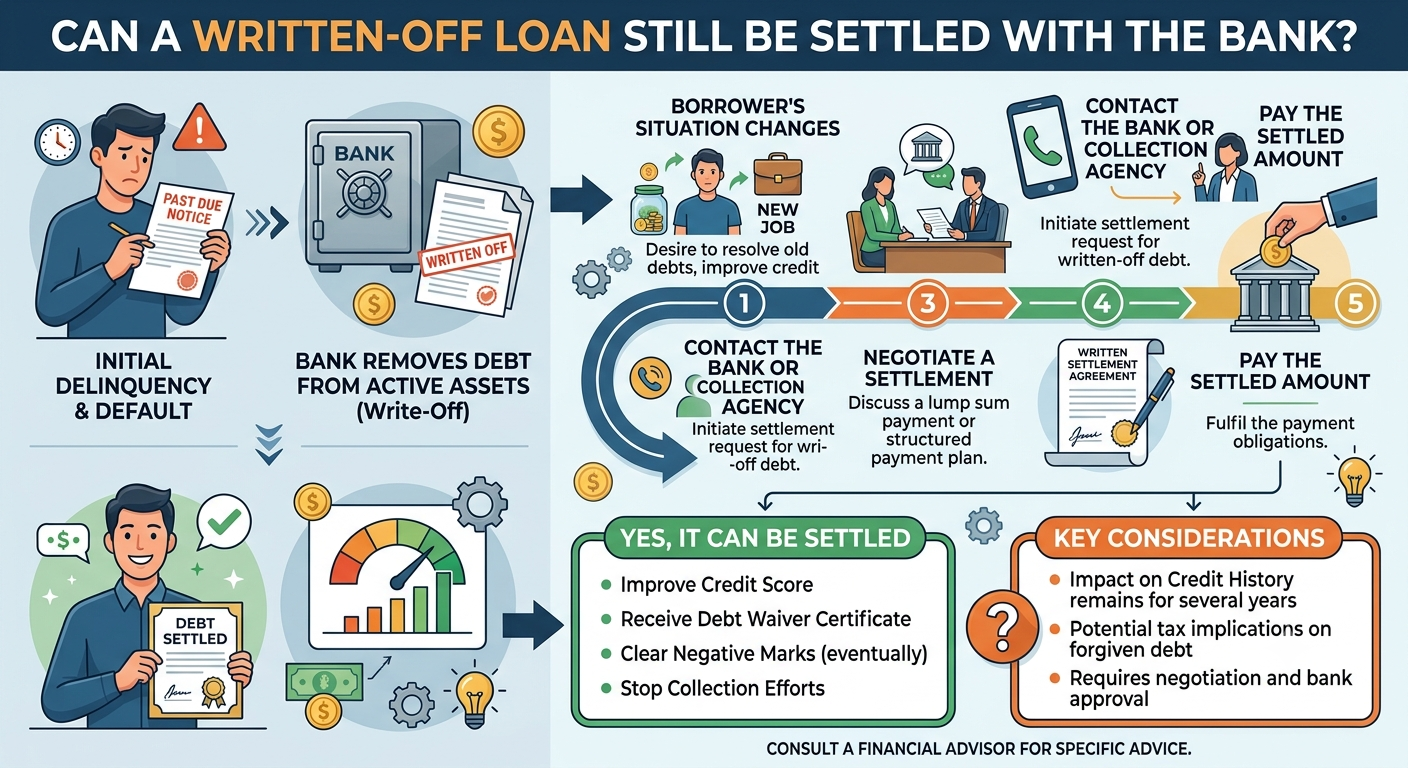
Discovering that your loan status has been marked as “Written-Off” on your credit report often triggers panic. Many borrowers assume this means the bank has forgiven the debt, while others fear it implies immediate, irreversible legal action.
The most crucial fact to understand is that a written-off loan can still be settled with the bank. In fact, once an account reaches a written-off status, lenders are often far more willing to negotiate a One-Time Settlement (OTS) to recover a portion of their funds and clear bad assets from their books.
What Does “Written-Off” Actually Mean?
There is a widespread misconception that a write-off means your debt has been erased. In reality, a loan write-off is primarily an accounting maneuver governed by banking regulations (such as Reserve Bank of India guidelines).
+-------------------------------------------------------------------------------+
|                       ACCOUNT WRITE-OFF VS. DEBT WAIVER                       |
+-------------------------------------------------------------------------------+
| Accounting Write-Off  | Internal tax/balance sheet adjustment by the lender.  |
|                       | The legal obligation to repay remains 100% active.   |
+-----------------------+-------------------------------------------------------+
| Debt Waiver/Settlement| Formal agreement where the lender waives remaining    |
|                       | balance after receiving a compromised lump sum.       |
+-------------------------------------------------------------------------------+
When an account remains unpaid for over 180 days, banks classify it as a Loss Asset. To maintain a healthy balance sheet and optimize tax liabilities, the lender moves the non-performing loan off its active ledger. However, your legal liability to pay remains entirely intact, and recovery efforts—whether internal or through recovery agencies—will continue until the debt is resolved.
Why Banks Want to Settle Written-Off Accounts
Even though the bank has written off the account, credit committees prefer receiving a partial payment over zero recovery.
- Recovery Boosts Net Profit: Any recovery made on a written-off account goes straight back into the bank’s profit provision, directly strengthening their financial results.
- Avoiding High Legal Costs: Pursuing long-drawn legal suits, SARFAESI proceedings, or civil litigation costs time and money. Negotiating a settlement allows lenders to recover funds immediately without incurring extra legal expenses.
- Closing Aged Records: Maintaining old bad debts requires ongoing administrative tracking. Accepting a lump-sum compromise lets the bank permanently close the file.
Step-by-Step Guide to Settling a Written-Off Loan
If you are ready to resolve a written-off account, follow this structured roadmap to protect your legal and financial interests:
Step 1: Request an Official Statement of Account
Obtain an updated, itemized statement directly from the bank’s home branch or Nodal Officer. Identify the original base principal versus accumulated penal interest, late fees, and bounce charges.
Step 2: Establish Involuntary Hardship
Gather clear documentation proving why the default occurred (e.g., job loss, medical emergencies, or severe business downturns). Lenders require concrete evidence showing that the default was involuntary rather than a willful choice.
Step 3: Present a Written Settlement Offer
Submit a formal hardship letter proposing a realistic lump-sum settlement offer—typically starting around 25% to 40% of the overall claim amount, depending on whether the debt is secured or unsecured.
Step 4: Obtain a Formal Sanction Letter
Never pay based on verbal promises from recovery representatives. Demand an official Settlement Sanction Letter printed on bank letterhead explicitly stating the compromised amount, due date, and confirmation of full balance waiver.
Step 5: Complete Remittance & Secure Your NDC
Pay directly into the bank’s official account. Once funds clear, secure an official No Dues Certificate (NDC) or No Objection Certificate (NOC) to prove your debt is legally satisfied.
Written-Off vs. Settled Status Comparison
| Feature | Written-Off Status | Settled Status (Post-OTS) |
| Legal Risk | Ongoing recovery & potential legal notices | Complete legal immunity & dispute closure |
| Balance Due | Full balance plus compounding penal fees | Zero balance owing |
| Credit Report | Severe ongoing damage | Account marked “Settled” with zero balance |
| Recovery Calls | Continuous agent follow-ups | Permanently stopped |
Essential Resources for Settling Bad Debts
Navigating institutional banking hierarchies, negotiating maximum principal waivers, and ensuring full legal discharge requires specialized guidance. Use these expert resources to assist your journey:
- Evaluate your eligibility for written-off debt waivers with a certified loan settlement expert.
- Explore structured options for written-off personal, credit card, and commercial loans through loan settlement services.
- Learn how to calculate realistic compromise percentages using complete loan settlement guides.
- Protect yourself from aggressive recovery calls by partnering with a trusted loan settlement agency.
- Review your financial hardship dossier with an experienced loan settlement expert.
- Waive accumulated penal interest and late charges using specialized loan settlement services.
- Manage legal notices and arbitration threats supported by an established loan settlement agency.
- Understand bank credit committee policies on loss assets through expert loan settlement advice.
- Safeguard your personal assets and legal rights with aid from a skilled loan settlement expert.
- Obtain institutional representation and direct bank escalation via dedicated loan settlement services.
- Secure your official No Dues Certificate (NDC) and legal discharge letter with help from a reputable loan settlement agency.
Final Thoughts
A written-off loan is not a dead end—it is an opportunity to negotiate a fresh start. By approaching your lender with verified hardship documentation, securing an authentic sanction letter, and obtaining an official No Dues Certificate, you can eliminate your outstanding liability and begin rebuilding your financial path.