
Receiving a formal legal notice from a bank or Non-Banking Financial Company (NBFC) is one of the most intimidating moments for a borrower in default. Whether it is a demand notice under Section 138 of the Negotiable Instruments Act for a cheque bounce, a notice under the SARFAESI Act, or a summons from a Debt Recovery Tribunal (DRT), the arrival of legal correspondence signals that the lender is shifting from routine recovery to legal escalation.
However, receiving a legal notice does not mean you have run out of options or that court litigation is inevitable. In reality, a legal notice is often the final precursor to serious negotiation. Lenders frequently use legal notices to test a borrower’s responsiveness before incurring the heavy costs of prolonged court proceedings.
Understanding how the negotiation process unfolds after a legal notice is issued enables you to de-escalate litigation, protect your rights, and negotiate a favorable One-Time Settlement (OTS).
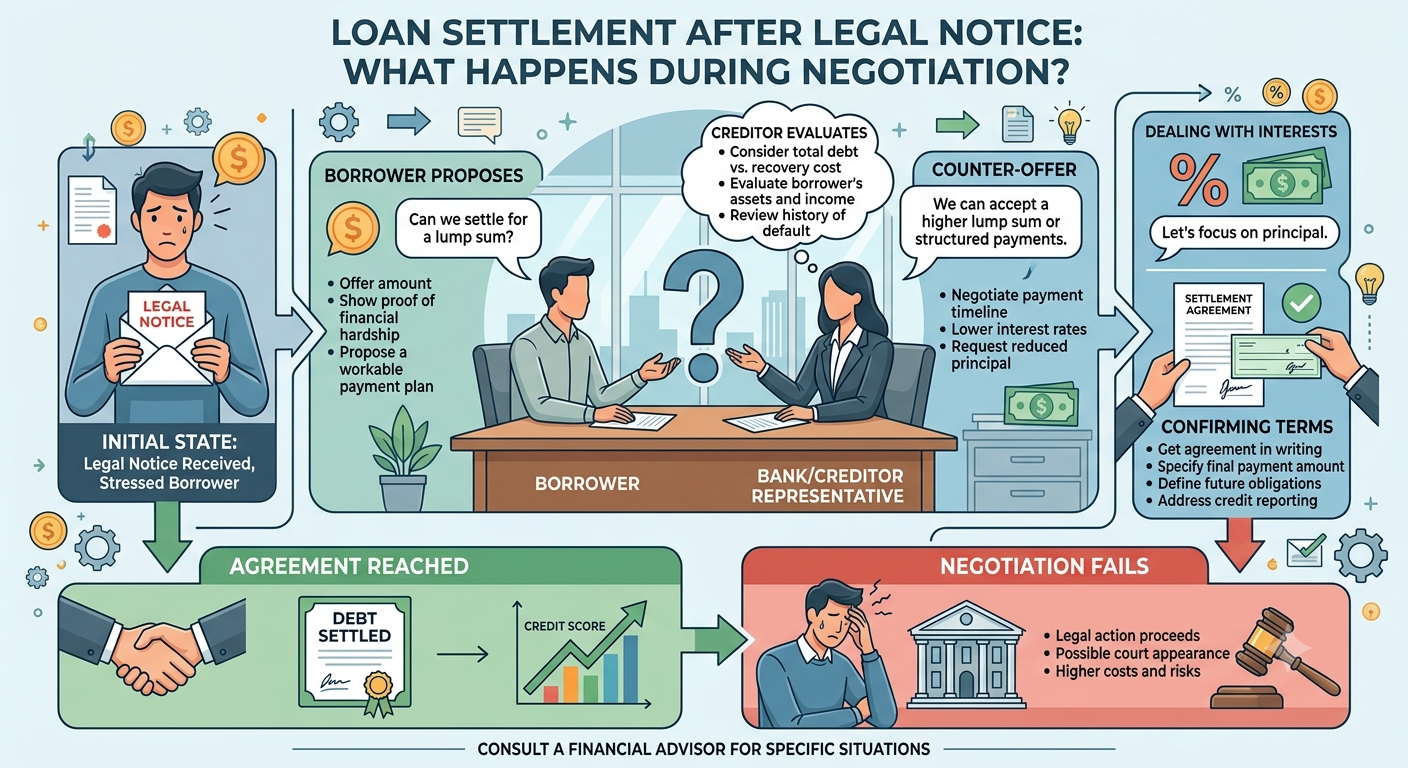
The Anatomy of Negotiation After a Legal Notice
+-------------------------------------------------------------------------------+
|             POST-LEGAL NOTICE NEGOTIATION WORKFLOW                            |
+-------------------------------------------------------------------------------+
| Phase 1: Receipt of Legal Notice & Strategic Response (Within 7-14 Days)      |
| Phase 2: Direct Dialogue with the Bank's Legal & Recovery Committee           |
| Phase 3: Hardship Proof Submission & Waiver Negotiations                      |
| Phase 4: Consent Terms & Settlement Sanction Letter Execution                 |
| Phase 5: Payment Execution & Legal Case Withdrawal                            |
+-------------------------------------------------------------------------------+
Phase 1: Acknowledgment and Formal Legal Reply
Ignoring a legal notice is the single biggest mistake a defaulted borrower can make. Unanswered notices can lead to ex-parte orders, court summons, or police complaints.
Upon receiving a notice, you should issue a formal reply through a legal representative within the specified timeframe (usually 7 to 14 days). The reply should:
- Acknowledge receipt of the notice while disputing any unfair penal charges, compounding interest, or incorrect balance calculations.
- Clearly state that non-payment stems from genuine, involuntary financial hardship rather than willful default.
- Express an explicit willingness to resolve the account through an amicable, out-of-court settlement.
Phase 2: Engagement with the Legal Recovery Committee
Once your reply is logged, responsibility for your account shifts from routine recovery agents to the bank’s internal legal recovery panel or advocate team.
During initial meetings, discussions focus on evaluating the feasibility of litigation versus compromise. Banks recognize that legal trials can drag on for years in Indian courts, incurring substantial advocate fees and administrative costs. If you demonstrate a clear intent to settle with a lump-sum offer, the legal team will usually present your case to the bank’s sanctioning committee.
Phase 3: Hardship Verification and Offer Assessment
During negotiation meetings, you must present a compelling hardship dossier proving your current inability to pay the total demanded amount. Essential documentation includes:
- Income Tax Returns (ITRs) or bank statements showing reduced cash flow.
- Medical discharge summaries or termination letters proving personal or business distress.
- An audited summary highlighting total assets versus current liabilities.
The bank evaluates these documents against their internal recovery targets to decide the maximum discount they can offer on accrued interest and principal balances.
Phase 4: Drafting Consent Terms and the Sanction Letter
If an agreement is reached while court or tribunal proceedings are already active, both parties must draft formal Consent Terms or a Joint Compromise Petition. This document is submitted to the presiding judge or arbitrator to stay the legal proceedings.
Simultaneously, the bank generates an official Settlement Sanction Letter detailing:
- The agreed compromised settlement amount.
- The explicit waiver of all remaining dues, penal fees, and legal charges.
- Payment timelines (either a single lump sum or structured short-term installments).
- A clause binding the bank to unconditionally withdraw all pending legal notices and cases upon receipt of funds.
Phase 5: Payment and Final Case Discharge
Once the agreed funds clear, the bank issues an official No Dues Certificate (NDC) and files formal withdrawal applications for all pending legal complaints (including Section 138 cheque bounce cases or arbitration filings), bringing the dispute to complete closure.
Key Tactical Differences: Pre-Legal vs. Post-Legal Settlement
| Parameter | Pre-Legal Notice Settlement | Post-Legal Notice Settlement |
| Primary Contact | Collection agents & branch managers | Bank advocate panel & Nodal Officer |
| Urgency Level | Flexible / Low | High (Governed by court deadlines) |
| Documentation | Standard hardship application | Legal response & Consent Terms |
| Resolution Outcome | Standard Sanction Letter & NDC | Sanction Letter, NDC & Court Case Withdrawal |
Critical Resources for Post-Legal Notice Support
Navigating legal notices, drafting formal responses, and negotiating directly with bank advocates requires specialized legal and financial expertise. Explore these essential resources for guidance:
- De-escalate legal notices and structure a compromise with a certified loan settlement expert.
- Explore tailored defense strategies and debt negotiation via loan settlement services.
- Learn how to handle cheque bounce notices and tribunal summons using complete loan settlement guides.
- Protect yourself from recovery harassment and improper legal threats through a trusted loan settlement agency.
- Review your legal notices and draft formal reply letters alongside a qualified loan settlement expert.
- Eliminate illegal penal charges and negotiate principal waivers using specialized loan settlement services.
- Manage court appearances, DRT filings, and consent petitions supported by an established loan settlement agency.
- Understand Reserve Bank of India (RBI) compromise frameworks with professional loan settlement advice.
- Safeguard your assets and personal freedom during legal disputes with help from a skilled loan settlement expert.
- Obtain complete administrative and legal representation through dedicated loan settlement services.
- Secure formal case withdrawal documents and your official No Dues Certificate with an experienced loan settlement agency.
Final Thoughts
Receiving a legal notice is a clear signal that it is time to formalize your settlement strategy. By responding promptly with legal guidance, presenting verifiable proof of financial hardship, and securing a written agreement backed by formal Consent Terms, you can stop impending litigation and resolve your outstanding debt safely.