
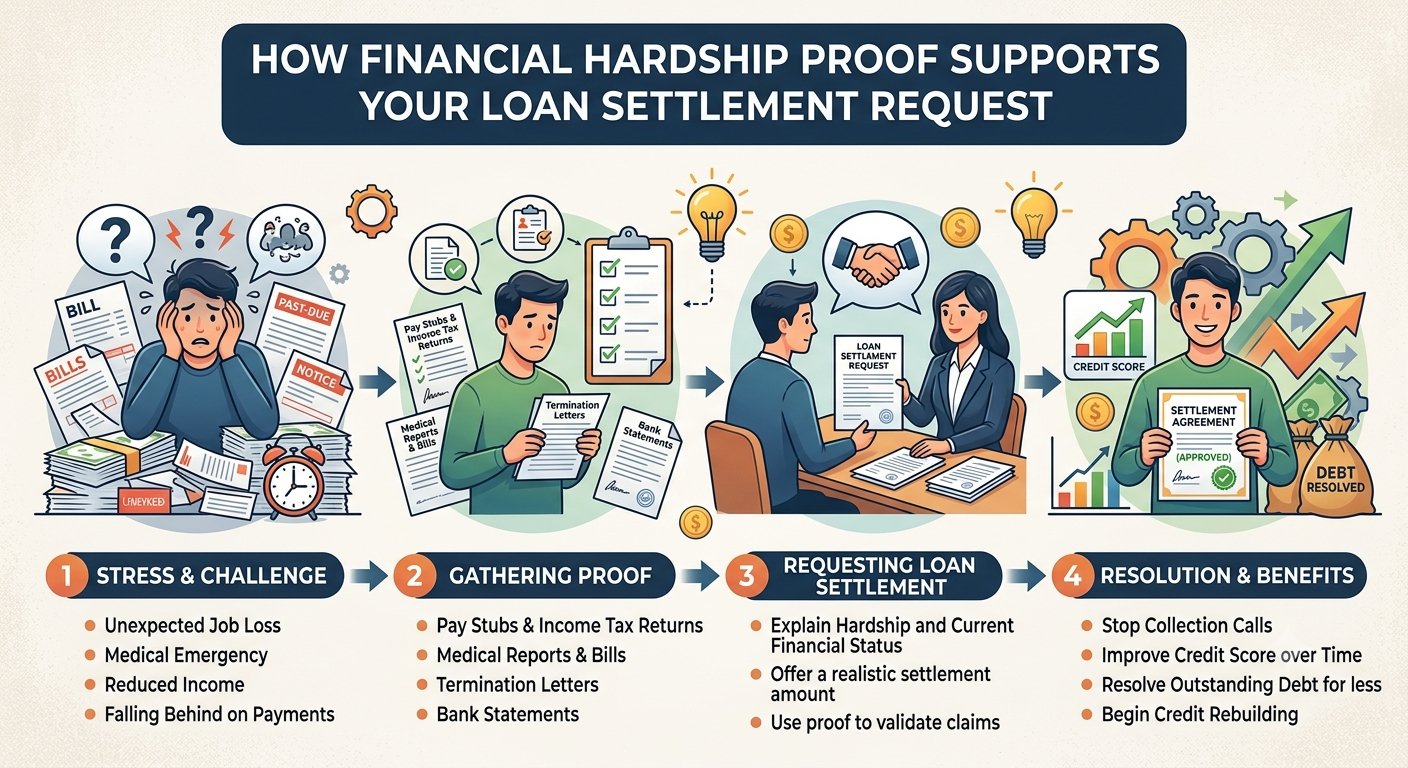
When facing mounting debt, defaulted EMIs, and compounding penal charges, requesting a One-Time Settlement (OTS) offers a viable path to financial recovery. However, banks and Non-Banking Financial Companies (NBFCs) do not grant debt waivers automatically. Lenders must verify that non-payment stems from genuine, involuntary financial distress rather than willful default.
Submitting a well-documented financial hardship proof is the single most critical factor in securing a favorable settlement. Proper documentation transforms a simple request into a compelling case, convincing credit committees to waive penal interest and discount outstanding principal balances.
Why Lenders Require Hardship Evidence
Under banking regulations set by the Reserve Bank of India (RBI), lenders must distinguish between willful defaulters (those with the capacity to pay who choose not to) and distressed borrowers (those facing genuine financial crises).
+-------------------------------------------------------------------------------+
|                    BORROWER CLASSIFICATION & HARDSHIP IMPACT                  |
+-------------------------------------------------------------------------------+
| Willful Defaulter | Capacity to pay present; defaults voluntarily.          |
|                   | Outcome: Aggressive legal action, DRT, SARFAESI.          |
+-------------------+-----------------------------------------------------------+
| Distressed        | Genuine involuntary loss; capacity to pay compromised.   |
| Borrower          | Outcome: Eligible for OTS, principal discounts, waivers.  |
+-------------------------------------------------------------------------------+
Providing verified hardship documentation assures credit managers that offering a compromise is the most practical way to recover funds, avoiding costly and protracted litigation.
Essential Documents to Prove Financial Hardship
To build an unassailable hardship dossier, assemble objective financial and legal records that clearly demonstrate your financial decline:
1. Proof of Income Loss or Employment Disruption
- Job Loss or Salary Cuts: Official termination letters, pink slips, layoff notices, or pay slips showing drastic salary reductions.
- Business Loss: Audited Profit & Loss statements, balance sheets, GST filing summaries, or client contract cancellation letters showing severe revenue drops.
2. Medical Emergencies and Health Costs
- Hospital discharge summaries, major diagnostic reports, and ongoing treatment estimates.
- Medical bills and payment receipts verifying that liquid savings were redirected to healthcare expenses.
3. Bank Account Statements & Tax Records
- 6 to 12 Months of Bank Statements: Proving zero liquid reserves, minimal average monthly balances, and absence of secondary income streams.
- Income Tax Returns (ITRs): Showing a clear year-over-year decline in total earning capacity.
4. Supporting Legal Notices or Liabilities
- Notices from other creditors, utility disconnect warnings, or proof of family dependencies that further strain your financial capacity.
Step-by-Step Strategy: Presenting Your Hardship Dossier
- Audit Total Outstanding Liabilities: Calculate your total debt exposure across all lenders, separating the core principal from accumulated late fees, bounce charges, and penal interest.
- Draft a Comprehensive Hardship Letter: Write a clear, factual letter addressed to the bank’s Nodal Officer or Recovery Manager. Detail the chronological timeline of your financial setback and explain why full repayment is impossible.
- Attach Verified Supporting Evidence: Cross-reference every claim in your letter with corresponding documents from your hardship dossier.
- Propose a Realistic Settlement Sum: Offer a realistic lump-sum compromise amount based on your actual capacity, supported by family contribution promises or asset liquidation plans.
- Demand an Official Sanction Letter: Never deposit funds based on verbal assurances. Ensure the bank issues an official Settlement Sanction Letter on bank letterhead before remitting payment.
Impact of Hardship Evidence on Negotiation Outcomes
| Submission Strategy | Bank Reaction | Likely Settlement Terms |
| No Hardship Proof | High suspicion of willful default | Rejection or minimal penal fee waiver |
| Partial Documentation | Moderate scrutiny & delayed review | Minor principal discount (10%–20%) |
| Complete Hardship Dossier | Fast-tracked credit committee review | Significant principal waiver (30%–60%) |
Helpful Resources and Expert Guidance
Navigating institutional credit committees, compiling technical financial dossiers, and securing maximal waivers requires specialized expertise. Explore these essential resources for support:
- Build a strong financial hardship case with guidance from a certified loan settlement expert.
- Explore tailored relief options for personal, business, and credit card debts through loan settlement services.
- Learn how to calculate realistic settlement discounts using comprehensive loan settlement guides.
- Protect yourself from recovery harassment by partnering with a reputable loan settlement agency.
- Review your financial records and hardship letters alongside an accredited loan settlement expert.
- Eliminate unfair penal charges and negotiate optimal principal discounts using specialized loan settlement services.
- Manage bank legal communications and recovery notices supported by an established loan settlement agency.
- Understand credit committee evaluation criteria with professional loan settlement advice.
- Safeguard your assets and credit recovery roadmap with direct assistance from a skilled loan settlement expert.
- Obtain institutional representation and documentation audits via professional loan settlement services.
- Secure your official No Dues Certificate (NDC) and full legal discharge with help from an experienced loan settlement agency.
Final Thoughts
Financial hardship proof is the cornerstone of any successful loan settlement request. By presenting clear, unassailable evidence of involuntary financial distress, you demonstrate good faith, satisfy banking regulatory requirements, and empower your lender to approve a fair settlement that grants you true debt relief.